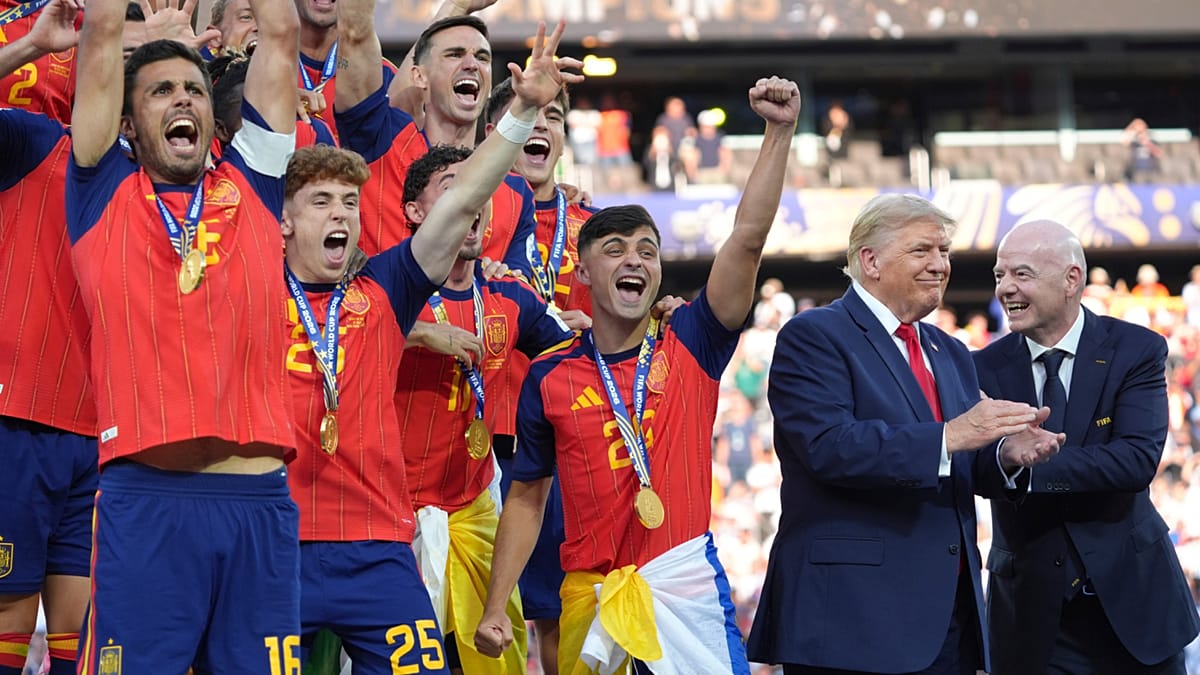
The 2026 World Cup concluded with Spain defeating Argentina 1-0 in the final in New Jersey, but a parallel contest unfolded online. A torrent of AI-generated videos, fabricated images, and misleading clips spread alongside the matches, often amassing millions of views before being debunked. These posts served varied purposes: humor, political messaging, criticism of players and teams, and, in many cases, simple clickbait designed to generate advertising revenue.
Euronews' fact-checking team, The Cube, examined some of the most prominent false and misleading content. The phenomenon highlights the growing challenge of disinformation in sports, where emotional investment and rapid sharing amplify the reach of fakes.
Haaland: The Face of AI-Generated Content
No player embodied the rise of AI-generated content more than Norwegian striker Erling Haaland. A video showing him glancing at his reflection in a restaurant and flinching went viral, garnering over 30 million views in a single day. It was later revealed to be a face swap applied to a video originally posted by a Chinese content creator. Despite the debunking, the clip gained an additional 10 million views across social media platforms.
More concerning were false quotes attributed to Haaland. One video on X showed the Manchester City striker speaking after Norway's defeat to England on 11 June, with a caption claiming he said, "I'm going to support Argentina because England illegally took their territory." Spanish subtitles reinforced the statement, referencing Argentina's claim over the Falkland Islands. The clip garnered thousands of views, but the caption was entirely fabricated. In reality, Haaland's post-match interview showed him saying, "I think I have some of my City teammates in England, and in France, and Spain, so of course I want England to do well." He added, "I've been supporting ... I think I got an England national team jersey before I got a Norway jersey when I was little, so of course I want England to do well because it's a nice country and it's a nice t-shirt."
Haaland was not alone. After the Norway-England match, England midfielder Jude Bellingham was falsely quoted in viral posts as saying, "Messi is my idol" and "FIFA is rigged and corrupt." Recordings of his actual post-match interviews show he made neither statement.
Conspiracy Theories and Fabricated Images
One of the most persistent conspiracy theories alleged that the tournament was rigged for Argentina to win. This narrative gained traction across social media, reaching a wide audience. "My two teenage boys are convinced the World Cup has been rigged for Argentina," wrote one LinkedIn user. The theory intensified after Argentina's 3-2 win over Egypt on 7 July, when controversial referee decisions led Egypt's Football Association to file a formal complaint with FIFA, accusing referee François Letexier and his team of "serious refereeing mistakes."
From there, theories expanded beyond refereeing. Social media users tied in unrelated events and public figures to argue that Argentina was receiving external support. One alleged backer was Israeli Prime Minister Benjamin Netanyahu. In an interview on The Mojo Podcast, Netanyahu described Argentina as a "very good team" and said President Javier Milei had swayed his support, calling Milei a "great friend" of Israel. An AI-generated image of Netanyahu wearing an Argentinian shirt during Argentina's match against Austria was used to support this claim. It gained thousands of views on X but was entirely fabricated—Netanyahu did not attend the match.
Other posts focused on Lionel Messi, with users framing his reported ties to Israel as evidence of rigging. "Why did Messi visit Israel twice in 2022, the SAME YEAR that Argentina won the World Cup?" claimed one user in an X post with over 80,000 views. Despite the viral spread, these claims were not backed by any publicly available official sources, and accounts relaying them provided no concrete evidence.
Fabricated evidence emerged instead, such as an AI-generated image of FIFA President Gianni Infantino injecting performance-enhancing drugs into Messi's arm. Another image, which gained thousands of views on X, alleged that referee Ismail Elfath had asked for a photo with Messi after the Argentina-England match. The image was actually from 2022, taken before a match between Argentina and another team.
The spread of such content underscores the need for critical media literacy, especially during high-stakes events. As research shows, even a handful of social media posts can cement false beliefs. For European audiences, the phenomenon is particularly relevant given the continent's role as a hub for both football and digital innovation. The 2026 World Cup may be over, but the battle against misinformation is far from finished.