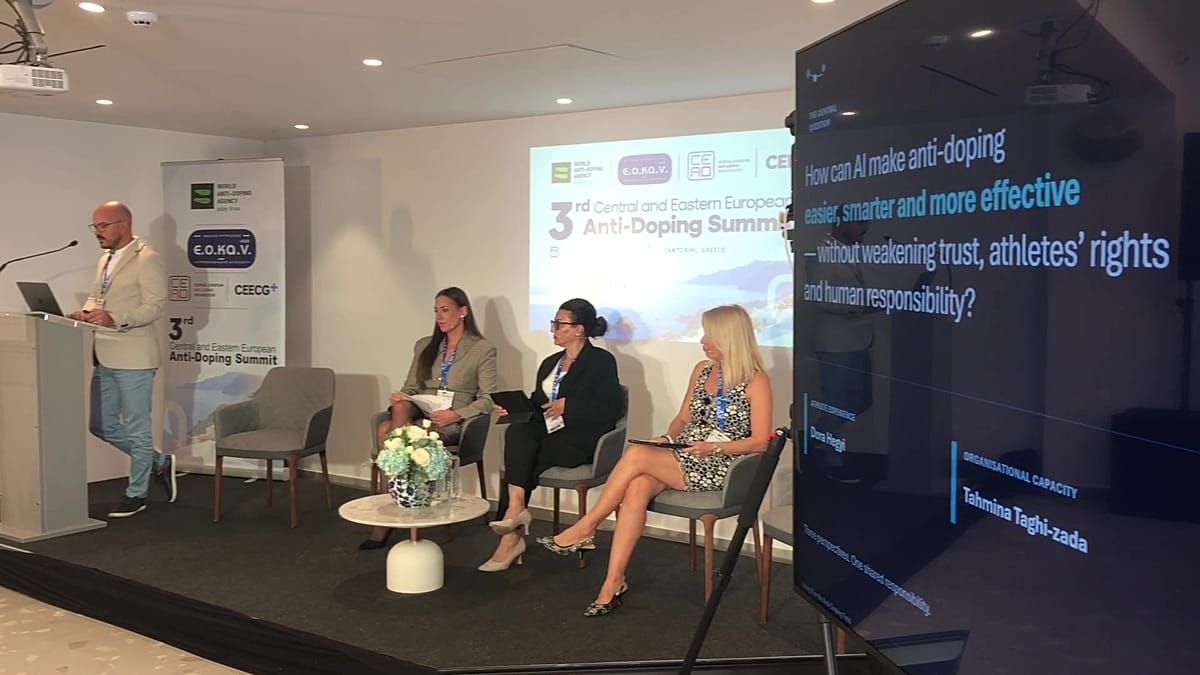
Artificial intelligence is becoming a double-edged sword in the fight against doping, as officials and athletes gathered on the Greek island of Santorini to weigh its potential and its perils. The third Anti-Doping Summit of Central and Eastern European Countries, held with participation from WADA and representatives of 26 nations, focused on how AI can support data analysis, improve test planning, and aid investigations.
These tools can process vast amounts of information, offering national anti-doping organizations a sharper lens on suspicious patterns. But as Sébastien Gillot, director of WADA's European Office, told Euronews, the same technology that helps authorities can also help those trying to evade them.
“It has tremendous power to help us understand trends, to identify the patterns offenders may be using and to analyse data so we can improve what we do, particularly when it comes to testing,” Gillot said. “Naturally, if these are useful tools for us, they can also be useful tools for those who cheat.”
Balancing innovation with athletes' rights
Dora Hegyi, a former Hungarian gymnastics champion and vice-chair of WADA's Athletes' Council, described the discussions as “very interesting” for their focus on how AI can inform athletes and streamline the work of national bodies. She also noted that legal aspects were on the table, including how anti-doping organizations already use AI and what athletes themselves think about it.
One of the most striking concerns came from Penny Konitsioti, a lawyer and vice-chair of Greece's National Anti-Doping Organisation's Disciplinary Committee. She warned that an athlete's online searches could later be used against them in legal proceedings. “When an athlete logs on to a platform and searches for something relating to their health or any other information connected to doping, they must know from the outset,” she said. “It must also be clearly stated on the platform and in the terms of use, not hidden in the 'small print' but clearly summarised – that the information they search for might later be used in legal proceedings and could end up being used against them.”
Konitsioti stressed that AI should remain a support tool for authorities—helping collect evidence or assisting a sports judge—but never replace established procedures or human judgment.
Privacy and trust at the core
Participants agreed that technological progress must come with safeguards. Human oversight in disciplinary procedures, transparency in how AI tools are used, and robust protection of personal data were all highlighted as essential. Hegyi put it simply: “If trust is 'built' so that AI systems are developed with athletes and not only for athletes, then it can work and can bear fruit in future programmes to fight doping.”
The summit also touched on updates to rules for therapeutic use exemptions and results management, aiming for consistent procedures across the continent. The broader message was clear: AI can strengthen the fight against doping, but only if it respects athletes' rights and maintains the integrity of the system.
As European institutions and national bodies continue to explore these tools, the lessons from Santorini may shape how the continent balances innovation with fairness. The challenge is not just to adopt AI, but to do so in a way that athletes can trust.