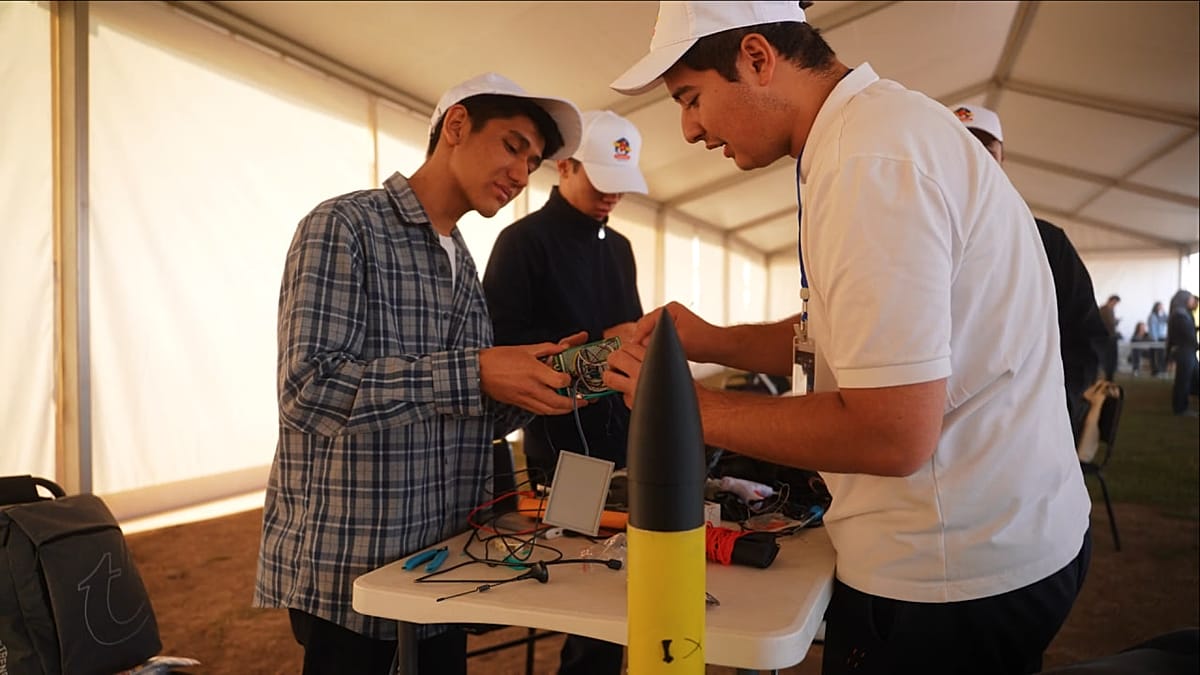
Building a full-scale satellite typically demands years of work, specialised cleanrooms and budgets that run into millions. But at an airfield outside Tashkent, the challenge was deliberately smaller: design a satellite model that fits inside a standard drinks can, equip it with sensors and communications gear, and send it skyward on a rocket.
The exercise, part of the fifth international CanSat training workshop, brought together 50 participants from 15 countries and more than 100 students from Uzbekistan. Organised by Uzbekistan's space agency Uzcosmos, the Islamic World Educational, Scientific and Cultural Organization (ICESCO) and Turin Polytechnic University in Tashkent, the programme gave young engineers a rare chance to test their creations under real flight conditions.
From classroom to launchpad
CanSats do not enter orbit. Instead, they simulate selected functions of a space mission while descending by parachute after being released from a rocket. For the teams, that meant several days of assembling electronics, configuring sensors and writing code at the university's Tashkent campus before heading to the launch site.
During the descent, the miniature satellites had to operate autonomously, collecting measurements and transmitting them to ground stations. One Uzbek team added a camera to its CanSat, alongside sensors for temperature and air pressure, and attempted to stream live video during the flight.
“The main challenge here is to make sustainable telemetry. It should connect the ground station and the CanSat itself,” said Ahmadkhon Latipov, a participant from Uzbekistan.
The devices also stored data onboard, so teams could recover information even if radio contact was lost. That dual approach mirrors how real satellites work, according to Baris Beynek, an instructor from Istanbul Technical University.
“In the real satellite project, there is a satellite which sends the data to ground station and also stores inside, which we also do,” Beynek said.
After landing, teams retrieved their CanSats and compared the recorded data with their pre-flight calculations, checking the performance of electronics, sensors, parachutes and communication systems. Fourteen teams reached the final stage, with Team Nebula taking first place, followed by Pegasus and Sky Lab.
Space skills beyond satellites
The competition is about more than building tiny spacecraft. Dr Muhammad Sharif, an adviser for science and environment at ICESCO, noted that the growing use of satellite technology is creating demand for skills that go beyond traditional aerospace engineering. He pointed to Earth observation, satellite communications and artificial intelligence, as well as applications in agriculture, food security and climate monitoring.
The programme also emphasises international collaboration. “They need to use their own skills, and they need to cooperate with other people,” Beynek said. “In space, international cooperation is the most important thing.”
For Uzbekistan, the workshop is part of a broader push to develop its space sector. The country has been investing in space education and infrastructure, and events like this help train a new generation of specialists. The CanSat challenge also aligns with regional trends: Turkey and Uzbekistan are rethinking urban design for a hotter climate, and both see technology as key to future resilience.
As satellite technology becomes more accessible, initiatives like this one are likely to multiply. The skills tested here—telemetry, data analysis, systems integration—are the same ones needed for larger space projects, including Europe's efforts to mass-produce satellites. And for the young engineers involved, the experience of seeing their work fly is a powerful motivator.