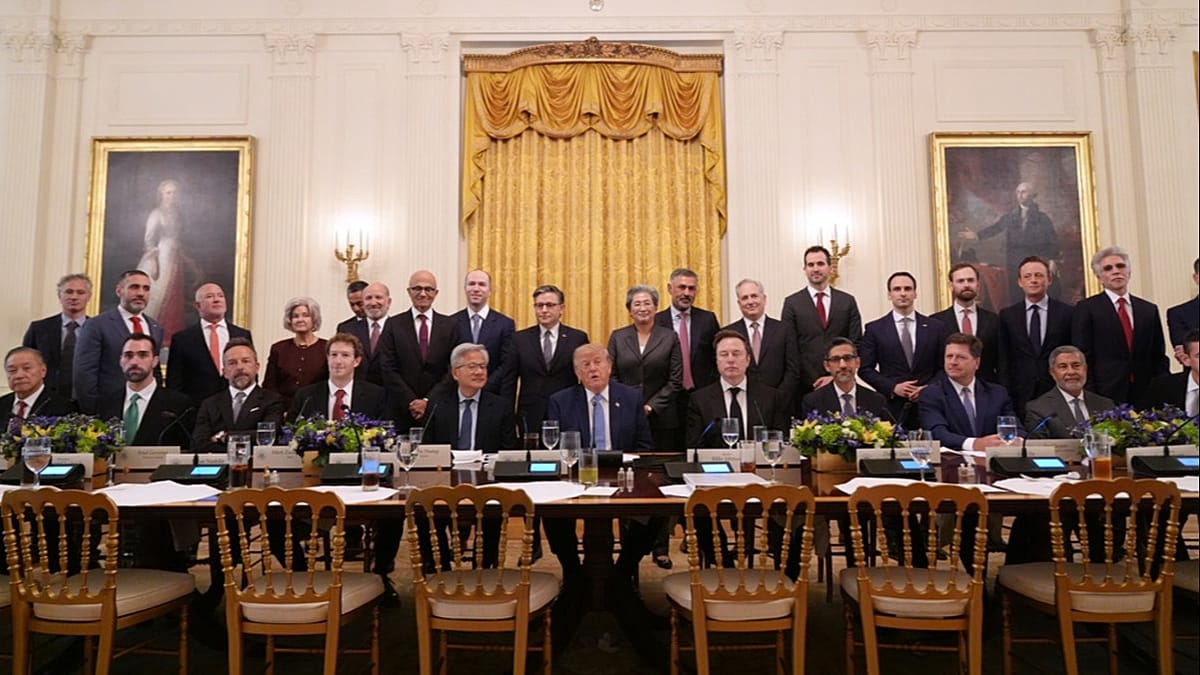
In a meeting at the White House on Tuesday, President Donald Trump and executives from major artificial intelligence companies signed a voluntary accord aimed at addressing public concerns about the technology's risks. The agreement, which Trump described as "morally binding," includes commitments to internal controls and independent audits, but stops short of imposing legal obligations.
The accord was signed by Trump, Anthropic CEO Dario Amodei, Google CEO Sundar Pichai, Meta CEO Mark Zuckerberg, OpenAI President Greg Brockman, Nvidia CEO Jensen Huang, and Elon Musk, who leads Tesla, SpaceX, X, and xAI. The meeting, which also included House Speaker Mike Johnson, came amid growing bipartisan opposition to the construction of data centres across the United States, which have raised concerns about energy use and local impacts.
Voluntary steps and future regulation
The accord, posted on Trump's social media platform Truth Social, outlines four voluntary measures: implementing "robust internal controls," engaging an "independent external auditor" to verify those controls, and establishing board-level committees to review auditor reports. It also leaves the door open for future legislation, stating that "over time, it may make sense to codify these steps into laws and regulations."
Trump praised the executives for their work, predicting "unbelievable growth" from the technology. However, Amodei, who has been a vocal advocate for slowing AI development, acknowledged that "the technology has very real risks," adding that the mechanisms to address them are "still under discussion."
The accord does not introduce binding regulations or legal liability, which some whistleblowers have argued are necessary to prevent AI from surpassing human intelligence and potentially causing catastrophic harm. Trump has consistently opposed such measures, stating before the meeting that the US government would not stifle AI development or support "guardrails."
"I will never stifle the growth of a technology that will be bigger than the industrial revolution," Trump said at the unveiling of a new government chatbot, America.gov. "We can't stifle it, and we're leading by a lot."
The agreement also addresses local opposition to data centres, with executives reportedly agreeing to provide more financial support to schools and reduce energy costs. Trump suggested that if opposition persists, companies might be forced to move operations overseas.
Trump framed the AI race as a global competition, primarily with China, and dismissed the need for deeper cooperation. "I didn't want to do anything, because we're leading. Why would I want to do anything?" he said.
The voluntary nature of the accord has drawn criticism from European lawmakers and regulators, who have been pushing for stricter rules. The European Union's AI Act, which entered into force earlier this year, imposes binding obligations on high-risk AI systems, a contrast to the US approach. As the technology continues to evolve, the debate over how to balance innovation with safety remains a central issue on both sides of the Atlantic.