Six algorithmic problems. Ten hours to solve them. Between the problem on the screen and the code submitted for scoring lies the real test: analysing the challenge, finding an efficient solution, and turning it into a program that actually works.
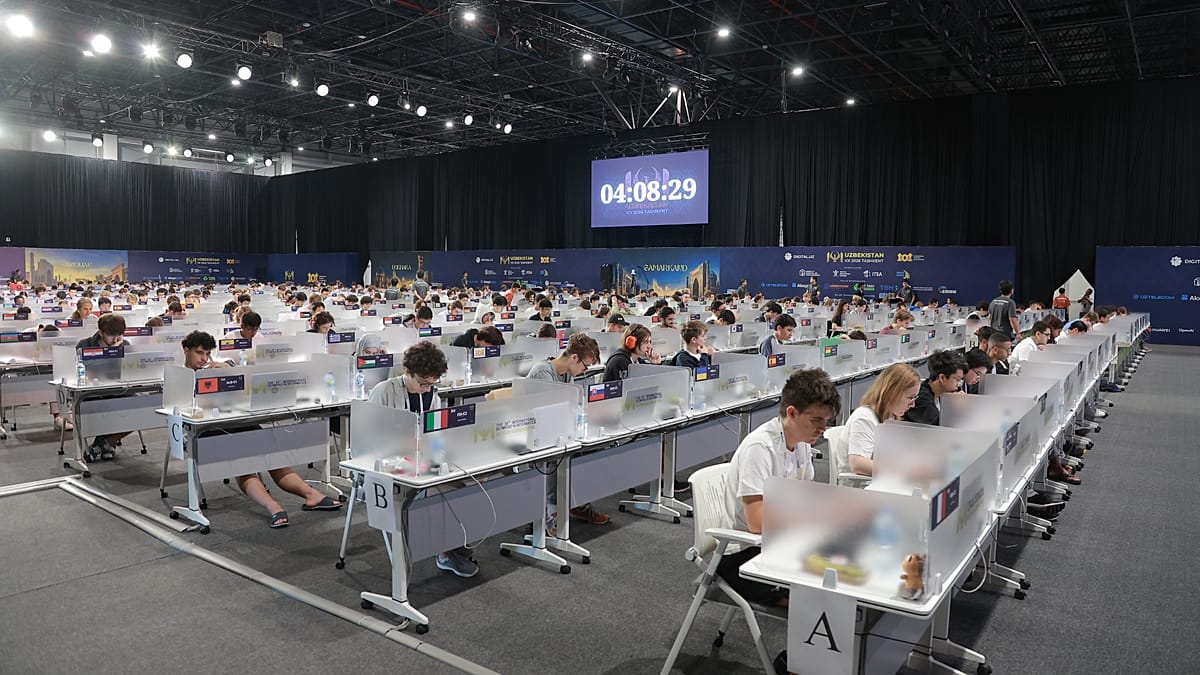
That was the task facing 386 of the world’s top young programmers from 97 countries at this year’s International Olympiad in Informatics (IOI) in Tashkent, Uzbekistan. The competition tests far more than the ability to write code. Contestants must analyse problems, design algorithms and data structures, program their solutions, and test whether they work.
However, this generation is competing at a time when artificial intelligence can increasingly help with several of those steps.
AI is already changing programming competitions
“AI is changing a lot in the way we organise contests, because we need to take into account that students have it,” Giorgio Audrito, team leader of the Italian delegation, told European Pulse. Online competitions have become particularly difficult to organise, Audrito said, adding that organisers are “still adapting” and discussing the issue within the IOI community.
Audrito also stated it remains difficult to predict exactly how AI will develop. For now, he believes programming experience is still necessary “in order to guide and revise whatever the AI is doing.”
Less coding, more time for solving problems
Some of the competitors in Tashkent already see AI changing the balance between writing code and thinking through the problem behind it. Qiwen Xu, a gold medalist from China, expects AI to become capable of producing a large share of the code programmers currently write themselves. During the five-hour contest, Xu said he and other competitors spent more than two hours turning their solutions into code. “But with the help of AI, we can spend more of our time on thinking or solving the problem ourselves,” he told European Pulse.
AI has also begun to influence the way Xu trains. Instead of relying only on repeated practice, he now studies the approaches taken by AI systems. “I learn from how AI solves or approaches the problems and that really is inspiring me on my own problem solving,” he said.
However, access to the same technology does not necessarily produce programmers with the same abilities. “Nowadays everyone can use AI on their own,” Xu said. “What makes you different from others is [...] your own reasoning or thinking that goes beyond AI or it leads you to how to use AI during your programming.”
Myriam Faltin, a 17-year-old competitor from Switzerland, also points to skills that go beyond technical knowledge. “You need to know some algorithms but you also need a lot of intuition on knowing which one to use when,” she told European Pulse. That intuition, Faltin said, develops through practice and by spending time on difficult problems rather than immediately looking for a solution.
AI does not replace the basics
The same technological shift is changing the discussion around computer science education and the skills future programmers will need. In Uzbekistan, that debate is also shaping national policy. Deputy Minister of Digital Technologies Rustam Karamjonov said preparing talent is one of the pillars of the country’s AI strategy. “Preparing talent and preparing people for being ready for the AI changes in the world and in Uzbekistan as well,” is one of those priorities, he told European Pulse.
Professor Tan Santek, president of the IOI, rejects the idea that increasingly capable AI makes learning programming fundamentals less important. “People were talking about how AI will replace all the programmers. So there's no point in learning programming or learning how to solve problems using computer. But to me, it is the opposite,” Tan told European Pulse. “If you don't have the basic foundation, you will not be able to actually use the tool of AI,” he added.
Tan believes education should place greater emphasis on “computational thinking” — teaching students how to formulate real-world problems in computational terms before developing programs to solve them. He suggested that this kind of training could begin as early as primary school.
As AI continues to reshape the tech landscape, the skills that distinguish a great programmer are evolving. The ability to reason, to design elegant solutions, and to guide AI tools effectively may become more valuable than raw coding speed. For the young competitors in Tashkent, the future of programming is not about writing more lines of code, but about thinking more deeply about the problems they solve.