The Asian Infrastructure Investment Bank convenes its 11th Annual Meeting of the Board of Governors in Doha on 28 and 29 September, under the banner "Tomorrow's Infrastructure: Impact and Innovation." The gathering is the first of the bank's second decade and the first under president Zou Jiayi, who took the helm from Jin Liqun. For vice president and corporate secretary Sir Sherard Cowper-Coles, the moment is less about ceremony than about clarifying purpose.
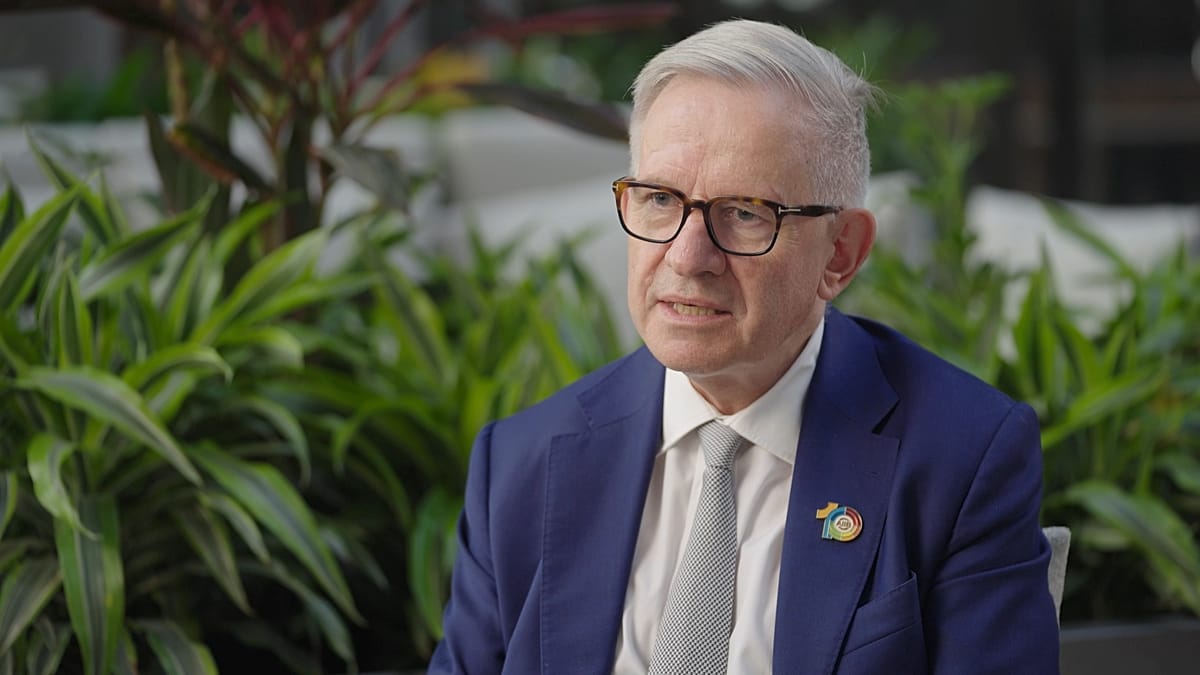
"It's a very important meeting because it's the first in our second decade," Cowper-Coles said in an interview at AIIB headquarters. "It's the first under the leadership of our new president, President Zou Jiayi. And it signals that we are concerned about maximising the impact of the money we raise, not only on our own account, but with our partners."
A narrower question behind a vast financing gap
Asia is projected to need roughly $1.7 trillion a year in infrastructure investment through 2030. No single institution can meet that figure, and the AIIB has never pretended otherwise. Its strategy instead revolves around a more tractable problem: how public money can pull additional capital in behind it. That means working with governments, development banks and private investors to convert infrastructure blueprints into projects that can actually attract financing.
The bank now counts 111 approved members across six continents, and demand has grown alongside the membership — while also changing shape. Renewable energy, clean water and resilient infrastructure remain priorities, but Cowper-Coles identified health and digital infrastructure as the fastest-growing categories. "We're looking beyond traditional infrastructure, not just ports and airports, roads and bridges, but also health infrastructure, digital infrastructure," he said. Infrastructure, in his framing, has become "the operating system of a modern economy and a modern society."
Preparing projects before they reach the market
Because no single lender can cover demand at this scale, the AIIB has shifted more weight onto what happens before a project is offered to investors. That involves early engagement with clients: preparing projects, structuring risk, and making them attractive enough that other financiers follow. In some cases it means the bank absorbing risk a private lender will not accept, or issuing a guarantee that unlocks financing far beyond its own contribution.
"We are looking more and more at the way in which we can make projects bankable, prepare them for the market," Cowper-Coles said. "We can take on the risk, the guarantees that the private sector can't, and then draw in money from elsewhere."
A $200 million guarantee to Türk Eximbank illustrates the approach. The deal covered 70% of the value of the bank's first green loan and mobilised close to $300 million from international banks. Local-currency financing and loan syndication are two further levers Cowper-Coles wants to use more aggressively as the AIIB seeks to expand the pool of capital it can deploy.
Climate finance at the core
Climate-related lending already accounts for the bulk of the AIIB's portfolio. In 2025, 71% of its financing was climate-related or green, and the bank has committed to keeping that share above 50% for years to come. "It's absolutely central to what our members are asking for," Cowper-Coles said. "It's also central to what we do."
The projects behind that figure vary widely. A $50 million water supply and sanitation scheme in Kyrgyzstan is bringing clean water to more than 100 towns and villages, reaching around 450,000 people. In Bangladesh, a $400 million programme with the Asian Development Bank is embedding climate resilience into how the government plans and budgets. In Chile, the bank has financed a desalination plant and aqueduct supplying clean water to "a region that has suffered from low rainfall for the past 10 years."
Some projects cross borders entirely. In Lao PDR, the AIIB is backing the Monsoon 600 MW wind project, which will allow the country to export electricity to Vietnam. Around a quarter of the bank's financing currently supports cross-border connectivity, a share it aims to raise to 25-30% by 2030.
Closer to where people live, the AIIB's urban upgrading programme in Indonesia has reached an area home to some 8.5 million people. "We've delivered clean water, paved streets, safe areas for children to play, and we're very, very proud of it," Cowper-Coles said. "It's made a huge difference to a huge number of people." He cited other examples in the same breath: the Izmir Metro expansion in Türkiye, and a nationwide fibre network being rolled out across Oman, both in partnership with other institutions. Further afield, the bank has backed the Zhanatas wind farm in Kazakhstan and solar projects in Egypt, Oman and the Maldives.
The AIIB enters its second decade with broader ambitions. Guided by a focus on impact, innovation and integrity, it aims to stretch its balance sheet further and mobilise additional capital for sustainable infrastructure. For Cowper-Coles, the ultimate measure is not the volume of commitments but whether investments deliver tangible results. "This isn't just about commitments and promises," he said. "It's about actually financing infrastructure for tomorrow, so that people get real benefits in terms of their quality of life."