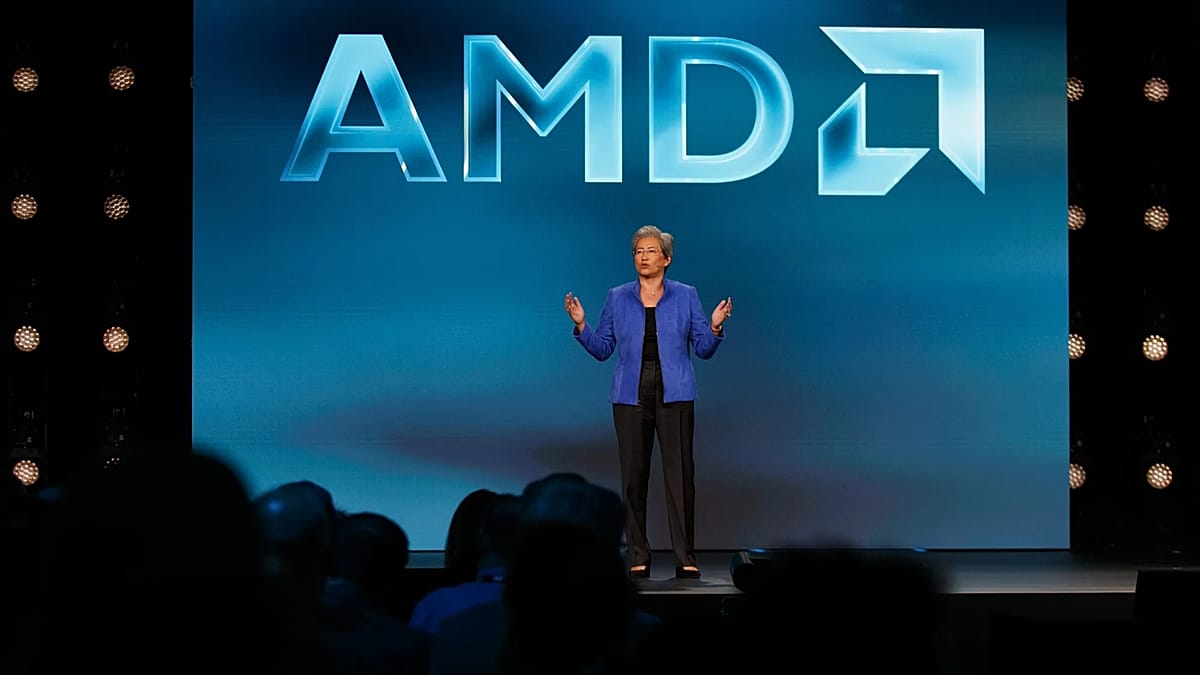
Advanced Micro Devices (AMD) has become the latest semiconductor giant to breach the $1 trillion (€850bn) market capitalisation threshold, as the artificial intelligence boom continues to reshape the global tech landscape. The California-based company's shares climbed 9.4% to $612 (€520) by late afternoon Central European Time on Monday, extending a rally that has added roughly $200 billion (€170bn) to its valuation in just one week.
The milestone underscores the extraordinary investor appetite for companies positioned at the heart of the AI infrastructure build-out. AMD, which has announced partnerships with both OpenAI and Anthropic, reported a 50% year-on-year jump in second-quarter revenues to $11.5 billion (€9.8bn), driven by a more than doubling of its data-centre business. The company said in early August that it expects data-centre sales to accelerate further in the second half of 2026, as cloud providers and enterprises upgrade their computing capacity to handle increasingly complex AI workloads.
Europe's role in the AI chip race
While AMD's success is rooted in Silicon Valley, its rise has significant implications for Europe, which is striving to build its own AI and semiconductor ecosystem. The continent's ambitions to reduce reliance on foreign chipmakers have gained urgency, with initiatives like the European Chips Act aiming to double the EU's share of global semiconductor production by 2030. Yet, European companies remain largely absent from the top tier of AI chip designers, a gap that policymakers in Brussels and national capitals are keen to close.
The surge in AI-related investment has also raised questions about the environmental cost of data centres, a concern that resonates across Europe. A recent study highlighted that polar ice sheets have shed 12 trillion tonnes since 1979, a stark reminder of the climate pressures that energy-hungry AI infrastructure could exacerbate. European regulators are increasingly scrutinising the carbon footprint of large-scale computing facilities, with some member states considering stricter energy efficiency standards.
At the same time, the AI boom is creating new opportunities for European startups. Berlin-based Langdock, a German AI company, recently moved its parent company from the US to the German capital, a sign that Europe is beginning to attract AI talent and investment. However, the continent still faces an uphill battle against the dominance of American and Asian chipmakers.
AMD's valuation, while impressive, still trails that of its chief rival Nvidia, whose market capitalisation approaches $5.5 trillion (€4.7trn). Nvidia has become the benchmark for AI performance, and its GPUs are the de facto standard in data centres worldwide. AMD's challenge is to convince customers that its MI300 series accelerators offer a compelling alternative, both in terms of performance and energy efficiency.
The company's partnerships with OpenAI and Anthropic are strategic moves to embed its technology in the next generation of AI models. Anthropic, which is reportedly preparing for a landmark listing that could value it at over $2 trillion, has chosen AMD as a key supplier for its compute needs. Such alliances are crucial for AMD to gain market share in a sector where Nvidia currently holds an estimated 80% dominance.
For European investors, AMD's rise offers a rare opportunity to participate in the AI boom through a listed stock, given the scarcity of European pure-play AI chipmakers. The company's shares are widely held by European funds, and its performance is closely watched as a barometer of the global tech cycle.
Yet, the rapid appreciation of AI-related stocks has also sparked concerns about a potential bubble. Some analysts warn that valuations have outpaced actual revenues, and that a correction could be imminent. The recent protests in San Francisco, where demonstrators called for a pause in AI development over safety fears, highlight the growing public unease about the pace of technological change.
Despite these risks, AMD's management remains bullish. In its earnings call, the company highlighted strong demand from cloud service providers and enterprise customers, and reiterated its commitment to delivering annual product updates. The company's ability to sustain its growth trajectory will depend on its execution and on the broader health of the global economy.
As Europe watches the AI race unfold, the continent's policymakers are grappling with how to balance innovation with regulation. The EU's AI Act, which entered into force earlier this year, aims to set global standards for the responsible development of AI. Whether Europe can carve out a meaningful role in the hardware side of the AI revolution remains an open question, but the stakes could not be higher.