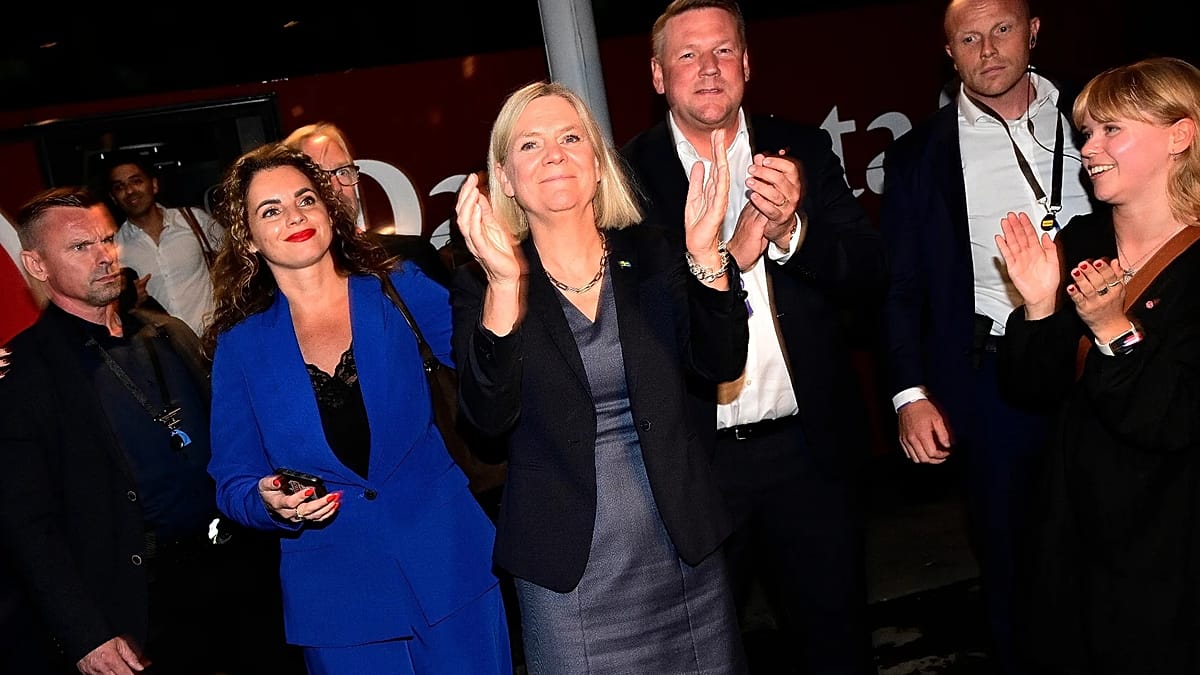
Sweden's Social Democrat leader Magdalena Andersson has declared herself ready to lead a new government, following her centre-left alliance's narrow victory in last weekend's general election. In a statement to reporters on Friday, she confirmed that she had informed the speaker of the Riksdag of her intention to seek the mandate to form a government.
"I have informed the speaker that I am ready to try to build a new government," Andersson said. "I want to lead Sweden in a new spirit of cooperation, and my aim is to seek broad cooperation."
Andersson, who previously served as prime minister from 2021 to 2022, is expected to rely on a four-party bloc comprising the Social Democrats, the Left Party, the Green Party, and the Centre Party. Together, these parties hold a three-seat majority in the 349-seat Riksdag, giving them a slim but workable parliamentary base.
The path to a new government, however, is unlikely to be smooth. The four parties have deep policy differences, and the Left Party has insisted on securing ministerial positions as a condition for its support—a demand that the Centre Party has consistently rejected. These tensions could complicate negotiations and test Andersson's promise of a "new era of cooperation."
A delicate balancing act
Andersson's task is to bridge the ideological gaps between the Centre Party, which leans liberal on economics, and the Left Party, which favours stronger state intervention. The Green Party adds an environmental dimension, while the Social Democrats anchor the coalition with their traditional welfare agenda.
In a video address posted on Thursday, Andersson struck a conciliatory tone, saying: "The Swedish people have voted to move Sweden forward, and I want to realise the new direction you have chosen." She added that it was now "up to all political forces to set aside partisan tactics and prioritise the best interest of Sweden and the Swedish people."
The outgoing prime minister, Ulf Kristersson of the Moderate Party, submitted his resignation on Thursday after his right-wing alliance—which included the far-right Sweden Democrats—lost its parliamentary majority. In his resignation letter, Kristersson called for "constructive openness" across party lines, a sentiment that may ease the transition but does little to resolve the substantive disagreements.
The speaker of the Riksdag is scheduled to meet party leaders individually on Friday to determine who should be tasked with forming the next government. An announcement is expected later in the afternoon, though the formal vote in parliament could take place in the coming weeks.
Sweden's political landscape has been volatile in recent years, with the rise of the Sweden Democrats reshaping the right-wing bloc and forcing the centre-left to seek broader alliances. The centre-left's narrow victory reflects a deeply divided electorate, and Andersson will need to navigate these divisions carefully.
Analysts note that the Left Party's demand for cabinet seats is not merely symbolic; it reflects a desire to influence policy on issues such as labour law and housing. The Centre Party, meanwhile, has warned that including the Left in government could undermine fiscal discipline and market confidence.
Despite the hurdles, Andersson's experience as a former finance minister and prime minister gives her credibility in negotiations. She has also signalled a willingness to engage with parties outside her immediate alliance, hinting at possible cross-bloc cooperation on specific issues.
The outcome of the talks will be closely watched across Europe, as Sweden is a key Nordic economy and a recent NATO member. The stability of its government matters for regional security and for the broader European political landscape.
For now, Andersson remains optimistic. "I want to see a new era of cooperation among the political parties," she said, echoing her campaign promise to unite a fragmented parliament. Whether she can deliver on that promise will depend on her ability to reconcile the irreconcilable.