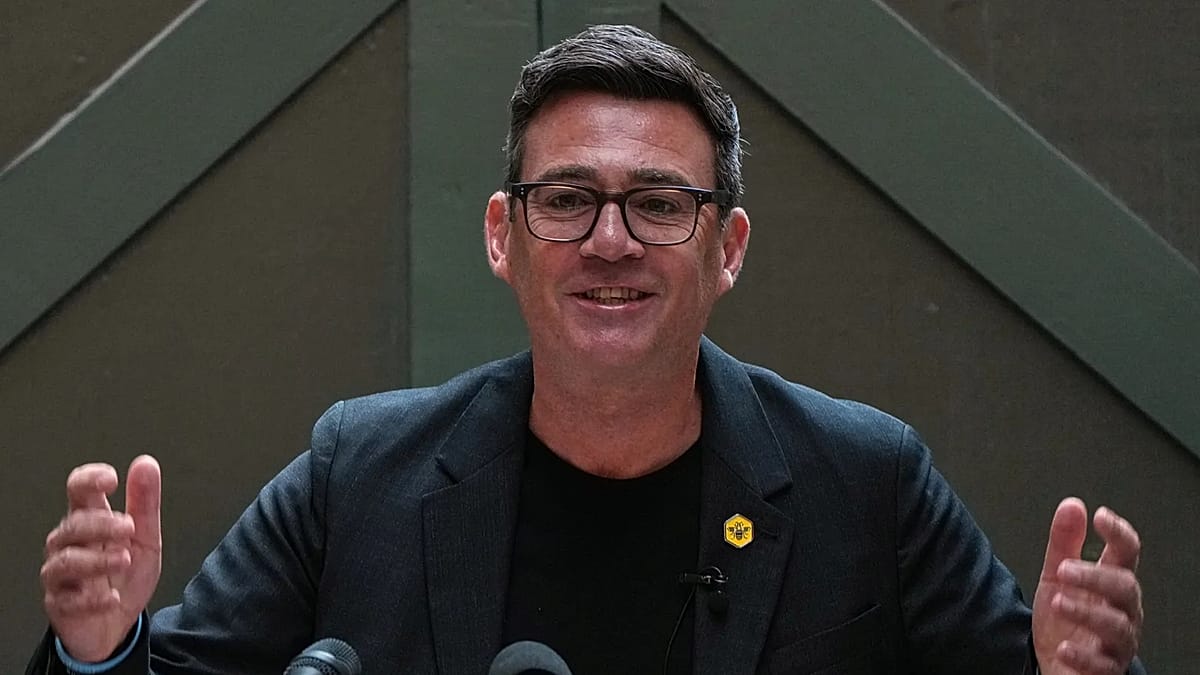
Andy Burnham is poised to become the United Kingdom's next prime minister after the last potential rival for the Labour Party leadership withdrew from the race. Former armed forces minister Al Carns told Sky News that a prolonged contest would be "not the best use of Labour's time" and urged the party to unite behind Burnham.
Carns' decision leaves Burnham as the sole candidate. Nominations for the leadership open on Thursday, and if no other contender emerges, Burnham will succeed Keir Starmer as Labour leader and prime minister later this month.
In a post on X, Carns wrote that Burnham had his "full backing" and had "earned this." He added: "Our job now as a Labour team is to help him succeed, because the country needs him to."
Darren Jones, the chief secretary to the Treasury and Chancellor of the Duchy of Lancaster, had also been considered a potential candidate but announced last month that he would step aside, questioning the benefit of a contest for both the party and the country.
From Manchester to Downing Street
Burnham's path to the leadership follows Starmer's announcement in June that he would step down after Labour's poor performance in local elections in May. Starmer will remain in office until a successor is chosen.
Burnham declared his candidacy after winning the Makerfield by-election in June with approximately 55 percent of the vote, defeating candidates from Nigel Farage's Reform UK party and Rupert Lowe's hard-right Restore Britain.
He previously served as the Member of Parliament for Leigh from 2001 to 2017 before becoming Mayor of Greater Manchester, a role in which he oversaw significant economic and cultural development in the region. Since returning to Westminster, Burnham has focused on domestic policy, pledging to end trickle-down economics and neoliberalism, and vowing to establish a "No. 10 North" to decentralise power from London.
On European affairs, Burnham has previously advocated for the UK to rejoin the European Union. However, during his Makerfield campaign, he tempered expectations, stating that while Brexit had been damaging, reopening the debate was not appropriate at this time. "My view is that Brexit has been damaging," he said in May. "But I also believe the last thing we should do right now is rerun those arguments."
Burnham's domestic agenda also includes a commitment to stick to Labour's 2024 manifesto, as he ruled out an early election.
The leadership transition comes amid broader political shifts across Europe, where debates over sovereignty, economic policy, and the role of the state are reshaping party landscapes. Burnham's emphasis on regional empowerment and public investment aligns with trends seen in other European countries, such as France's ongoing discussions about decentralisation and Germany's focus on industrial policy.
As the UK navigates its post-Brexit relationship with the continent, Burnham's pragmatic stance on Europe may help ease tensions with Brussels, though he has made clear that rejoining the EU is not on the immediate agenda. His approach reflects a broader European debate about balancing national interests with continental cooperation, a theme that resonates from the EU's auto sector to discussions on data protection and AI regulation.
With no further challengers expected, Burnham's ascent appears all but certain. The Labour Party is now focused on presenting a united front as it prepares for the next general election, with Burnham's leadership likely to shape the UK's political direction for years to come.