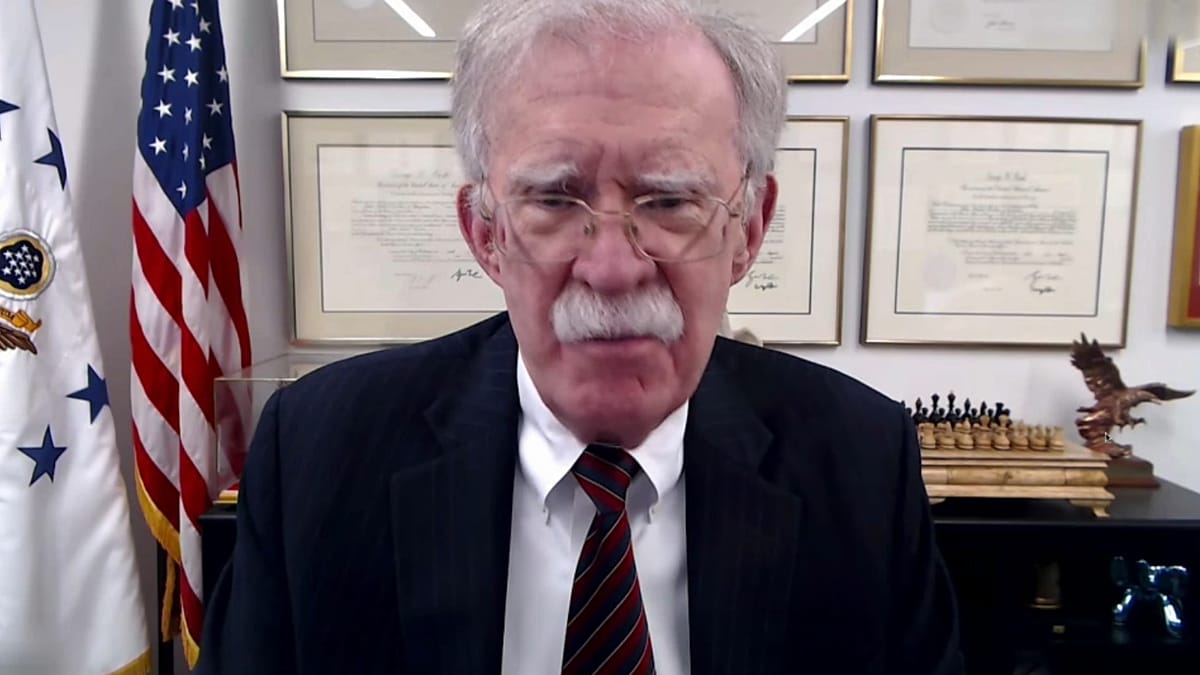
Former US National Security Adviser John Bolton has dismissed Donald Trump's renewed calls for US control of Greenland as a deliberate attempt to provoke reactions, telling Euronews the US president often makes such remarks "because it drives people crazy."
Speaking during Euronews' special coverage of the NATO summit in Ankara, Bolton said Trump's latest comments on Greenland should be seen as part of his political style rather than an indication of US foreign policy. Trump repeated at the summit that Greenland should come under US control, arguing the strategically important Arctic territory is vital to US security, while lashing out at Denmark for not doing enough to fortify it.
Bolton, who served as Trump's national security adviser during his first term, said the president has a long history of making provocative statements simply to attract attention. "He's trolling people," Bolton told Euronews. "Why does he talk about taking Greenland? Because it drives people crazy. That's what it's about."
Recalling his time in the White House, Bolton described an episode in which Trump deliberately dictated part of a social media post in capital letters because, according to Bolton, he wanted to provoke a reaction. The remarks come amid renewed European anxieties over Trump's Greenland ambitions, which have reopened debates about Arctic security and sovereignty.
NATO Summit: Mixed Signals and a Conciliatory Turn
Despite Trump's criticism of several allies, including Spain, which the US leader described as a "wasted cause," Bolton said the summit's results were positive. "I think the final statement that was agreed unanimously is a good statement," he said, adding that the outcome for Ukraine remained "very positive," even if President Volodymyr Zelenskyy did "not get everything he wanted."
In a bilateral meeting, the US leader acknowledged that his relationship with the Ukrainian president had improved after an initial clash in the Oval Office in 2025. The summit's final declaration, which made no reference to a 2027 date for a summit in Albania, prompted Bolton to question the need for NATO to continue holding annual leaders' summits. "There is no requirement for a NATO summit every year," Bolton said. "If you skipped a year or two, it wouldn't be the end of the world."
He suggested that holding fewer summits could also reduce the risk of political turbulence, given the uncertainty surrounding Trump's future approach to the alliance. The US president was critical of allies on his way to Ankara but was more constructive in his final press conference, referring to them as mostly good people. This shift in tone was noted by European leaders, who had braced for a more confrontational stance. For a deeper look at the summit's dynamics, see our analysis of Trump's conciliatory turn.
Bolton's comments underscore a broader pattern: Trump's Greenland fixation is less about territorial acquisition and more about generating headlines. For European capitals, the challenge is to distinguish between rhetorical provocation and genuine policy shifts. As the Arctic becomes increasingly contested, the question of Greenland's status remains a live issue, but one that, for now, appears to be more about political theatre than strategic reality.