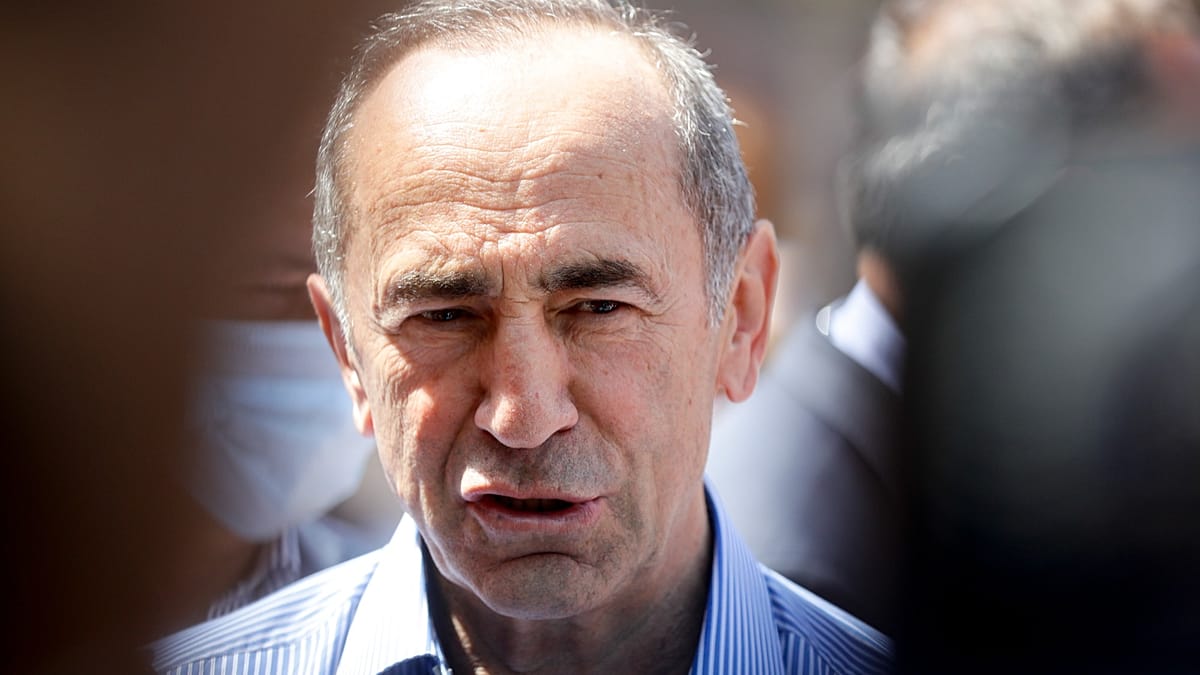
Armenian law enforcement detained former President Robert Kocharyan and his eldest son on Tuesday after sweeping searches of properties linked to the family, the country's Anti-Corruption Committee announced. The 71-year-old, who led Armenia from 1998 to 2008, faces charges of abuse of authority, bribery, and large-scale money laundering, according to the Prosecutor General's Office.
Four other individuals were also taken into custody as part of the investigation, which alleges that state assets were sold to private companies below market value during Kocharyan's tenure. The committee said nine other people are implicated in the case, including Serzh Sargsyan, who served as Kocharyan's prime minister and later as president from 2008 to 2018. Sargsyan was summoned for questioning in Yerevan on Tuesday.
A political earthquake in Yerevan
The detentions come less than 24 hours after a heated parliamentary exchange between Prime Minister Nikol Pashinyan and Kocharyan's younger son, Levon, who is a member of the opposition Armenia Alliance bloc. During a question-and-answer session, Levon accused Pashinyan of pressuring courts and law enforcement to target political opponents. Pashinyan shot back, questioning the origins of the Kocharyan family's wealth and insisting that assets acquired at public expense should be returned to the state.
Robert Kocharyan, who now leads the Moscow-friendly Armenia Alliance—the second-largest opposition force in parliament—has long been a polarizing figure. His office head, Bagrat Mikoyan, called the detentions "yet another attack on President Kocharyan and his family" and said Kocharyan felt unwell and was taken to a hospital.
Kocharyan's presidency was marked by deep integration with Russia. He signed a declaration of "allied partnership" with the Kremlin and oversaw a surge in Russian investment in Armenia's economy. His personal ties to Vladimir Putin are well documented; in 2021, Kremlin spokesperson Dmitry Peskov described their relationship as "good relations for a very long time."
This is not the first time Kocharyan has faced legal trouble. In 2019, he stood trial over the deadly crackdown on protesters following the disputed 2008 presidential election, which left at least ten people dead. Those charges were later dropped, and proceedings ended in 2021.
Analysts see the latest case as a deliberate escalation by Pashinyan's government, which has pivoted toward the West and sought closer ties with the European Union. Alexander Iskandaryan, director of the Caucasus Institute in Yerevan, said the move "is a signal to the Kremlin." He added: "Kocharyan effectively positions himself as a Russian proxy, and we see a trend where the authorities have begun to fight—intensively and by all possible means—against political forces aligned with Russia."
Pashinyan, who came to power in the 2018 street revolution, has consistently portrayed himself as a champion of the people. His party was re-elected in June, and he has pursued a foreign policy that includes Armenia's moves toward an EU membership bid, a direct challenge to Moscow's influence.
The crackdown on pro-Russian figures extends beyond Kocharyan. Last year, Samvel Karapetyan, an Armenian-Russian billionaire and leader of the largest opposition party, was arrested on suspicion of calling for Pashinyan's overthrow. Karapetyan, founder of Russia's Tashir Group, has an estimated fortune of $4.1 billion (€3.5bn)—nearly half of Armenia's annual public budget. In April, he told a court he was renouncing his Russian and Cypriot citizenships to run in the June 2026 parliamentary elections. He and his lawyers deny all charges.
The detentions are likely to deepen the political rift in Armenia, pitting a government intent on European integration against an opposition that looks to Moscow. As the legal proceedings unfold, the international community will be watching closely—not least in Brussels, where EU officials have welcomed Pashinyan's overtures. The case also echoes broader regional dynamics, as seen in Ukraine's anti-corruption efforts targeting high-level officials.
For now, Kocharyan remains in custody, and the investigation continues. Whether this marks a definitive break with Armenia's Soviet-era political legacy or simply a new chapter in its turbulent post-Soviet politics remains to be seen.