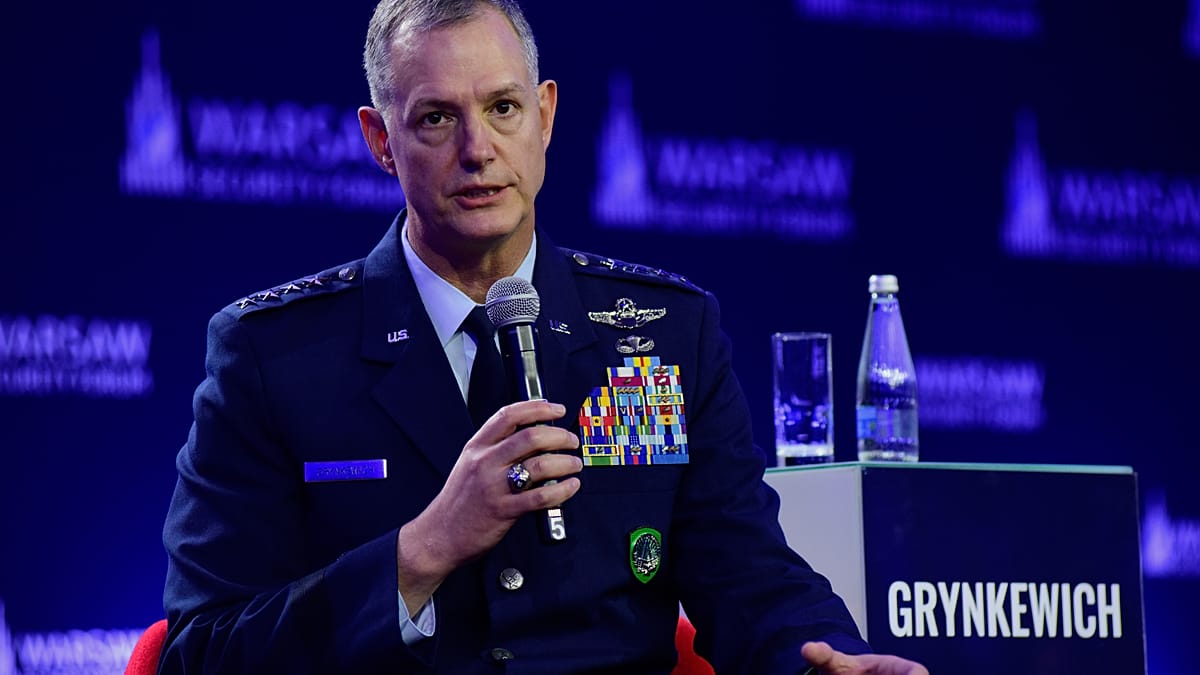
WARSAW — NATO's top military commander has laid out a new defensive blueprint designed to convince any potential aggressor that an attack on the alliance would be a catastrophic miscalculation. Speaking at the Warsaw Security Forum, General Alexus Grynkewich, the Supreme Allied Commander Europe (SACEUR), detailed a strategy that he said would make any assault on a member state “utterly futile.”
The plan, known internally as the 'Theory of War', rests on three principles: block, blunt, and break. It is intended to reassure the roughly one billion people under NATO's protection while sending an unambiguous signal to Moscow and other adversaries that the alliance is prepared to respond with overwhelming force.
“If attacked, we are ready to fight tonight,” Grynkewich told the audience in the Polish capital, drawing applause. “We will continue to prepare and rehearse each and every day, so we will be more ready tomorrow, and even more ready the day after that.”
A three-stage response
The first stage, “block,” focuses on preventing an initial incursion from seizing allied territory. NATO ground forces would engage advancing formations, fix them in place, and destroy units attempting to cross into alliance borders. “We will fix the enemy formations and deny the seizure of Alliance territory,” Grynkewich said.
If the attack persists, the second stage, “blunt,” would bring a broader array of capabilities to bear, including advanced sensors and autonomous systems that can identify and assess threats with minimal human intervention. The goal is to halt any further enemy advance and degrade its momentum across multiple operational domains.
The final stage, “break,” targets not only enemy troops but the entire warfighting system that sustains them. Long-range precision strikes and sensor networks would be used to dismantle command structures, supply lines, and logistics hubs, leaving the adversary unable to continue operations. “Enemy formations will be starved of replenishment. Enemy commanders will be unable to control their forces. Enemy forces and support capabilities will be reduced and destroyed,” Grynkewich declared.
Lessons from Ukraine
The strategy draws heavily on observations from the battlefield in Ukraine, where both conventional and drone warfare have evolved rapidly. “We're learning a tonne from Ukrainian partners,” Grynkewich noted. The conflict has highlighted the importance of resilient logistics, electronic warfare, and the integration of unmanned systems — all of which are now embedded in NATO's planning.
Grynkewich stressed that the approach is purely defensive. “We have no plans, no intentions, and no ambitions beyond the protection of our people and the defence of our territory,” he said. He described the likelihood of an imminent attack as low, but warned: “If someone is foolish enough to attack us, we will fight.”
The unveiling comes amid heightened anxiety on NATO's eastern flank, where authorities in countries like Poland and the Baltic states have reported incidents of sabotage, arson, and drone incursions, some involving military-grade explosives. In Poland, security services have recently increased patrols around schools following online threats, and police have warned of possible attacks on senior officials, including Prime Minister Donald Tusk. These developments underscore the volatile security environment that NATO's new strategy is meant to address.
Grynkewich also addressed concerns about the reliability of the United States' commitment to the alliance, a topic of debate among some member states. He pointed to the joint statement issued at the NATO summit in July, in which Washington reaffirmed its “ironclad commitment to Article 5,” the collective defence clause.
The 'Theory of War' has been endorsed by all 32 NATO members and will guide the alliance's force posture and readiness efforts in the coming years. As Grynkewich put it, the objective is simple: “We will, in short, ensure any attack, against any Ally, proves utterly futile.”