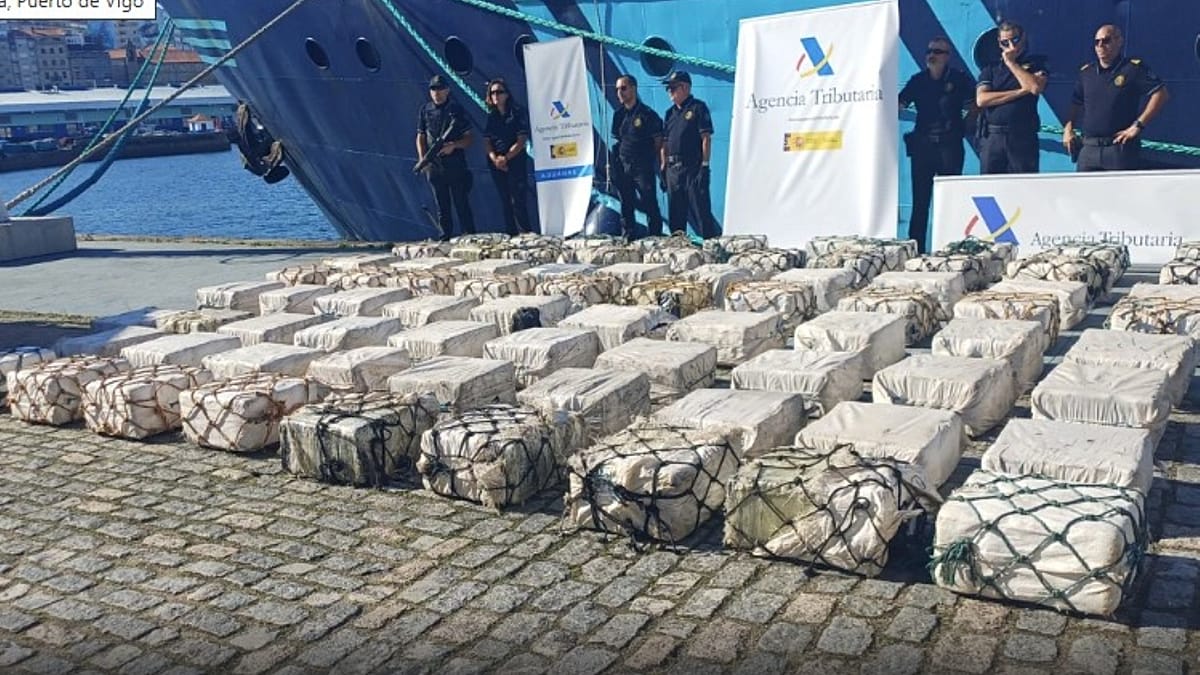
Spanish and French authorities have dismantled a logistics network that supplied yachts to drug trafficking organisations from the Balkans and Eastern Europe, following the seizure of more than two tonnes of cocaine in the Atlantic Ocean. The operation, codenamed Doncella, culminated in the arrest of five individuals, including the alleged mastermind based in Girona, Catalonia.
The interception took place some 400 nautical miles off the Galician coast, where a Spanish patrol vessel boarded a 14-metre yacht flying the Polish flag. On board, officers discovered 70 bales containing approximately 2,100 kilograms of cocaine stowed across the deck. The haul represents one of the largest maritime drug busts in recent years on the Atlantic route.
Investigation began in Girona
The investigation was launched in February in Girona after authorities flagged a suspicious yacht. The vessel, which flew a Polish flag, raised questions due to irregularities in its paperwork. Further checks revealed that its owner had a prior conviction for theft, prompting deeper scrutiny.
According to Spain's Customs Surveillance Service, the network was known to supply foreign-flagged leisure boats to organised crime groups operating in Eastern Europe and the Balkans. Intelligence gathered through the Intelligence Centre for Counter-Terrorism and Organised Crime, with assistance from Polish authorities, helped locate the yacht in Roses, a coastal town in Girona. From there, it was kept under surveillance until 11 July, when it set sail with its tracking system deliberately switched off to evade monitoring.
International cooperation
The operation relied on close collaboration between multiple agencies. The US Drug Enforcement Administration, the UK's National Crime Agency, and Portugal's Maritime Analysis and Operations Centre for Narcotics provided crucial support. A Spanish patrol vessel tracked the yacht and pinpointed its position 400 miles off Galicia.
In the early hours of 14 September, a boarding team seized the vessel and arrested its four crew members. The crew comprised nationals of Argentina, Uruguay, Colombia, and Albania. The Albanian suspect is believed to have been responsible for overseeing the delivery of the cocaine to buyers in the Balkans, a region that has become a significant hub for drug trafficking networks.
While the yacht, named Petrel I, was being towed to the port of Vigo, police in Girona arrested the alleged ringleader of the network, a Chilean national who was in charge of sourcing the vessels. The investigation remains open, with authorities seeking to arrest a man in Barcelona believed to have handled the group's surveillance and logistics.
This seizure underscores the growing role of Spanish and Portuguese waters as transit points for cocaine destined for European markets. The Atlantic route, often used by South American cartels, has seen increased activity in recent years, with Galicia's rugged coastline providing a discreet landing point for smugglers.
The operation also highlights the importance of international cooperation in tackling maritime drug trafficking. As European agencies tighten their grip on traditional smuggling routes, criminal networks are adapting by using smaller vessels and more sophisticated methods, including the use of yachts with false documentation.
Authorities have not disclosed the estimated street value of the seized cocaine, but a haul of this size would likely be worth tens of millions of euros. The case adds to a series of recent successes in the fight against drug trafficking in the region, including Spain's broader efforts to curb illegal activities.
The investigation continues as police work to dismantle the entire network, which appears to have had connections across several countries. The arrest of the Barcelona-based suspect is considered a priority, as he is believed to have played a key role in coordinating the logistics of the operation.