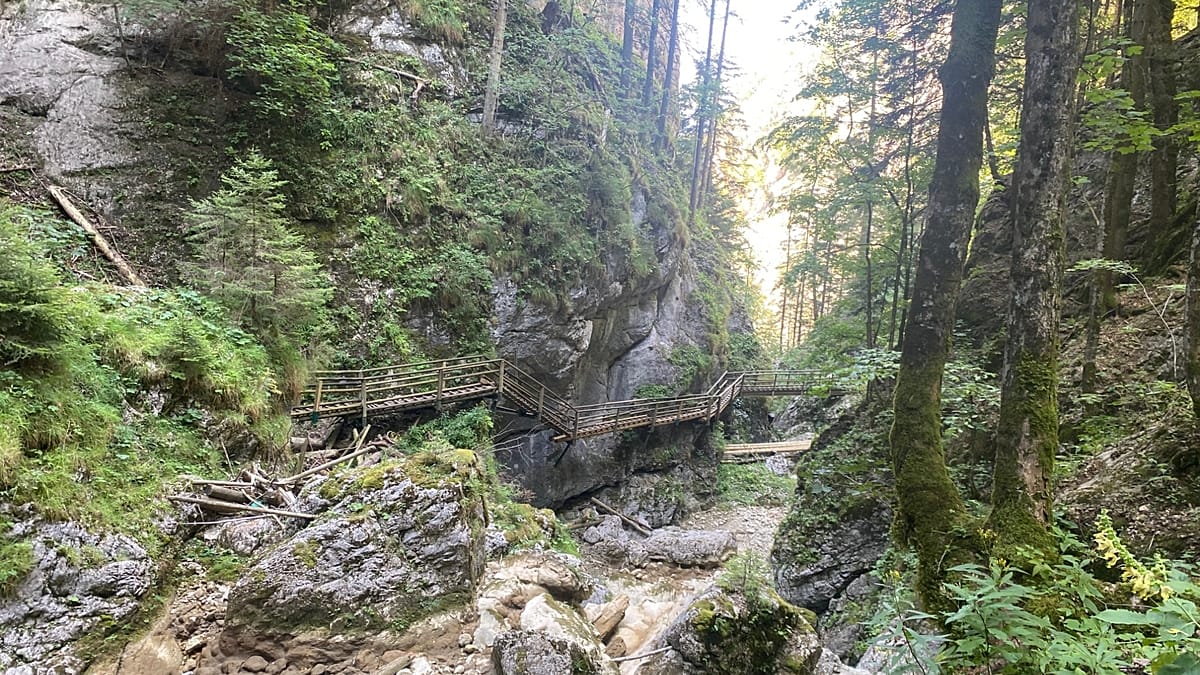
For decades, a hike through the Bärenschützklamm in Styria meant scrambling over slick rocks beside thundering waterfalls and wading through icy streams. The gorge, carved over millennia into the eastern Alps, draws roughly 40,000 visitors a year. But when I walked its trails in early August, the sound of rushing water was absent. The creeks had shrunk to trickles, and in places the streambed was so dry that it served as a walking path.
The cause is a punishing combination of heatwaves, scarce winter snow, and a rainless summer—conditions that are becoming more frequent across Europe as the climate warms. According to GeoSphere Austria, precipitation from January to June 2026 was 27 percent below the long-term average nationwide. In some regions, it was the driest first half of a year since 1885.
A landscape under stress
Gerhard Jantscher, chairman of the Austrian Alpine Club's Mixnitz section, told European Pulse that the Alps are feeling the strain. “By the end of July, the flow of water through the Bärenschützklamm had ceased due to a lack of precipitation,” he said. The gorge is fed by the Mixnitz Stream, which rises on the Sommeralm plateau and flows via the Teichalm before plunging into the gorge. “The region relies on natural precipitation so that the Sommeralm and Teichalm can absorb rainfall and gradually release it into the stream.”
Jantscher estimates that at least a week of steady rain would be needed to restore normal water levels. But even then, the long-term outlook is uncertain. “The landscape, formed over hundreds of years, is changing fast,” he warned.
The dry conditions are not unique to Austria. Across the Alps, glaciers are retreating, permafrost is thawing, and seasonal water cycles are shifting. A recent heatwave set records in Austria and put Italy on red alert, underscoring the regional scale of the problem.
A gorge reborn after tragedy
Despite the missing water, the Bärenschützklamm remains a dramatic sight. The trail winds through narrow rock corridors, past moss-covered boulders and ancient spruce trees, with wooden ladders—some over a century old—bolted to cliff faces. It is a raw, primeval landscape, and even without waterfalls, the geology is awe-inspiring.
The gorge was closed to the public in 2020 after a fatal accident, and only reopened this year following a €2 million safety upgrade. “We began planning the safety measures and the construction of the walkway system in 2021,” Jantscher explained. “The Mixnitz section of the Austrian Alpine Club raised these funds through our own efforts to make the gorge accessible again.”
The work included reinforcing ladders, installing new handrails, and stabilising rock faces. The gorge, declared a natural monument in 1978, now undergoes annual geological and technical inspections. “Sigi Wentner and I spearhead the project on a voluntary basis,” Jantscher said. “Every spring we consult geological experts to understand the behaviour of the rock faces, trees, and water, and to intervene if changes occur.”
The reopening has been a relief for local tourism, which depends on the gorge's draw. But the dry spell raises questions about the future of such attractions in a warming world. “We have to adapt,” Jantscher said. “The conditions are not what they were even a decade ago.”
For now, visitors can still enjoy the gorge's dramatic scenery, but the experience is fundamentally different. The absence of water is a stark reminder that Europe's natural heritage is not immune to climate change. As Jantscher put it, “We are witnessing a transformation that will require new thinking about how we manage and protect these places.”
The situation in the Bärenschützklamm echoes broader concerns about water scarcity in the Alps, which supply drinking water to much of Europe. Economic pressures on households in Austria and Greece are already being felt, and climate-related disruptions could add to them. Meanwhile, the gorge's plight is a vivid example of how quickly natural wonders can change—and a call to address the root causes.