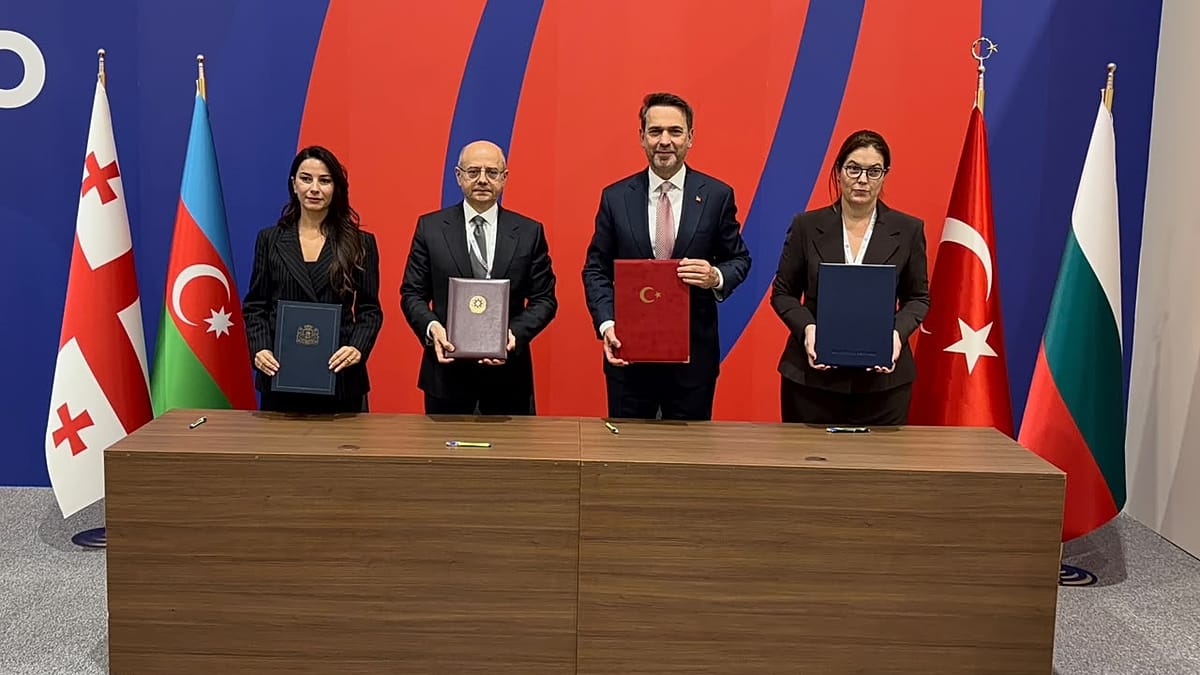
At the COP31 climate summit in Antalya, Azerbaijan has placed a bold infrastructure project at the centre of its agenda: a network of 'Green Energy Corridors' designed to carry renewable electricity from the Caspian basin to European markets. The initiative, formalised on 10 November 2026, brings together Azerbaijan, Türkiye, Georgia and Bulgaria in a Strategic Partnership Agreement in Clean Energy, turning years of conceptual planning into binding commitments.
The core ambition is to build a high-capacity transmission system that exports wind and solar power generated in the Caspian region directly to Eastern and Central Europe. By physically integrating renewable grids across multiple countries, the partners aim to establish a direct electricity transit route that bypasses traditional logistical bottlenecks. The agreement was signed by Azerbaijan's Energy Minister Parviz Shahbazov, Türkiye's Minister of Energy and Natural Resources Alparslan Bayraktar, Georgia's Vice Prime Minister and Minister of Economy and Sustainable Development Mariam Kvrivishvili, and Bulgaria's Minister of Energy Iva Petrova.
A synchronised grid from the Caspian to the EU
The infrastructure will rely on expanding existing overland high-voltage lines through the South Caucasus and Türkiye. A crucial component is the parallel enhancement of fibre-optic communications along the transit route, ensuring secure, uninterrupted transmission and modern grid management. The initiative aims to transform Azerbaijan into an interregional electricity hub, a role that could reshape energy flows between the Caspian and the European Union.
For European markets, Bulgaria's formal involvement is critical. The partnership directly addresses Eastern Europe's urgent macroeconomic mandate to diversify energy imports and reduce historical reliance on legacy fossil fuel corridors. Integrating the South Caucasus power network directly with Bulgaria establishes a vital new energy artery into the broader EU grid, providing consumer markets with a stable, alternative supply of decarbonised electricity.
The multilateral structure also distributes the immense financial and technical burdens of grid modernisation across four distinct national economies. This alignment lowers logistical risks for international investors, private equity firms, and development banks expected to fund the upcoming construction phases. As EU household energy prices dip, the corridor could offer a longer-term stabilising effect on regional markets.
Diplomatic momentum and parallel talks
Throughout the COP31 summit, the Azerbaijan Pavilion functioned as a central hub for detailing the logistical and financial scope of these cross-border projects. Presentations highlighted the 'Corridor of Dialogue' concept, framing the strategic Azerbaijan-Türkiye energy interconnection as the foundational backbone for the wider four-nation initiative. Massive investments in domestic renewable generation, particularly onshore and offshore wind projects in the Caspian Sea, will require robust, export-oriented infrastructure to be economically viable.
Aside from the principal signing, the Azerbaijani Ministry of Energy conducted a rapid series of parallel diplomatic engagements to solidify the broader grid agenda. Minister Shahbazov held intensive bilateral meetings with international renewable giants including Vestas, ACWA Power and NKT to discuss the parallel development of power generation, energy storage and cross-border grids. These talks signal a pragmatic approach, moving beyond broad climate pledges to concrete project planning.
The initiative comes at a time when Europe's energy security remains a pressing concern. Russian strikes on Ukrainian energy infrastructure have underscored the fragility of existing supply routes, while COP31's green rhetoric clashes with a continued fossil fuel scramble. The Caspian corridor offers a tangible alternative, but its success will depend on sustained political will and investment.
For Eastern Europe, the project represents more than an infrastructure upgrade; it is a strategic shift towards energy independence. By linking the South Caucasus and the EU, the four nations intend to diversify transmission routes and ensure long-term regional energy security. As the world watches, the corridor could become a model for cross-border clean energy cooperation—or another ambitious pledge lost to geopolitical realities.