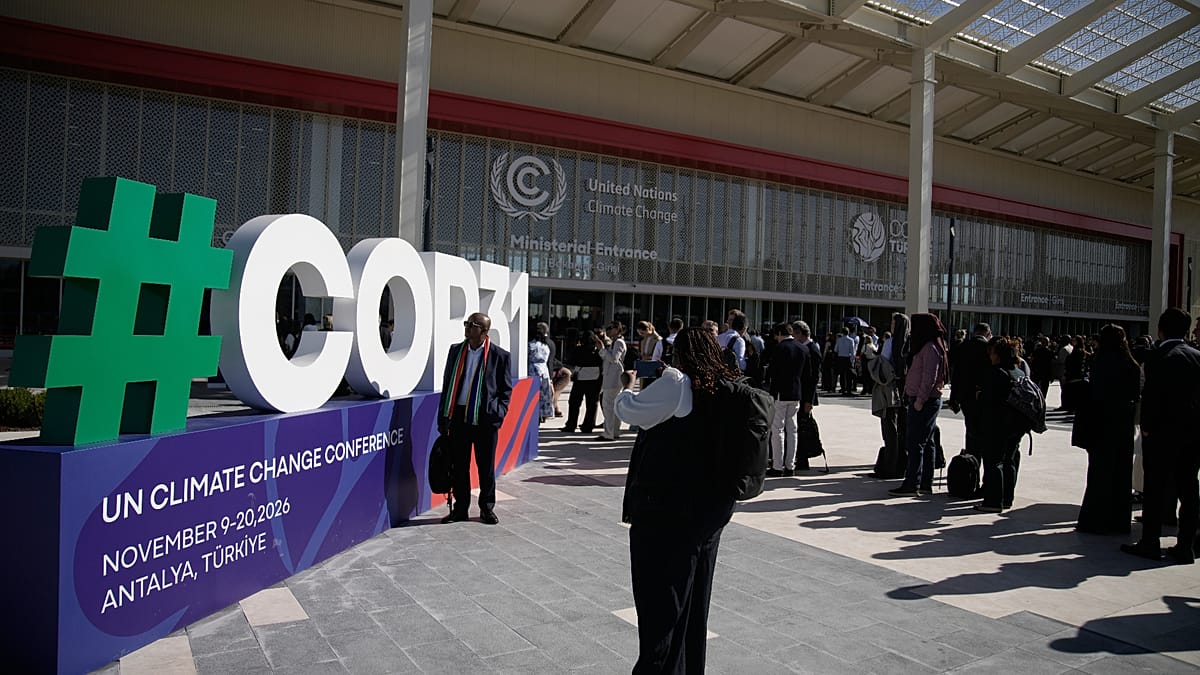
As delegates gather in Antalya for COP31, European leaders are voicing support for a swift transition away from fossil fuels. Yet behind the scenes, several EU governments are actively seeking new oil and gas agreements, underscoring the continent's ongoing dependence on hydrocarbons in a time of geopolitical upheaval.
The energy crisis triggered by the US-Israeli conflict with Iran has pushed energy security and affordability to the top of Europe's agenda. With prices soaring and industries struggling, many governments are prioritising reliable and cheap energy over long-term climate commitments, even as UN climate talks focus on phasing out fossil fuels.
While all 27 member states have endorsed the EU's official position at COP31, national actions tell a different story. New supply deals, expanded import infrastructure, and renewed interest in domestic production are becoming central to Europe's crisis response, revealing how deeply many economies still rely on fossil fuels.
Hungary's balancing act
Hungarian Energy Minister István Kapitány recently confirmed that Budapest is in talks to purchase gas from Romania's Neptun Deep field and seeking greater access to Croatian and Greek LNG terminals. “If someone stands on one leg, security is the most important question,” he told the G7 Paradigma energy conference, referring to Hungary's dependence on a limited number of suppliers.
György Bacsa, CEO of Hungarian oil and gas group MOL, warned that severing ties with Russian energy could carry a heavy economic price. “This is also a question of affordability. Today, you have to pay such a premium for basic raw materials and energy supplies that, at a certain point, it can lead to societal dysfunction,” he told Euronews. Bacsa stressed that the situation is “no longer a marginal issue where you are simply willing to pay 10 or 20 percent more for green or non-Russian energy.” He cautioned that soaring energy bills could “seriously undermine” the Hungarian and Slovak economies, potentially triggering a political crisis with wider European repercussions.
Croatia and Greece: regional ambitions
Croatia is positioning itself as a regional energy hub, using its Krk LNG terminal and port infrastructure to reduce neighbours' reliance on Russian gas. Prime Minister Andrej Plenković has argued that the Adriatic pipeline offers an alternative to Russian oil for landlocked countries, though Budapest and Bratislava contend that such alternatives come at a higher cost.
For Greece, energy security is increasingly a matter of national sovereignty. Ahead of COP31, Environment and Energy Minister Stavros Papastavrou argued that countries should not have to choose between climate protection and energy supply. “Harnessing our energy resources is a matter of national importance,” he told local media as Greece embarks on a new offshore project. Athens aims to reduce dependence on Russian energy and strengthen ties with the US, Cyprus, Egypt, and the Balkans, making LNG and gas infrastructure part of its foreign policy strategy.
Greece has made strides in renewables, with wind and solar accounting for more than 40% of electricity generation in 2025. Yet despite further investment, their share failed to increase that year, while gas gained ground.
Romania's dual role
Romania is similarly positioning itself as a regional supplier. Speaking in Abu Dhabi on 3 November, State Secretary for Energy Marius-Viorel Poșa promoted the country as an investment destination. “Romania's energy resources and infrastructure position it as an energy hub in Central and Eastern Europe and an attractive investment destination,” he said. Poșa highlighted the Black Sea's Neptun Deep gas project, alongside investments in wind power, the Cernavodă nuclear plant, and regional electricity interconnections.
But Bucharest is also wary of the economic costs of decarbonisation. At an EU energy ministers' meeting on 15 October, Romanian Energy Minister Dumitru Chisăliță backed the transition while warning against measures that could undermine industrial competitiveness. Romanian industrial production fell 2.6% year-on-year, one of the sharpest contractions in the EU, according to Eurostat. “Companies need predictable rules and realistic deadlines for adaptation and investment. We must pursue decarbonisation objectives while taking into account their effects on security of supply, the economy and consumers,” Chisăliță said.
Brussels lowers expectations
With governments facing domestic resistance and a global energy crisis, Brussels is playing down hopes of a major breakthrough on fossil fuels at COP31. A senior Commission official said the EU wants COP31 to build on the historic commitment made at COP28 in Dubai to transition away from fossil fuels, but securing progress will be “politically difficult.”
The EU has welcomed a roadmap presented by the Brazilian COP30 presidency on transitioning away from fossil fuels, seeing it as a chance to give fresh momentum to the Dubai pledge. Encouraged by COP30, 57 countries, including 14 European nations, backed a declaration at the Santa Marta conference in Colombia to develop such roadmaps. “We do hope that the Brazilian roadmap will inspire an increasing number of countries to sign up and to make work of it,” the official said.
However, as Turkey hosts COP31 in Antalya, its official focus on electrification is drawing criticism from environmental groups over its continued fossil fuel reliance and expansion. The gap between rhetoric and reality is not unique to Turkey—it mirrors the broader European dilemma of balancing climate ambitions with immediate energy needs.