Poland is grappling with the aftermath of a shooting in Kraków's Main Market Square that left six people dead and the country in shock. The attacker, who was wounded by police and died in hospital on Monday morning, has not been publicly named. Prime Minister Donald Tusk described the assault as an act of terrorism, and flags across the European Union have flown at half-mast in solidarity.
The attack unfolded on a busy weekend afternoon in the heart of the city, a UNESCO-listed square that draws tourists and locals alike. Witnesses described scenes of panic as shots rang out near the Cloth Hall. Police have not yet established a clear motive, but investigators are looking into the perpetrator's background, including any possible links to extremist networks or signs of radicalisation.
A preventable tragedy?
Jacek Siewiera, an adviser to the European Commission's PreparEU initiative, has raised uncomfortable questions about whether the tragedy could have been avoided. In an interview, he pointed to a broader European blind spot when it comes to lone attackers who act without clear organisational backing. "We have invested heavily in counter-terrorism since the Paris and Brussels attacks," Siewiera said, "but the threat has evolved. A single individual with a legally obtained weapon can cause devastation in minutes, and our intelligence-sharing mechanisms are not always agile enough to catch the warning signs."
His comments echo a wider debate across the continent. Several EU member states have recently tightened gun laws, but the Kraków attack has renewed calls for a more coordinated European approach to monitoring radicalised individuals, especially those who may not fit traditional profiles. The European Commission has promised to review existing security protocols, though critics argue that more concrete action is needed.
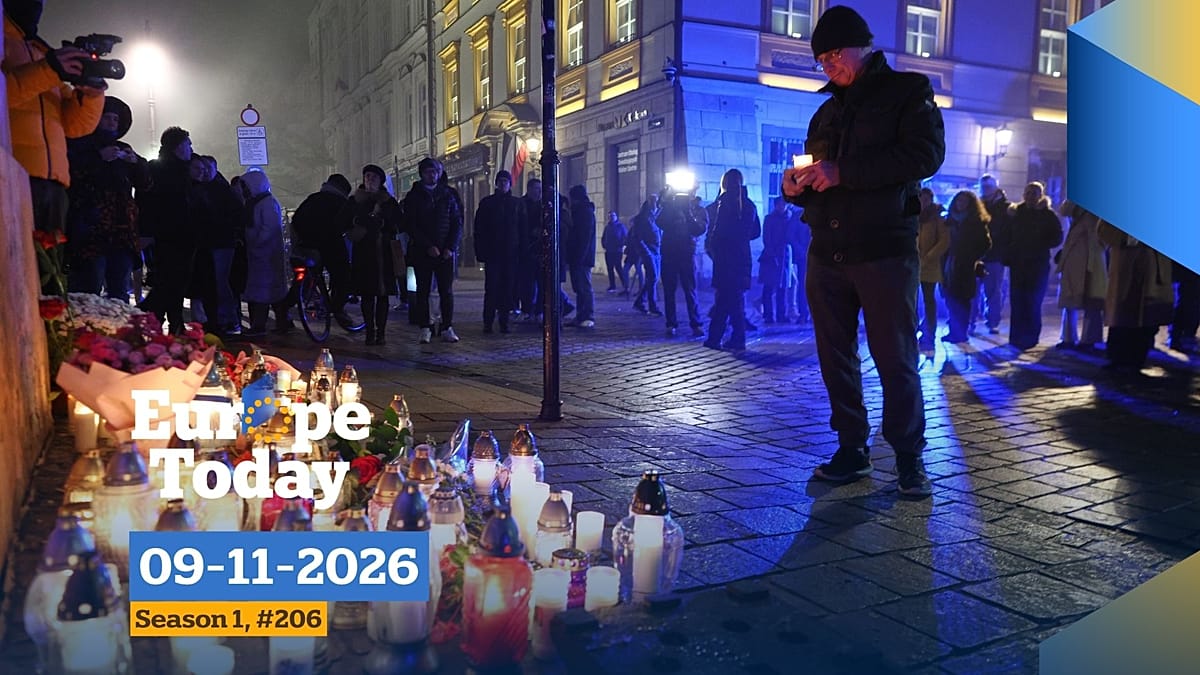
Meanwhile, the city of Kraków is mourning. A vigil was held on Monday evening in the Main Square, which has since reopened to the public. Local authorities have set up a support fund for the victims' families. The attack has also prompted an outpouring of solidarity from across Europe, with leaders from Berlin, Paris, and Brussels expressing condolences. European leaders have united in solidarity following the tragedy.
Ukraine peace talks in Abu Dhabi
In a separate development, new peace talks on Ukraine are set to begin in Abu Dhabi, with European officials confirming their participation. The talks, which will include representatives from Ukraine, Russia, and international mediators, are seen as a potential step towards de-escalation, though expectations remain low. France has confirmed its role in the discussions, and the EU's foreign policy chief is expected to attend.
The agenda is expected to cover prisoner exchanges, humanitarian corridors, and the safety of the Zaporizhzhia nuclear plant. However, the question of territorial integrity remains a sticking point. Sasha Vakulina, a European affairs analyst, noted that "the Europeans are keen to be in the room, but the real decisions will be made between Washington and Moscow. Still, the EU's presence is crucial to ensure that any agreement respects international law and Ukraine's sovereignty."
The Abu Dhabi talks come at a delicate moment, as the conflict enters its third year with no end in sight. European leaders have stressed that any peace deal must not reward aggression, but they are also under pressure from domestic publics weary of the economic costs of the war. France's role in the talks has been seen as a sign of European unity on the issue.
The race to succeed Lagarde
In Brussels, finance ministers have begun the delicate process of choosing Christine Lagarde's successor as President of the European Central Bank. Lagarde's term ends in 2027, but the informal jockeying has already started. The front-runners include several current and former finance ministers from the eurozone, with France and Germany both keen to place a candidate. The decision will be made by consensus among EU leaders, and the outcome will shape monetary policy for years to come.
The ECB faces a challenging environment: inflation has cooled from its peak, but growth remains sluggish, and the bank is navigating a period of high interest rates. The next president will need to balance the ECB's price-stability mandate with the need to support the European economy. Maria Tadeo, Europe Editor for Euronews, reported from the European Council that "the search for Lagarde's successor is already a topic of intense lobbying, though no formal process has begun. The key is to find someone who can command respect in Frankfurt and in the capitals."
COP31 opens in Antalya
Meanwhile, the COP31 climate summit has opened in Antalya, Turkey, bringing together world leaders, diplomats, and activists. The summit is expected to focus on financing for climate adaptation and the transition away from fossil fuels. Fatih Birol, Executive Director of the International Energy Agency, spoke with Maria Tadeo about the urgency of the moment. "We are not on track to meet the Paris goals," Birol said. "But there are reasons for hope: renewable energy is expanding faster than ever, and the cost of solar and wind has plummeted. The question is whether governments can match their promises with policies."
Chloé Mikolajczak, a social and environmental activist, offered a more critical view. "Climate activism has not failed," she argued. "But it has not succeeded either. We have moved the needle on public awareness, but emissions are still rising. Success at COP31 would mean a concrete commitment to phase out fossil fuels by 2030, and a clear plan to fund the transition in the Global South."
The summit comes at a time of geopolitical tension, with the war in Ukraine and the Middle East casting a shadow over international cooperation. Yet, as Birol noted, "climate change does not wait for peace." The full interview with Birol will air on On the Record tomorrow night at 9:10pm.
As Europe faces these multiple challenges—security, diplomacy, economic leadership, and climate—the need for coherent and decisive action has rarely been more apparent. The Kraków attack has reminded the continent of its vulnerabilities, while the talks in Abu Dhabi and the summit in Antalya offer opportunities for progress. Whether European leaders can rise to the occasion remains to be seen.