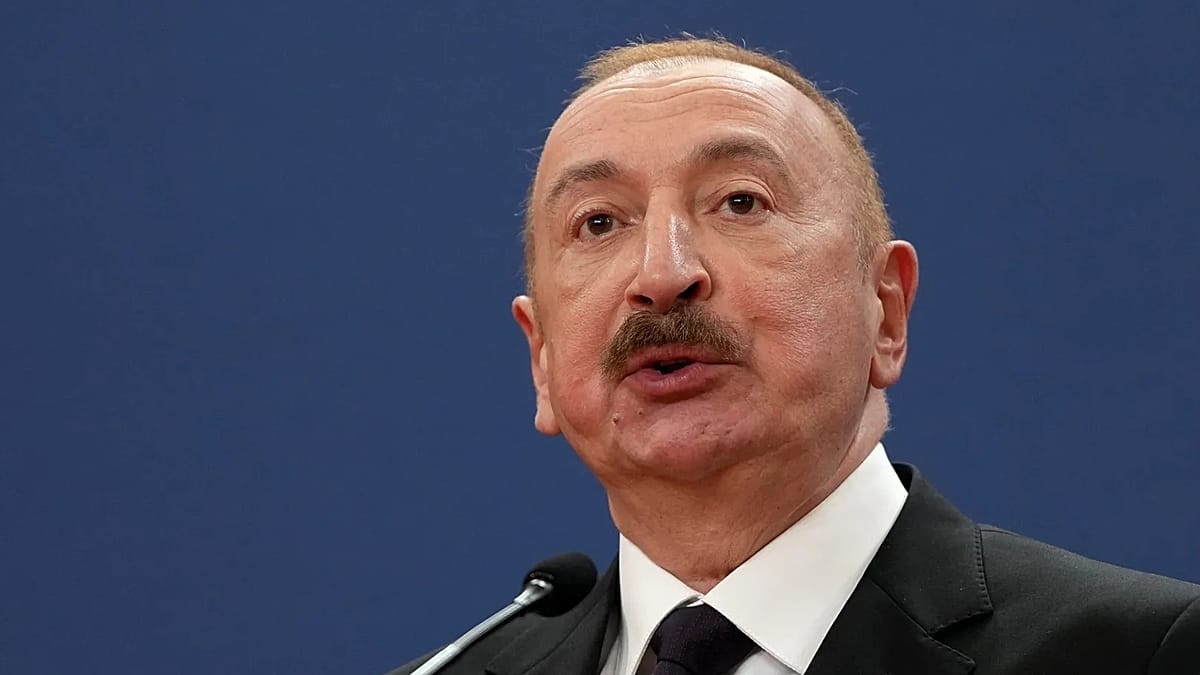
President Ilham Aliyev declared on Monday that Azerbaijan is contemplating a complete exit from the Council of Europe, escalating a dispute that began when the Parliamentary Assembly of the Council of Europe (PACE) suspended Baku's voting rights in 2024. Speaking at the fourth Shusha Global Media Forum, Aliyev stated, “I say openly that Azerbaijan is considering full withdrawal from the organisation. Not just the suspension or freezing of our membership, we are unequivocally considering leaving that structure.”
The Council of Europe, a 46-member body focused on human rights, democracy, and the rule of law, has seen growing tensions with Baku in recent years. Aliyev noted that the Secretary General of the Council of Europe had contacted him, urging restraint and proposing dialogue to resolve the impasse. “They must restore the voting rights of our delegation. After that, the Azerbaijani delegation will return,” Aliyev said, framing the suspension as an unjust act that requires acknowledgment of error from Strasbourg.
Background of the Dispute
The suspension of Azerbaijan's voting rights in PACE stemmed from concerns over the country's human rights record and political repression. Aliyev, who led Azerbaijan's delegation to PACE in 2001, described the deterioration as “regrettable” but insisted Baku had not taken any wrong steps. “We have not taken any wrong steps. They have made an unjust decision. Therefore, they must step back and acknowledge their mistakes,” he added.
This threat of withdrawal is not unprecedented; other member states have previously suspended participation or threatened to leave, but a full exit would be a significant blow to the Council of Europe's credibility and influence in the South Caucasus. The organisation already faces challenges from Hungary's parliamentary moves that test its democratic norms.
Azerbaijan's relationship with European institutions has been complex. While Baku has maintained economic ties with the European Union, particularly in energy, its political alignment has often diverged. The country's model of religious coexistence has been touted as a diplomatic asset, but its domestic governance has drawn criticism from human rights groups.
Aliyev's remarks come amid broader geopolitical shifts in Europe, where debates over sovereignty and institutional loyalty are intensifying. The Council of Europe, distinct from the European Union, includes members like the UK, Switzerland, Norway, and Balkan states, making it a key forum for continental dialogue. A withdrawal by Azerbaijan would reduce its reach and potentially embolden other governments facing similar scrutiny.
The Azerbaijani leader's ultimatum leaves the Council of Europe in a difficult position: reversing the suspension could be seen as bowing to pressure, while maintaining it risks losing a member state. Aliyev's demand for an apology and restoration of rights suggests little room for compromise, though he expressed no interest in deepening tensions. “They must step back and acknowledge their mistakes,” he reiterated.
For now, the ball is in Strasbourg's court. The Council of Europe's response will test its ability to uphold standards while managing the political realities of a diverse membership. As European institutions grapple with challenges from within and without, this episode underscores the fragility of multilateral cooperation in an era of rising nationalism.