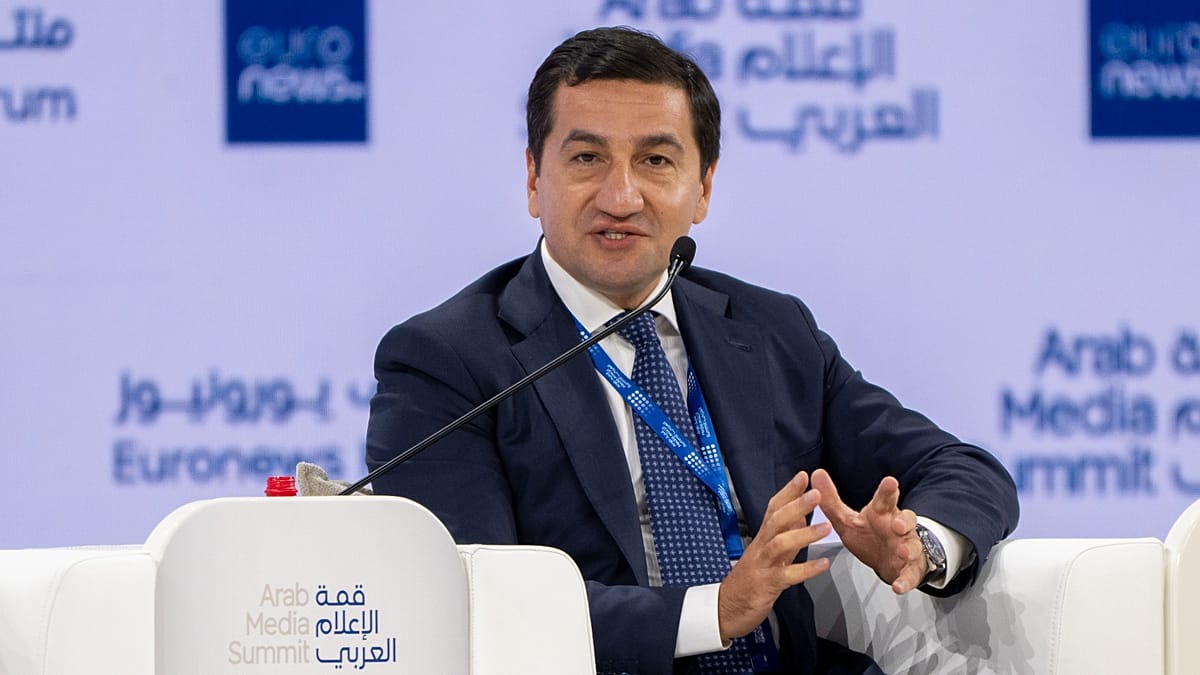
At a panel during the Arab Media Summit in Dubai, Azerbaijan's presidential adviser Hikmet Hajiyev struck a cautious tone on the prospects for lasting peace with Armenia, describing it as an "uphill struggle" even after Baku's military victory. He urged Yerevan to do more to prepare its own public for reconciliation, warning that "revanchist forces" in Armenia and the diaspora remain influential.
Hajiyev, who heads the foreign policy department in the Azerbaijani presidential administration, told Euronews that Baku is committed to safeguarding the Christian heritage within its borders. "We are dedicated to preserving the Christian heritage on the sovereign territory of Azerbaijan, regardless of their belonging, and that is a full stop because it's our cultural heritage," he said.
The comments come amid ongoing disputes over religious sites in the Karabakh region, where Armenian church authorities have accused Azerbaijan of demolishing churches. Baku rejects those claims, pointing instead to the destruction of Islamic monuments during the decades of Armenian occupation.
A history of coexistence
Hajiyev emphasised Azerbaijan's long tradition of religious tolerance, noting that Islam, Christianity, and Judaism have coexisted in the country for centuries. He highlighted that Azerbaijan is home to some of the earliest Christian communities, with the Caucasian Albanian kingdom adopting Christianity as a state religion in the fourth century. He also noted the country's Zoroastrian heritage, saying he is "more than proud" of that legacy.
"Throughout the years of occupation in Karabakh and Eastern Zangezur, our mosques, our Islamic cultural heritage were a subject of complete destruction by Armenia — even the pigs were put inside of the mosques," Hajiyev said. "We are not taking it as a sign of revenge, but it's our history and our heritage and we cannot forget that."
The adviser's remarks were part of a broader defence of Azerbaijan's post-conflict approach, which he framed as a model of interfaith harmony in the South Caucasus.
Criticism of the European Parliament
Hajiyev also used the forum to criticise the European Parliament, which he accused of adopting resolutions that "humiliate" and "undermine" the peace process. "The European Parliament is not part of the solution, it's part of the problem," he said, adding that some Western media outlets also spread disinformation about the region.
He called on the EU to adopt a more balanced policy towards the South Caucasus, saying it "shouldn't be only a one-centric approach, it should embrace the entire region with balanced cooperation with the regional countries." He urged Brussels to focus on building a new partnership rather than drawing dividing lines.
The EU has been involved in mediating between Baku and Yerevan, but relations have been strained. France, for instance, has linked the renewal of EU sanctions to the release of prisoners in Azerbaijan, a move that has complicated the bloc's approach.
Hajiyev's comments reflect a wider frustration in Baku with what it sees as European interference. Yet he insisted that Azerbaijan remains committed to regional peace, even as it faces what he described as persistent disinformation campaigns.
As the South Caucasus moves towards a post-conflict era, the fate of religious and cultural sites remains a sensitive issue. Azerbaijan's pledge to protect Christian heritage is likely to be tested as reconstruction and normalisation proceed.