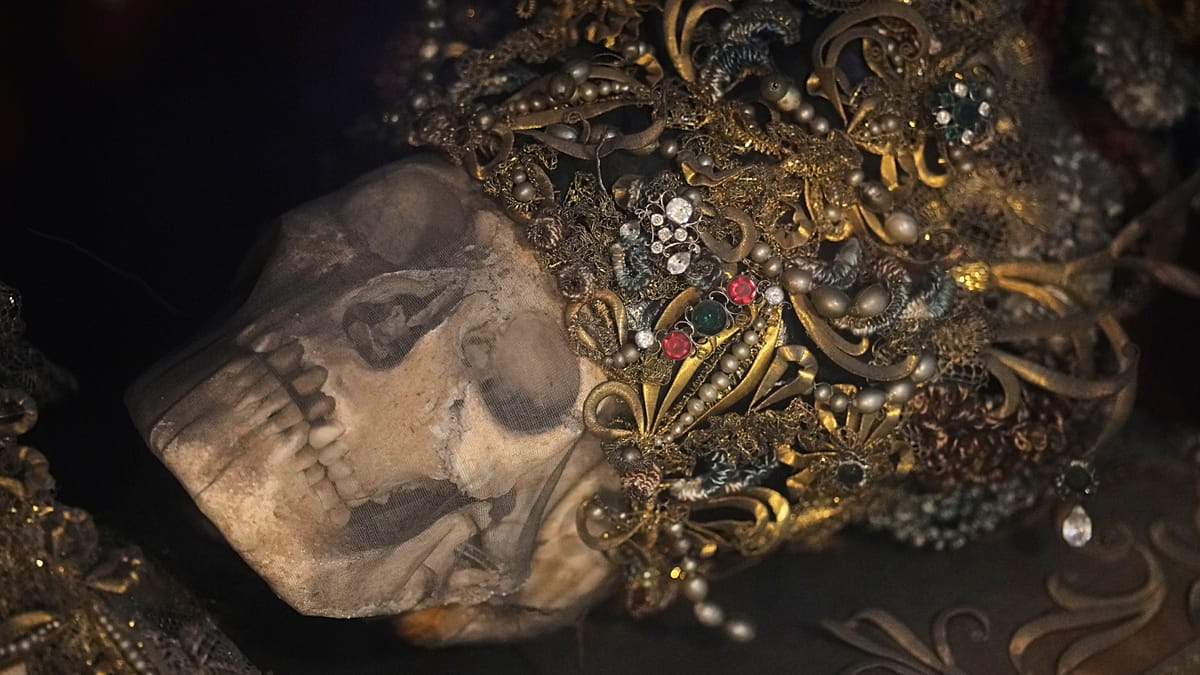
In the quiet Bavarian town of Bad Staffelstein, the Benedictine monastery church of Banz holds a sight that unsettles and fascinates in equal measure: four full skeletons, each adorned with silk, gold jewellery, silver, lace, and precious stones. Known as Vincenzius, Valerius, Benedictus, and Felix Benedictus, these are catacomb saints—remains of early Christian martyrs exhumed from Roman catacombs and brought to Germany in the late 17th and 18th centuries.
The relics are displayed in glass-fronted cabinets, their hollow eye sockets seeming to follow visitors. For many, the experience is eerie, but for the church, they serve a deeper purpose: a reminder of hope in times of despair.
A Baroque Response to Trauma
Priest Walter Ries explains the historical context: "It was at the end of the Thirty Years' War. It was a terrible time. Three-quarters of the German population simply perished. Wars, plagues, etc., were dreadful here as well. And through the Baroque, people tried to open the gate to heaven. That's why everything was designed so beautifully. It was simply an escape from the present, which was often so terrible. And that's why these eerie skeletons were beautifully draped and depicted as vividly as possible."
The Thirty Years' War (1618–1648) devastated much of Central Europe, and the Baroque era that followed sought to counter that trauma with ornate, emotional religious art. The catacomb saints, with their glittering adornments, are a literal embodiment of that impulse—transforming death into a spectacle of divine promise.
Enduring Fascination
Church custodian Anita Gottschlich acknowledges the macabre allure. "It's actually a little creepy," she whispers, noting how one skeleton seems to stare back. Yet she also observes the lasting impact: "I notice that when older people come here who visited as children, they always look for the Holy Bodies, because they can still remember them."
These 'Holy Bodies' are not unique to Banz. They can be found in many Baroque Catholic churches and monasteries across Bavaria, as well as in neighbouring Austria, Switzerland, Czechia, and Italy. The practice of bringing relics from Rome was widespread in the 17th and 18th centuries, as churches sought to enhance their prestige and attract pilgrims.
"At the time, the church simply designated them all as saints," says Ries. "And, of course, in many countries, including Germany, people wanted to have such holy remains, simply because this enhanced the status of their own church or monastery and perhaps turned it into a place of pilgrimage."
To heighten the sense of occasion, the skeletons are kept hidden behind wooden panels for most of the year. The panels are painted with images of the skeletons, so visitors know what lies behind. Only on certain feast days or by special request are the panels removed, revealing the gilded dead in their full splendour.
The catacomb saints of Banz offer a window into a Europe still grappling with the aftermath of war and plague, a continent where faith and artistry combined to create something both beautiful and unsettling. For modern visitors, they remain a powerful reminder of how societies cope with trauma—and how the dead can be made to speak across centuries.