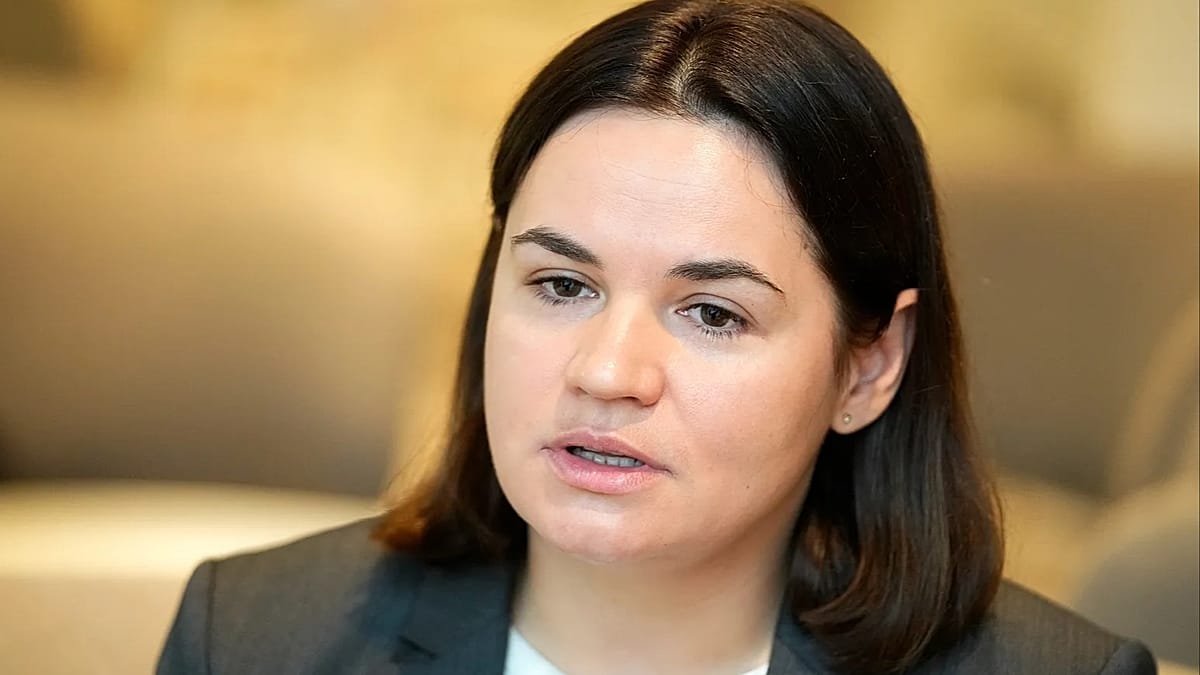
Belarus's decision to place Euronews on its list of “extremist materials” is an act of retaliation for the outlet's coverage of the disputed 2020 election, political prisoners, and Russia's war in Ukraine, according to opposition leader Sviatlana Tsikhanouskaya.
In an exclusive interview with Euronews, Tsikhanouskaya said the move shows that Aliaksandr Lukashenka's government remains fearful of independent information, six years after mass protests erupted over the presidential vote.
“It is revenge – revenge by the regime for Euronews' reporting,” she said. “Euronews covered the 2020 protests, it covered the election, which Lukashenka lost. It covered the stories of political prisoners and the war, which started from Belarus.”
The Belarusian information ministry added Euronews's website to its “Republican List of Extremist Materials,” according to Belarus-based media. The ruling takes immediate effect under the country's civil procedure rules, meaning access to the site will be restricted and readers could face administrative penalties for storing or sharing its content. Euronews's television broadcast has been banned in Belarus since 2021.
Tsikhanouskaya called the designation “hypocritical,” noting that Lukashenka himself once gave an interview to Euronews. “Now even watching them can be considered a crime in Belarus,” she said.
She warned that the label could turn the simple act of seeking independent news into grounds for repression. “Watching Euronews or reading the Euronews website can land you in jail. Sharing Euronews news can become a crime,” she said. The ruling gives the regime and its security agency, the KGB, “another excuse to prosecute people who are simply looking for information,” she added, and could also endanger journalists, contributors, and those who assist news organizations.
Repression as a system of control
Tsikhanouskaya's comments come ahead of the sixth anniversary of the August 2020 election, which was followed by an unprecedented wave of peaceful demonstrations against Lukashenka's declared victory. The opposition, the European Union, and many Western governments rejected the result as fraudulent. The authorities responded with a sweeping crackdown on protesters, activists, independent media, and civil society.
Tsikhanouskaya said repression has become the operating principle of the state because the government fears that any relaxation could trigger another uprising. “If it stops, people will rise up again,” she said. “Constant, systemic repression has become the modus operandi of the entire system.”
She noted that arrests continue daily and that the true scale of the crackdown remains unclear because many detainees are not publicly identified. “Under such terror, visible protest is almost impossible. It has gone underground,” she said. “But I know that people haven't given up. They are waiting and preparing for new momentum.”
The opposition leader, who lives in exile, argued that control of information is central to the government's survival. Millions of Belarusians still follow independent outlets covertly, she said, using virtual private networks and other tools to bypass censorship. “Independent media are the backbone of our movement,” she said.
She stated that independent reporting has helped many Belarusians understand the reality of Russia's war in Ukraine, despite official propaganda, and that most support Ukraine. But she warned that the state is adapting as quickly as citizens. “The KGB often uses tech platforms to track, identify, and prosecute opponents,” she said, adding that her team is working with companies including Meta and Alphabet to ensure their platforms are not used to facilitate persecution.
Tsikhanouskaya advised Belarusians to prioritize digital security, including using VPNs, keeping separate devices for accessing independent media, and avoiding contact with unknown accounts that could be linked to security services. She said Belarusians are also advised to regularly clear their phones, use pseudonyms online, and avoid responding to unknown contacts, which could be attempts by the KGB to recruit or blackmail them. Some independent outlets use accounts that are not branded as “extremist,” she said, allowing audiences to continue accessing information under difficult conditions.
“Difficult conditions force us to be creative,” she said. “That is the only way to survive under a dictatorship.”
She said the “extremist” designation should not deter Euronews from continuing its work. “Euronews can take this designation as a badge of honour,” Tsikhanouskaya said. “Many decent people and organisations have been declared 'extremist' by the dictator. It means your work matters.”
Despite the crackdown, she urged Belarusians not to see the democratic movement as defeated. “Our struggle has not ended. It has simply taken a different form,” she said. “It is no longer a sprint, but a marathon.”
Tsikhanouskaya said a strong Ukraine and a weakened Russia could create an opening for democratic change in Belarus, arguing that Lukashenka's government depends on Kremlin support. “Without Russian support, Lukashenka's regime will not survive,” she said. “That is why so many Belarusians hope for Ukraine's victory.”
Related coverage: European criticism of the ban and how the ban targets viewers.