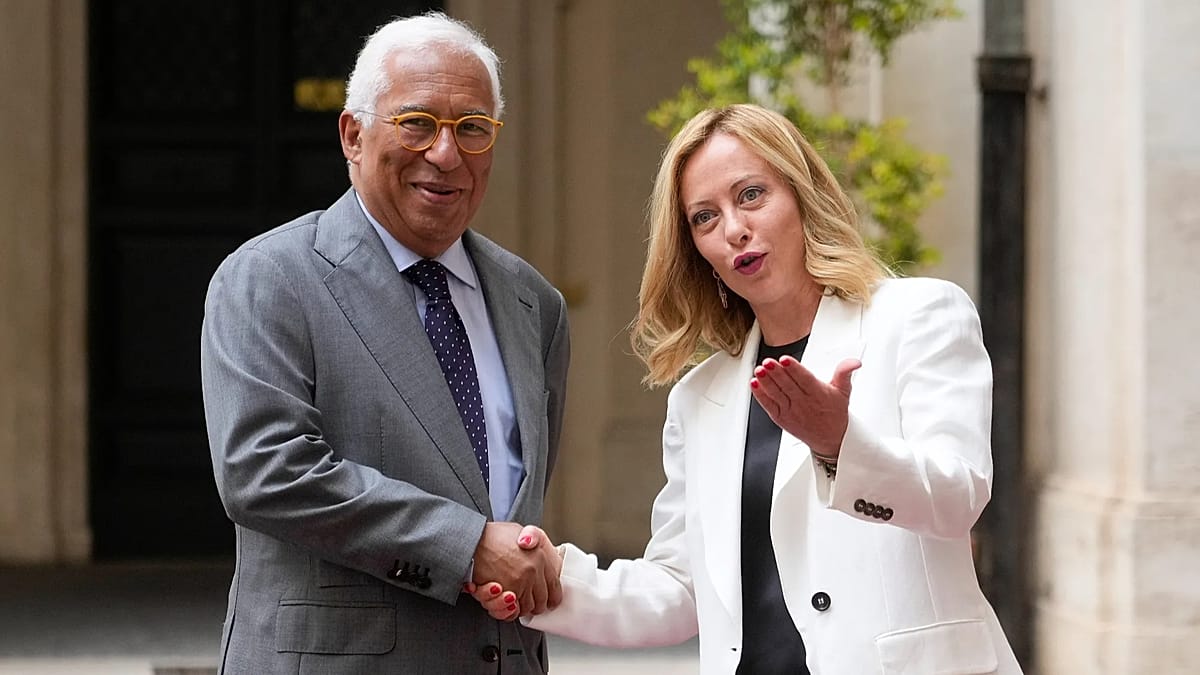
Italian Prime Minister Giorgia Meloni has sharply criticised the European Union's disjointed handling of peace negotiations over Ukraine, warning that competing initiatives are eroding the bloc's credibility on the world stage. In a letter sent on Thursday to European Council President António Costa, Meloni argued that Europe must present a united front if it is to play a meaningful role in ending the war.
The letter, seen by Euronews, comes as officials from France, Germany and the United Kingdom—the so-called E3—meet with representatives from the United States and Ukraine in Brussels to discuss a possible end to the conflict. Meloni's intervention highlights growing frustration among EU leaders over the lack of a coherent strategy, with multiple formats and forums emerging without a clear mandate or shared direction.
“Proceeding in disarray, with initiatives that chase and overlap one another, will not help us, either with our partners or with those we must convince to stop a senseless aggression,” Meloni wrote. “All of this is making us less credible.”
The Italian leader is under domestic pressure, with opposition parties accusing her government of being internationally irrelevant. Several political forces, including some within her own coalition, are urging an end to military assistance to Ukraine. Meloni's letter appears designed to counter that narrative by positioning Italy as a driving force for European coherence.
A proliferation of formats
Meloni listed several examples of the fragmented approach, including an informal meeting in Miami involving national security advisers from some European states, Ukraine, NATO and EU representatives, as well as a phone call between the leaders of Finland and Norway and Russian President Vladimir Putin. She also criticised the proliferation of negotiating groups, such as the E3, the “Coalition of the Willing” (which brings together 37 EU and non-EU states), and the “Berlin format” comprising Germany, France, Poland and representatives of NATO, the G7 and the EU.
“Europe needs to speak with a single voice on the Ukrainian question,” Meloni wrote. “This need can no longer be postponed.” She has asked for the issue to be discussed at the informal European Council in Dublin next week, with the aim of deciding how the EU should be represented in the peace talks.
The call for unity comes at a critical juncture. A crucial round of talks between Ukrainian and Russian negotiators, mediated by US officials, is scheduled to take place in Abu Dhabi on 10 and 11 November, covering security arrangements and de-escalation. The EU's ability to influence those talks may depend on whether it can present a cohesive position.
Meloni's letter reflects a broader debate within the EU about its role in international diplomacy, particularly on issues where the United States takes the lead. While some member states favour a more assertive European role, others are wary of undermining transatlantic unity. The upcoming Dublin summit could prove pivotal in shaping the EU's approach to the Ukraine conflict and beyond.
As the bloc grapples with internal divisions, the question remains whether Meloni's push for a single voice will gain traction. Her intervention underscores the stakes: if Europe cannot coordinate, it risks being sidelined in negotiations that will determine the continent's security architecture for years to come.