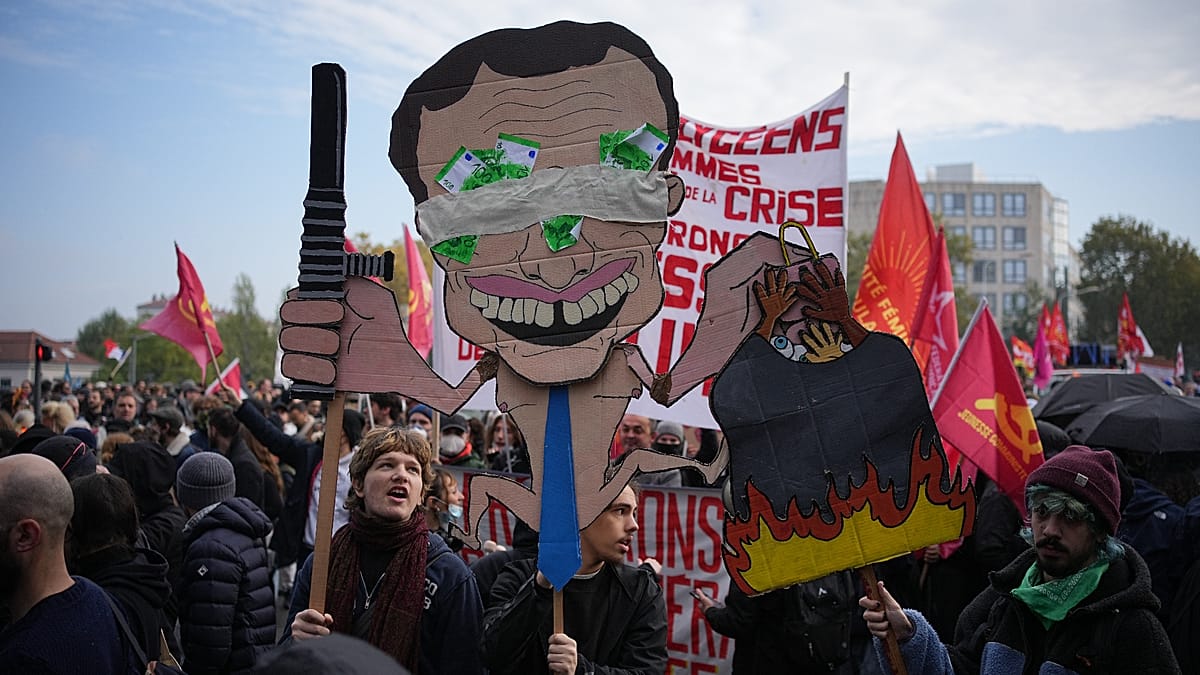
Thousands of workers and students across France have taken to the streets in a coordinated wave of strikes and demonstrations, demanding higher wages and a stronger commitment to public services. The protests, which began early on Tuesday, have disrupted transport, education and public administration in cities from Lille to Marseille.
Nationwide action, local restrictions
In Paris, Lyon and at least six other major urban centres, authorities have imposed restrictions on protest routes, citing security concerns and the risk of disruption to daily life. Demonstrators, however, argue that such measures are an attempt to stifle legitimate dissent at a time when household budgets are under severe strain.
The movement brings together an unusual alliance: trade unions representing public-sector workers, private-sector employees, and student organisations that have been mobilising for months over tuition fees, housing costs and the erosion of youth support systems. The convergence reflects a broader frustration with the cost-of-living crisis that has gripped the country, as inflation outpaces wage growth and energy prices remain volatile.
In the capital, crowds gathered at Place de la République before marching towards the Bastille, while in Lyon protesters assembled near the Part-Dieu business district. Similar scenes unfolded in Nantes, Bordeaux, Toulouse, Strasbourg and Lille, where local unions reported high turnout despite the restrictions.
Demands for higher wages and public investment
The core demands are consistent across the country: a significant increase in the minimum wage, indexation of salaries to inflation, and a halt to planned cuts in public services, particularly in health, education and transport. Union leaders have warned that without concrete government action, the protests will escalate.
“We are not here for a one-day show of force,” said a spokesperson for the CGT, one of the main unions involved. “We are here to force the government to listen to the millions of people who can no longer make ends meet.” Student groups echoed that sentiment, pointing to rising rents and the cost of basic necessities as reasons for their participation.
The protests come at a delicate political moment. The government of President Emmanuel Macron has already faced significant backlash over pension reform and is now grappling with a deepening budget crisis. As France faces mass strike action amid the budget crisis, the executive is under pressure to balance fiscal discipline with social demands.
Echoes across Europe
The French protests are not happening in isolation. Across the continent, similar movements have emerged as citizens grapple with the same economic pressures. In Denmark, students have rallied against cuts to state education grants, while in the Czech Republic, media workers have struck over a state funding plan. These parallel actions highlight a growing European-wide discontent with austerity measures and the rising cost of living.
For many observers, the French protests are a test case for how governments respond to such pressures. France has a long tradition of street politics, and the current wave could influence policy debates in other capitals. The outcome may also shape the political landscape ahead of the European Parliament elections, where economic issues are expected to dominate.
As the day wore on, some protests turned tense, with police using tear gas in a few locations, but the overall mood remained determined rather than violent. Organisers have announced further actions in the coming weeks, including a possible general strike if their demands are not met.
The government has yet to respond officially, but ministers have hinted at targeted measures to help the most vulnerable. Whether that will be enough to defuse the movement remains uncertain. What is clear is that the alliance between workers and students has given the protests a new energy, one that could prove difficult to ignore.