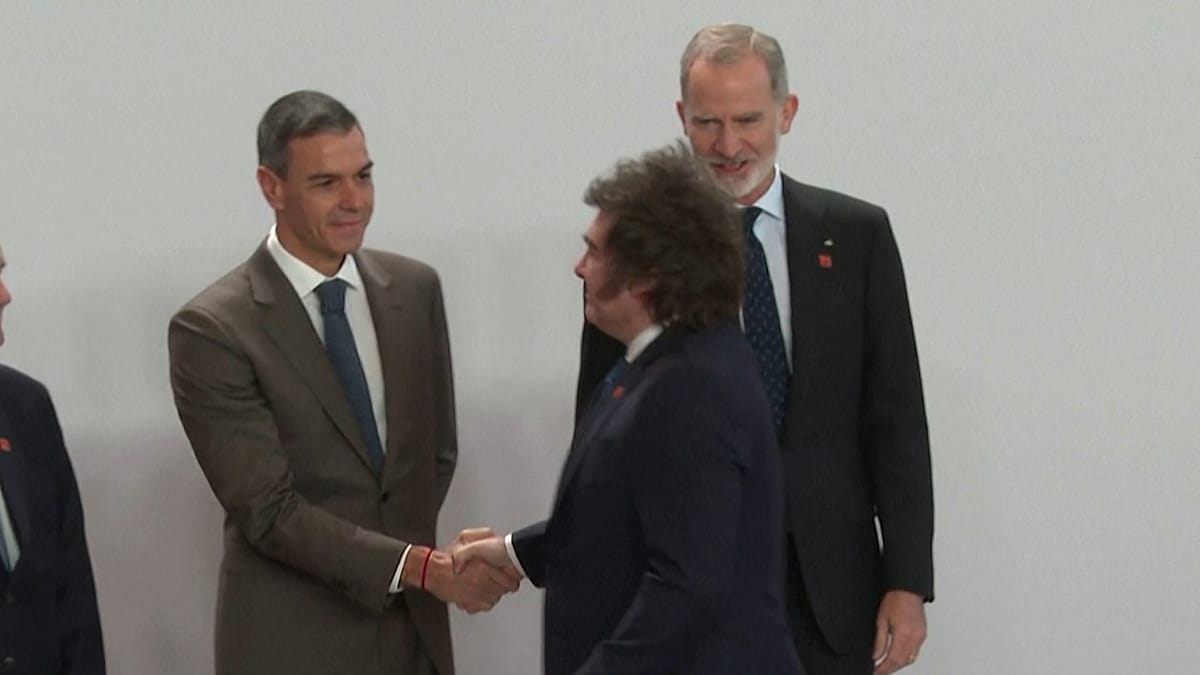
MADRID — The 30th Ibero-American Summit opened here on Thursday with a moment of high tension: Argentine President Javier Milei and Spanish Prime Minister Pedro Sánchez came face to face for the first time in months, exchanging a greeting that was as brief as it was cold.
The encounter, captured on video, showed the two leaders shaking hands without warmth, a reflection of a relationship that has deteriorated into open hostility. Just two weeks earlier, Milei had called Sánchez an “unpresentable dictator” during a rally in Buenos Aires, the latest salvo in a feud that has repeatedly spilled into personal attacks.
The roots of the dispute go back years, with ideological differences between Milei’s libertarian right and Sánchez’s socialist government fueling frequent clashes. The tension reached a diplomatic crisis in May 2024, when Spain withdrew its ambassador from Buenos Aires after Milei, speaking at a Madrid event organized by the far-right Vox party, accused Sánchez’s wife, Begoña Gómez, of corruption. That episode marked a low point in bilateral relations, and Thursday’s frosty greeting did little to suggest a thaw.
A summit of contrasts
The summit, hosted by Spain, brings together leaders from 22 Latin American and European nations, with a focus on strengthening ties across the Atlantic. But the Milei-Sánchez standoff has overshadowed the agenda, drawing attention to the deep political divisions within the Ibero-American community.
For Sánchez, the summit is also a domestic balancing act. His government has been weakened by a series of scandals, including a recent train disaster in Toledo that has added to his political woes. The political fallout from the crash has complicated his ability to project authority on the international stage.
Milei, meanwhile, has used such gatherings to promote his radical economic agenda, often clashing with more progressive leaders. His presence in Madrid was seen as an opportunity to rally conservative allies in Europe, though his confrontational style has alienated many.
The summit also comes at a time when the European Union is grappling with its own enlargement debates, as seen in recent Brussels summits. The push by Montenegro, Albania, and Ukraine for EU entry highlights the continent’s shifting geopolitical landscape, a context that makes the Ibero-American forum a useful platform for dialogue.
Despite the chill, both leaders participated in the summit’s working sessions, with Sánchez calling for greater cooperation on climate change and digital transformation, while Milei stressed the importance of free trade and reduced state intervention. Their public remarks avoided direct confrontation, but the underlying animosity was palpable.
Diplomats in Madrid noted that the cold greeting was a deliberate signal. “They are not ready to reconcile,” one European official said, speaking on condition of anonymity. “The personal animosity is too deep, and the ideological gap too wide.”
For now, the Milei-Sánchez relationship remains a cautionary tale of how personal politics can strain international diplomacy. As the summit continues, observers will watch whether the two leaders can keep their differences from derailing broader regional cooperation.