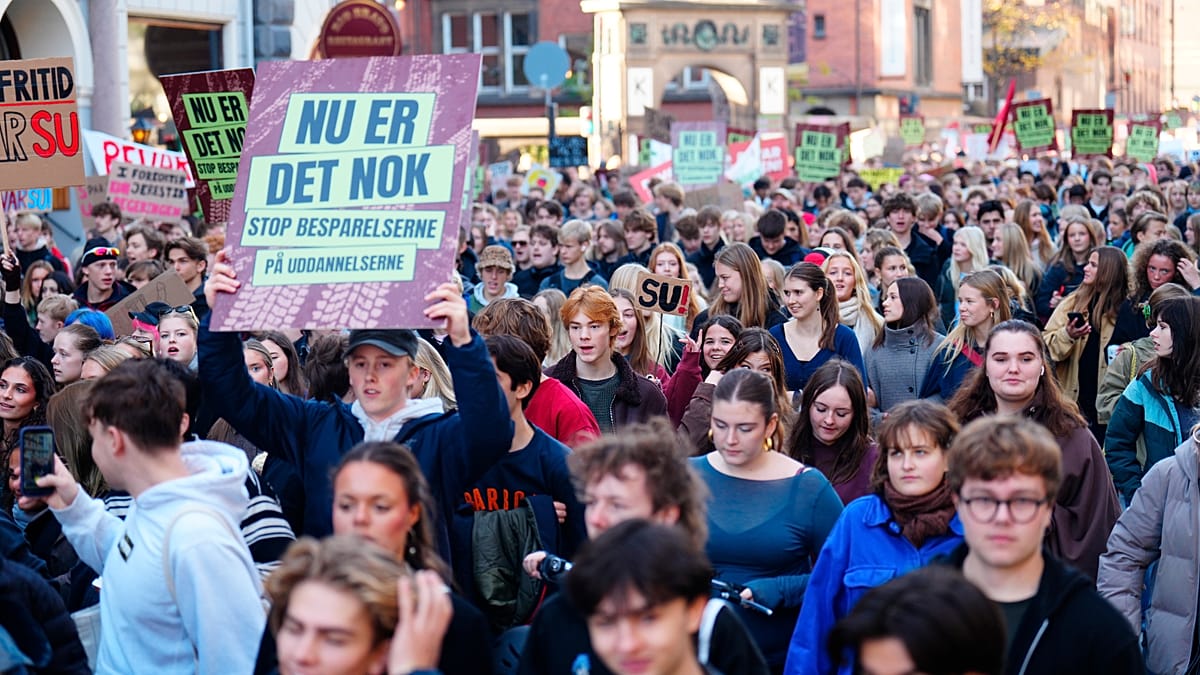
Thousands of Danish students took to the streets of Copenhagen on Wednesday, adding their voices to a wave of youth protests that has swept across Europe. The demonstration, organized by a coalition of high school and university associations, targeted a government proposal to scale back the country's cherished student allowance, known as the SU.
Marchers gathered at City Hall Square before walking to the parliament building, where they chanted slogans such as “Less Support, Less Educated,” “Broken Promises,” and “Don't Cheat the Young.” Organizers estimated that between 12,000 and 13,000 people took part, while around 40,000 students at 57 schools went on strike for the day. The protest remained peaceful, with a visible police presence.
The proposed changes, part of a draft budget bill, would abolish the SU for students who live with their parents and whose parents' combined annual income exceeds 700,000 Danish kroner (€94,000). Students whose parents earn between 419,589 kroner (€56,138) and 700,000 kroner would see their grants reduced. According to the Higher Education Ministry, about 14,000 students would lose their grant entirely, and a further 8,000 would receive less.
Introduced in 1970, the SU has long been a pillar of Denmark's egalitarian education system, ensuring that young people can pursue higher education regardless of their family's financial situation. Currently, students living with their parents receive 1,154 kroner (€154) a month, while those living independently receive 7,426 kroner (€993). The government argues that the cuts are necessary to free up funds for defence spending, a priority that has gained urgency across Europe in recent years.
Anger over broken promises
For many protesters, the plan represents a betrayal of the centre-left government's commitments. “I'm infuriated that we finally get a supposedly 'red' government in Denmark that includes the left parties, and anyway we get cuts to our welfare and to the economies of young people whilst they're funding corporate tax reductions and warfare,” said Kieran Hindshaw, a 23-year-old agronomy student. “I hope they will look at this demonstration and change their mind.”
Oscar Tonsberg Hoffmann, president of the Danish High School Students' Association and one of the protest organizers, stressed the importance of the SU in maintaining what he called “one of the world's strongest educational systems.” He said student organizations had tried to engage in dialogue with the government, but without success.
Dagmar Demuth, a high school student at the rally, highlighted the practical impact of the allowance. “It's important when you are in school and trying to educate yourself. It's hard to have to pay for yourself, so sometimes it's nice to have a little helping hand with the SU,” she said.
The government has also proposed tightening unemployment benefits for recent graduates, requiring them to have worked for 18 of the last 24 months of their studies to qualify. Critics say this would disproportionately affect those who focused on their studies rather than part-time work.
The Danish protests are part of a broader European movement. In France, student demonstrations have led to school blockades and union strikes, and similar actions have spread to other countries. In Germany, youth protests have at times turned violent, with riots and looting in Frankfurt after demonstrations escalated.
Inside the Danish government, the proposal has caused friction. The Socialist People's Party and the Social Liberal Party, both part of the ruling coalition, had previously opposed touching the SU. Interior and Economic Affairs Minister Pia Olsen Dyhr, who leads the Socialist People's Party, has had to defend the U-turn. “It's no secret that this is not an initiative that comes from us. But we have made compromises in this government, and I fully stand by them,” she said.
For the students on the streets, however, the compromise is hard to accept. They argue that cutting education support to fund defence sends a damaging signal about the country's priorities. As the protest wound down, many vowed to continue their campaign, hoping that the government will reconsider before the budget is finalized.