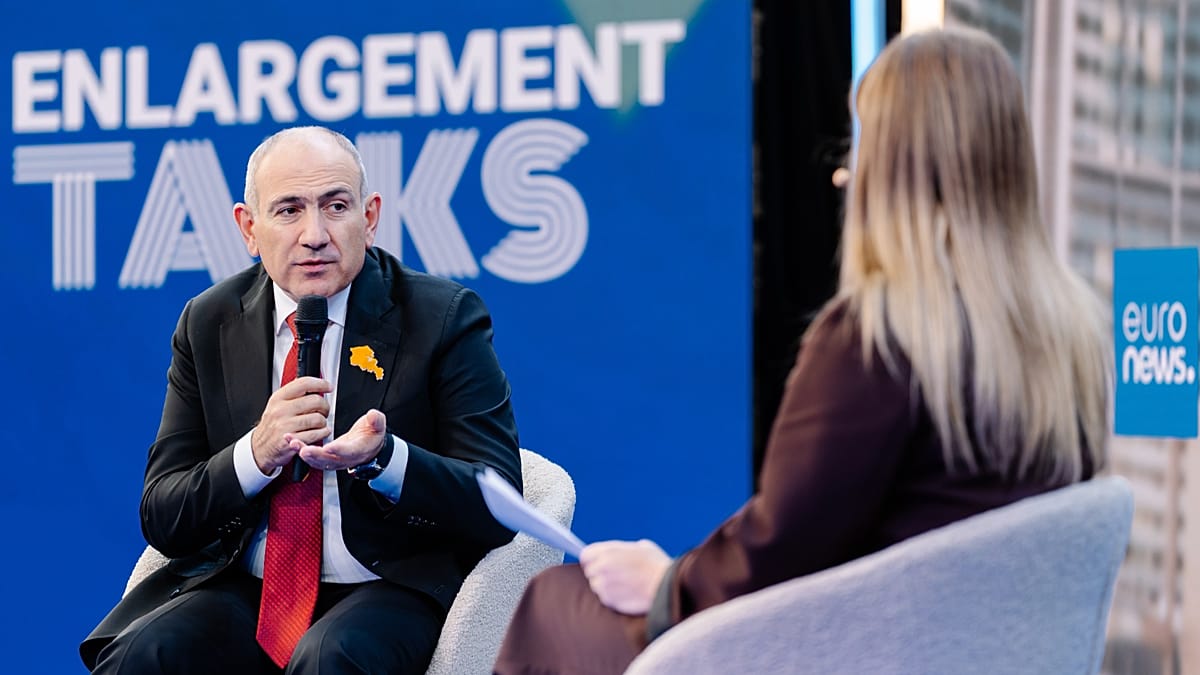
Armenian Prime Minister Nikol Pashinyan has argued that the South Caucasus is on the cusp of a "totally new global role," driven by peace efforts and the region's potential to ease global supply chain pressures. Speaking at Euronews' Enlargement Summit on Tuesday, Pashinyan framed the current moment as a historic opportunity for Armenia, Georgia, and Azerbaijan to cooperate on infrastructure and trade, despite their differences.
"The South Caucasus is a region with differences, but with common interests and there can be common views and strategies as well," Pashinyan said. He pointed to the ongoing peace process between Armenia and Azerbaijan, alongside trilateral cooperation with Georgia, as the foundation for opening up regional connectivity. That, he argued, could help address the global supply chain crisis that has disrupted trade since the pandemic and the war in Ukraine.
A new trade corridor
Pashinyan highlighted the growing importance of Central Asia and the so-called TRIPP corridor—short for Trump Route for International Peace and Prosperity—as a potential new global trade artery. "We are in the process of establishing a new global trade route for all countries, especially for the European Union, for China, for the Middle East, for Africa," he told Euronews. The corridor would link the Caspian and Black Sea regions, passing through the South Caucasus, and could offer an alternative to existing chokepoints.
The idea has gained traction as Western nations seek to diversify supply chains away from Russia and the Suez Canal. For the EU, a stable South Caucasus would provide a shorter overland route to Central Asia and beyond. However, the plan's viability depends on a lasting peace between Yerevan and Baku, as well as on the unresolved status of the Zangezur corridor, which would connect Azerbaijan to its exclave of Nakhchivan through Armenian territory.
Balancing act with Russia
Pashinyan also addressed Armenia's delicate foreign policy balancing act. Yerevan remains a member of the Russia-led Eurasian Economic Union (EAEU), but has increasingly signaled its European aspirations. "If there is no balance in any relations, there is always a risk, and the process of balancing our foreign relations is a process of managing those risks," he said.
He acknowledged the inherent contradiction: "We know that it is not possible to be a member of the European Union and the Eurasian Economic Union simultaneously and I made it public that we understand that." Still, he insisted that the ultimate decision rests with the Armenian people. "Democracy is a strategy for us and we want our people to have the opportunity to make the democratic choice," he added, noting that the government is working to create a real alternative for citizens.
Pashinyan's cautious tone reflects the political realities at home and the region's dependence on Russian security guarantees, despite growing public frustration with Moscow's role. Armenia has also faced pressure from Brussels to distance itself from the Kremlin, but any abrupt break could have severe economic consequences.
EU membership on the horizon
Pashinyan reiterated that Armenia could formally apply for EU membership in 2027 or 2028. He pointed out that both Turkey and Georgia are already EU candidate countries, which he called "an asset, a benefit for our European policy." "Hopefully Armenia will be the third candidate country in our region," he said.
However, he acknowledged that the EU is unlikely to accept a country with an unresolved conflict. "Looking at what is going on in the world it is very important now to institutionalise the agreement between Armenia and Azerbaijan, so now we need to sign the peace agreement and ratify it," Pashinyan said. He described the peace process as having "turned into reality on the ground," with a real chance for lasting stability.
The prime minister also touched on Armenia's complex neighbourhood. Relations with Turkey remain fraught, while ties with Georgia and Iran are strong, though the latter are constrained by international sanctions. "We have complicated relations or no relations with Turkey and we have always had very good relations with Georgia, with Iran," he explained.
For the EU, Armenia's pivot is a test of its enlargement policy in the South Caucasus. The bloc has so far been cautious, but the prospect of a peaceful, connected region is strategically attractive. As Pashinyan put it, the South Caucasus could become a bridge between Europe and Asia—if the political will holds.