From missile strikes on commercial vessels in the Red Sea to Russia's increasingly bold attacks on maritime traffic in the Black Sea, the world's key shipping lanes have once again become flashpoints. In response, Europe is scrambling to strengthen its naval presence and reduce its reliance on the United States for security.
France, with the second-largest exclusive economic zone on the planet, is at the forefront of this effort. This week, international delegations gathered near Paris for Euronaval, the world's largest naval defense exhibition, running from 3 to 6 November. The show has become a platform for Paris to display its growing maritime arsenal and its ambitions for European strategic autonomy.
France's naval buildup
Speaking at the opening of Euronaval, French Defence Minister Catherine Vautrin outlined the country's ambitious procurement plans. "We are renewing our attack submarines, frigates, and support vessels," she said. "We are preparing for our future aircraft carrier, the France Libre, and the SNLE 3G, the third-generation nuclear-powered ballistic missile submarine that will replace the current fleet responsible for our continuous at-sea deterrence."
France is the only European nation to operate a nuclear-powered aircraft carrier, the Charles de Gaulle, and it maintains one of the continent's most balanced submarine fleets. It is also the world's second-largest arms exporter, trailing only the United States.
In March, President Emmanuel Macron delivered a landmark speech from a submarine base in Brittany, vowing to increase France's nuclear warhead stockpile for the first time since 1992 and warning that he would not hesitate to defend the country's "vital interests." The speech was widely seen as a signal of France's determination to act as Europe's security anchor.
Since September 2025, French authorities have stepped up efforts to disrupt Russia's shadow fleet, which Moscow uses to circumvent Western sanctions on its energy exports. At least six tankers suspected of belonging to the fleet have been intercepted and boarded, amid concerns over irregular flag registrations and fraudulent documentation.
Drones and European industry
This year's Euronaval has placed a heavy emphasis on unmanned and autonomous naval systems. On Tuesday, the French government signed an agreement to build a domestic ecosystem of drone manufacturers that can quickly respond to the navy's operational needs.
"One of the major revolutions of our time is the naval drone," said François Watteau, director of the Naval Combat Programme Management Unit at the French Directorate General of Armaments (DGA). "It incorporates artificial intelligence and allows us to achieve more at a lower cost and over a greater distance."
France prioritises domestic and European companies in its defense procurement, with 92% of the Ministry of the Armed Forces' suppliers based in France in 2024. According to Watteau, the country has "always had a strong navy," but it has been significantly bolstered over the past year thanks to the military programming law for 2024–2030 and a renewed national interest in naval equipment.
Vice-Admiral Éric Chaperon, now naval advisor to Thales, told Euronews that this year marks a strategic turning point. "In previous years, we would showcase new products and technologies that we were working on, but which were still some way off. Given the current geopolitical context, however, it is clear that navies have become much more focused on the near future and what can be delivered immediately."
Thales, a major French defense and technology group in which the state holds a stake, has extensive contracts with the armed forces and European defense programs. But not everyone is happy with the dominance of established players.
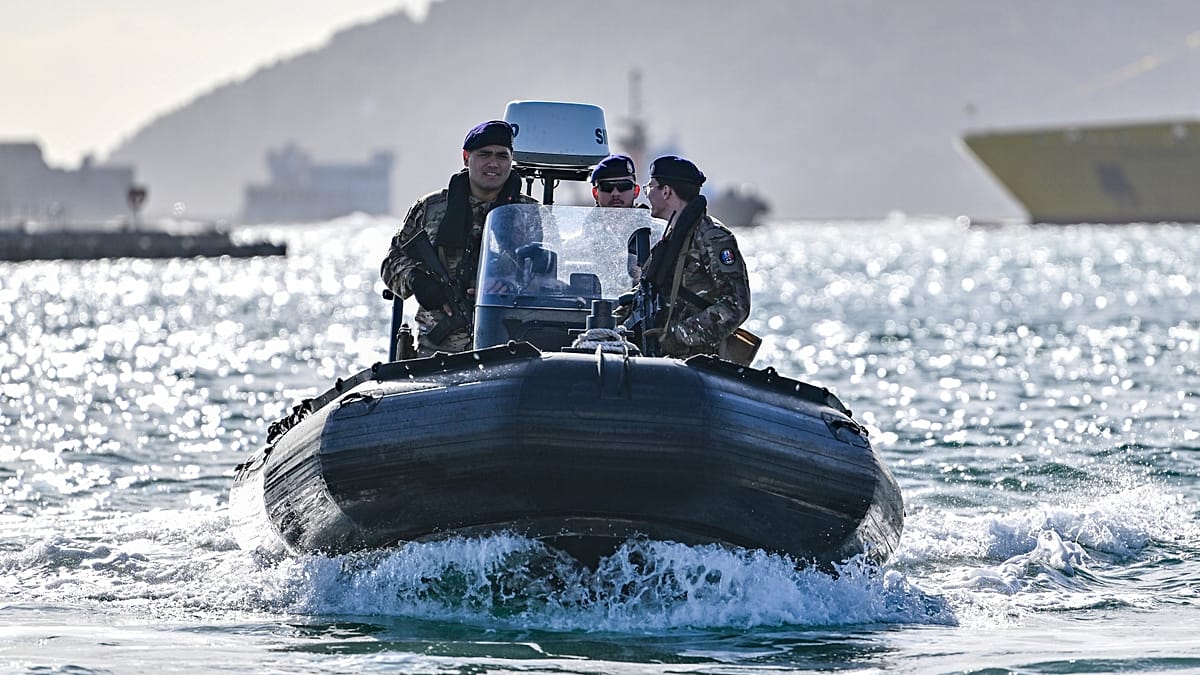
"There are favoured companies, the industry leaders, the big players such as Naval Group and Thales in France," said Martin Serrault, director general of Sillinger, a French manufacturer of inflatable boats for defense. "These major companies employ thousands of people and tend to capture most of the market."
The future of France's defense plans will be shaped by the upcoming presidential election. The government has proposed raising the 2027 defense budget to €63.4 billion, an increase of about €6.5 billion (11.4%) compared with 2026. Several presidential candidates are expected to visit Euronaval, including left-winger Raphaël Glucksmann on Wednesday and conservative figures Édouard Philippe and Bruno Retailleau, as well as far-right leader Marine Le Pen, on Thursday.
As Europe faces a more volatile maritime environment, France's push for naval strength is not just about national defense. It is a bid to build a credible European pillar within NATO and to ensure that the continent can protect its own interests, whether in the Red Sea, the Black Sea, or the waters off its own coasts.