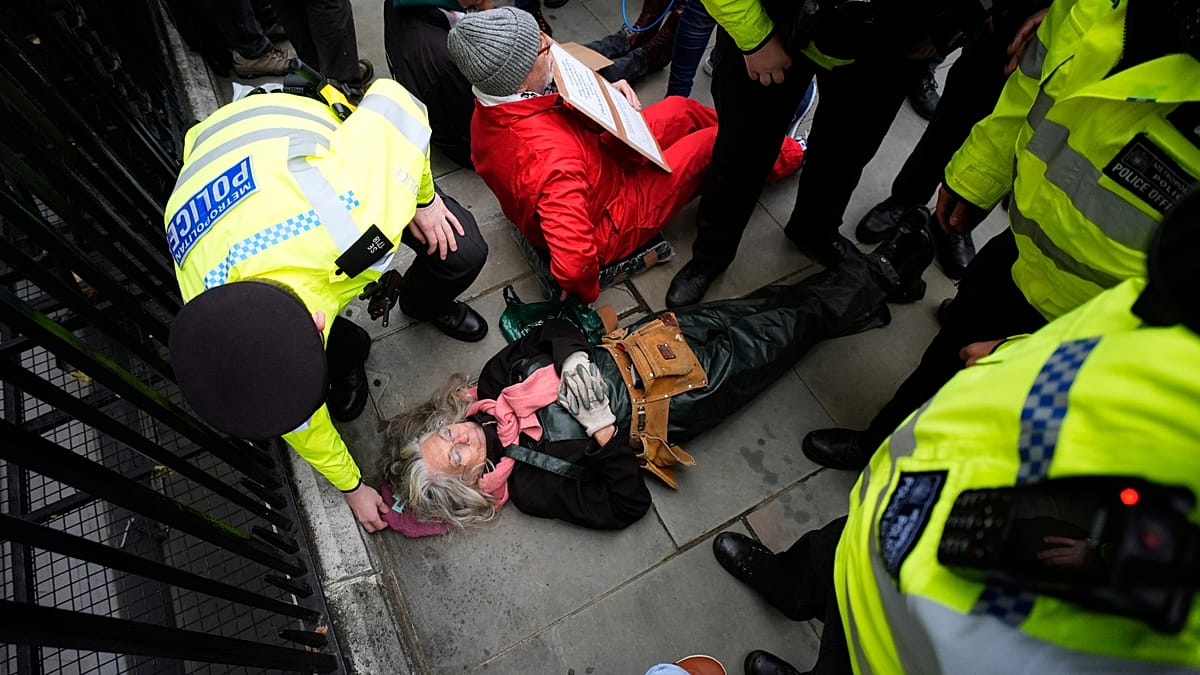
London's Metropolitan Police arrested supporters of the activist group Palestine Action outside the UK Supreme Court on Wednesday, as the country's highest court resumed hearings on the legality of the government's ban on the organisation.
The arrests took place in the morning outside the court building in Parliament Square, where a small but vocal crowd had gathered to protest the ban. Officers moved in after warnings to disperse, detaining several individuals without immediate explanation. The Metropolitan Police later confirmed the arrests, saying they were made to prevent a breach of the peace.
Legal challenge to the ban
The Supreme Court is reviewing a government order that designates Palestine Action as a terrorist organisation, a move that makes membership or support for the group a criminal offence. The ban was imposed under the Terrorism Act, following a series of direct actions by the group targeting arms companies and infrastructure linked to Israel's military operations.
Palestine Action has argued that the ban is disproportionate and infringes on the right to protest. Lawyers for the group have also questioned the evidence used to justify the designation, claiming it relies on a broad interpretation of what constitutes terrorism.
The case has drawn attention across Europe, where similar legal battles over protest rights and national security are playing out. In Poland, for instance, police actions at the constitutional tribunal have sparked debate about the limits of state power. The UK Supreme Court's ruling could set a precedent for how other European countries balance security concerns with civil liberties.
Police tactics under scrutiny
Wednesday's arrests are likely to intensify scrutiny of police tactics at protests. In recent months, UK authorities have faced criticism for using broad powers to detain activists, a trend also seen in other European capitals. In Madrid, police cleared a housing protest camp in Puerta del Sol, while in Lisbon, housing protests reached parliament amid similar concerns.
Legal experts note that the UK's approach to protest policing has become more assertive in recent years, with the introduction of new public order offences. The Supreme Court case could have implications beyond Palestine Action, affecting how future protest movements are treated under the law.
Palestine Action has vowed to continue its campaign regardless of the legal outcome. In a statement, the group said it would not be silenced by arrests or bans, and called on supporters to mobilise across the UK.
The Supreme Court is expected to deliver its judgment in the coming weeks. Until then, the ban remains in force, and police say they will continue to enforce it.
The case is one of several high-profile legal battles over protest rights in Europe. As governments grapple with security threats, the courts are increasingly being asked to define the boundaries of lawful dissent. The UK Supreme Court's decision will be closely watched by activists and lawmakers alike.