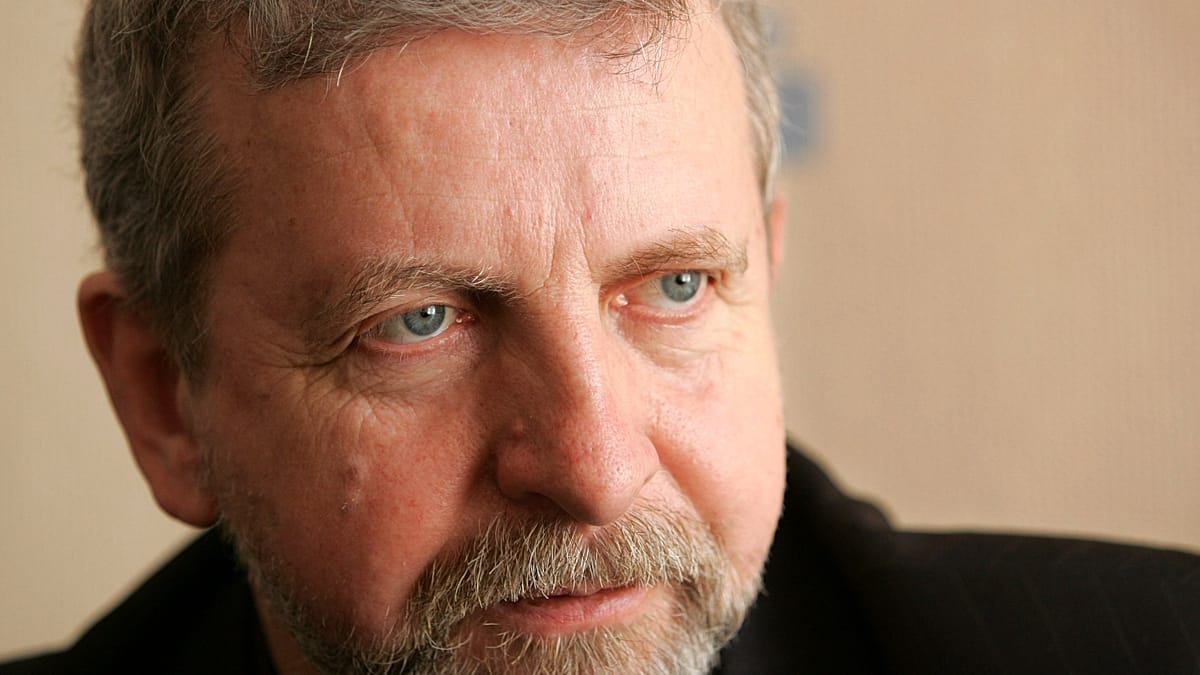
Aliaksandr Milinkevich, the physicist who became the face of Belarus's democratic opposition in the 2006 presidential election, has died at the age of 79. His death was announced on Tuesday, though no further details were immediately provided.
Milinkevich had been in fragile health since undergoing a complex operation to remove a blood clot from his carotid artery last year. He spent a prolonged period in critical condition and later underwent extensive rehabilitation.
From physics to politics
Born in 1947 in Grodno, Milinkevich initially pursued an academic career. After graduating from the faculty of physics and mathematics at the Grodno Pedagogical Institute, he taught at a local school before earning a PhD and becoming an associate professor at the same institution. He authored dozens of academic works on quantum electronics and laser technology, as well as on Belarusian culture and education.
As the Soviet Union collapsed, Milinkevich moved into public service, serving as deputy chair of the Grodno city executive committee from 1990 to 1996. In 2001, he managed the presidential campaign of Semyon Domash, and five years later he ran for president himself.
A pro-European challenger
In 2005, Milinkevich was chosen as the candidate of the united opposition democratic forces, running on a platform that emphasized a pro-European vision for Belarus. The campaign was marked by intense pressure from the authorities, including threats of criminal prosecution, disinformation in state media, and arrests of opposition activists.
According to official results, Lukashenka won with 83% of the vote, while Milinkevich received 6%. The United States and European governments questioned the credibility of the outcome, which handed Lukashenka a third term. That same year, Milinkevich received the European Parliament's Sakharov Prize for Freedom of Thought.
After the brutal crackdown on protests in Belarus in 2020, Milinkevich went into exile with his family. He became an adviser to opposition leader Sviatlana Tsikhanouskaya and founded the Free Belarusian University, based in Warsaw.
'Return to the European family'
Following the 2006 election, Milinkevich established the civic movement "For Freedom," which he led for a decade. The movement championed European values, civil society development, free and fair elections, and democratic rights.
"By our mentality, traditions, history, culture and language, we are Europeans. For me, it has never been a matter of choosing which way we should go, east or west. For me it has been about returning to the European family from which we were forcibly taken into an empire," he once said.
He saw the struggle as existential, warning that "the master of the Kremlin does not recognise as a nation not only Ukrainians, but us as well."
Tributes and legacy
Tsikhanouskaya expressed her condolences, writing on X: "A man of exceptional dignity, a kind soul and a brilliant mind, he was a true point of reference for many of us. For me, Aliaksandr was a source of support and wisdom, whose advice I always valued deeply." She added that his "devotion to Belarus, our language and culture, and his ability to unite and support people in the most difficult moments will remain with us."
European Parliament President Roberta Metsola also paid tribute, saying: "Aliaksandr Milinkevich dedicated his life to the fight for democracy in Belarus. His courage and legacy will stay with us. Europe continues to stand with the people of Belarus."
In a 2006 interview with Euronews, Milinkevich said: "The humiliation people feel when living in fear, the violation of their dignity — this, I believe, is the root cause of all Belarus's problems." Despite decades of repression, he maintained his optimism, especially after the 2020 protests. "We have experience, we had the fantastic year 2020, when everyone contributed to the Belarusian spirit and the desire to defend their 'self', truth, freedom. After 2020, I am an absolute optimist, because a completely different nation was born. People overcame their fear," he said.
Milinkevich's death comes as Belarus remains under Lukashenka's rule, with opposition figures in exile and civil society suppressed. His legacy as a unifying figure for democratic forces and a bridge to Europe will endure. For those following the region, his life story is a reminder of the ongoing struggle for freedom in Belarus, a cause that continues to resonate across the continent.