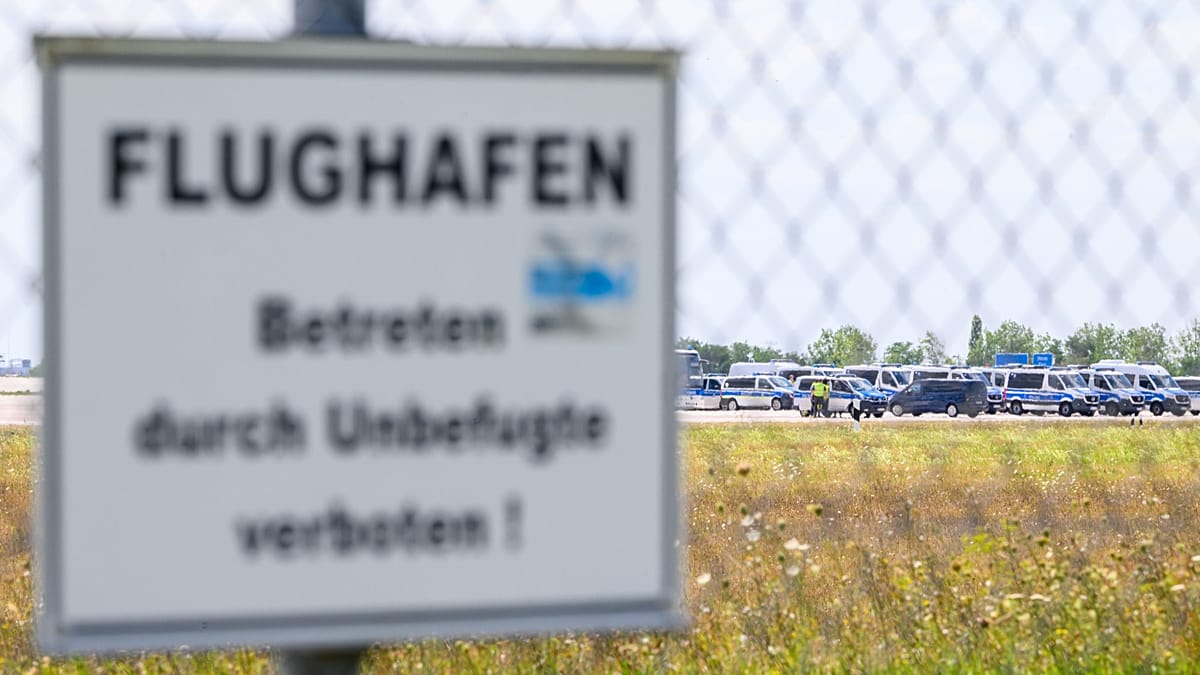
Berlin has formally accused Moscow of orchestrating an attempted drone attack on Leipzig/Halle Airport last month, a significant escalation in the ongoing confrontation between Germany and Russia over hybrid warfare.
Speaking at a press conference on Tuesday, German Interior Minister Alexander Dobrindt stated that the assessment of the incident "fits the known pattern of Russian hybrid operations in Europe." The airport, located in the eastern state of Saxony, is a crucial logistics hub for military supplies, used by the German armed forces, NATO allies, and Ukraine's Antonov Airlines.
The incident occurred on the night of 4-5 August, when security personnel discovered a drone carrying explosives near a Ukrainian cargo plane. Police deployed a robot to defuse the device. A second drone, also with traces of explosive material, was reportedly found weeks later in the vicinity of the airport.
Germany, a NATO member and one of Ukraine's staunchest supporters, has long accused Russia of waging a campaign of espionage and sabotage on its soil. The Kremlin has consistently denied these allegations. However, the Leipzig incident marks the first time Berlin has directly blamed Russia for an attack on critical infrastructure.
Diplomatic consequences
In response, German Foreign Minister Johann Wadephul announced on Tuesday the closure of Russia's consulate in Bonn and the Russian House of Science and Culture in Berlin. The latter, a seven-story building opened in 1984 in what was then East Berlin, sits near the Russian embassy and has long been suspected of being a hub for espionage.
Conservative lawmaker and security policy expert Roderich Kiesewetter told Welt TV that the facility is presumed to be a center for intelligence operations. He noted that more than 100 people live there "with no one knowing who they are," and that the building's power consumption is disproportionately high, suggesting it is "presumably filled with technical surveillance equipment" and used by "people who are not well-disposed toward Germany."
Chancellor Friedrich Merz had previously warned on 25 August that perpetrators of hybrid attacks against Germany would "pay for them," without naming a specific adversary. Berlin had initially refrained from pointing fingers, speaking only of the possible involvement of "foreign powers."
The incident comes amid a broader pattern of suspected Russian sabotage across Europe. In recent months, Germany has reported suspicious drone sightings over military and industrial sites, and a suspected rocket attack targeted a key substation in Brandenburg. The EU has been grappling with how to respond to these threats, with EU ministers in Ireland confronting drone threats and other hybrid challenges.
Speaking after a meeting of EU defence ministers in Ireland on Tuesday, the bloc's top diplomat, Kaja Kallas, said Moscow was escalating its "kinetic hybrid attacks" against Europe. "With this, Russia wants to scare us away from supporting Ukraine. They will not succeed," she said. "We will increase our support to Ukraine and invest in our own defence." She added that the EU was "planning the most far-reaching sanctions against Russia yet."
The closure of the Russian cultural center is a symbolic but potent move, reflecting Berlin's determination to push back against what it sees as a sustained campaign of interference. The building, a landmark in the German capital, has been a point of contention for years, with critics calling for its closure due to its alleged intelligence role.
Germany's actions are likely to be watched closely by other European nations, many of which have faced similar hybrid threats. The EU has been working on closing defence gaps and has discussed tapping frozen Russian assets to support Ukraine, a proposal championed by Sweden. The Leipzig incident may accelerate these efforts, as European leaders seek to counter Russian aggression without escalating into open conflict.