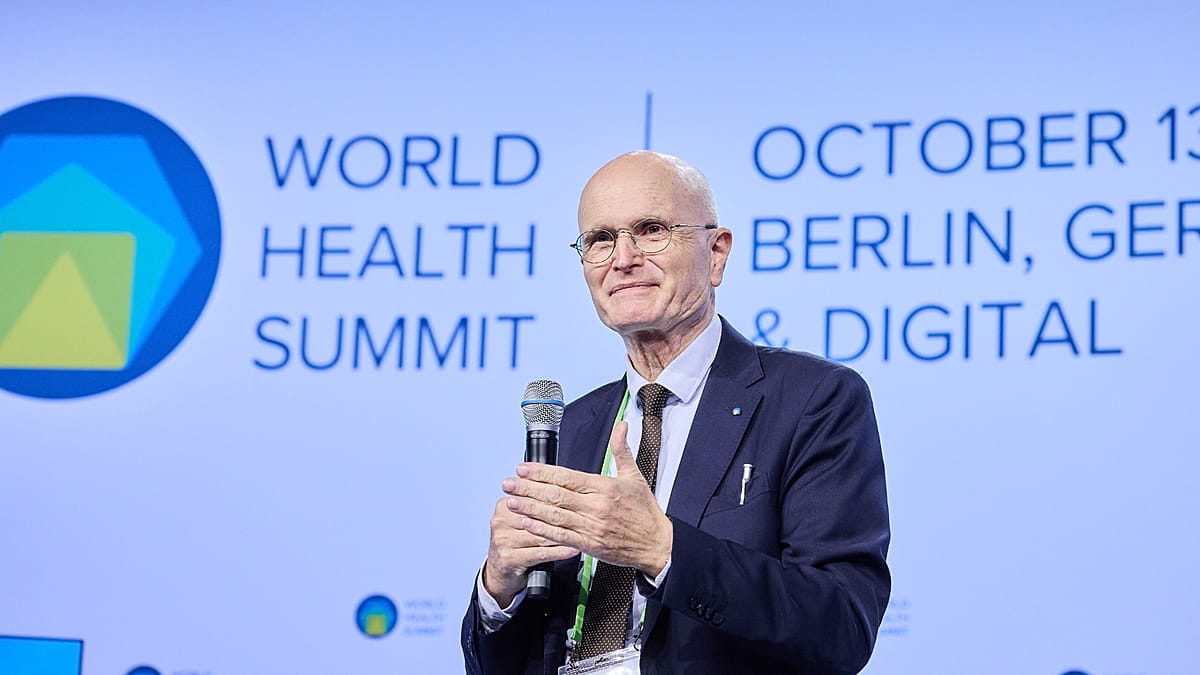
In a world marked by overlapping crises, global health must be treated as a collective endeavour rather than a national pursuit, according to Professor Axel R. Pries, president of the World Health Summit (WHS) in Berlin. Speaking to Euronews, Pries, a physician and former dean at Charité, stressed that no country can tackle health threats alone and that multilateral mechanisms need urgent revitalisation.
A 'political virus' undermining cooperation
At the WHS Regional Meeting in Nairobi in April, Pries warned of a 'political virus' – a growing tendency among nations to view health through a narrow, nationalist lens. He described this as a pandemic in itself, spreading across all regions and obstructing effective solutions. While local responses remain essential, he argued, they must be coordinated globally. The COVID-19 pandemic demonstrated that purely local approaches are insufficient, a lesson that applies equally to mental health and non-communicable diseases.
Pries called for a revival of multilateral frameworks, noting that the partial withdrawal of the United States from global health policy has created a vacuum. Europe, he believes, is well placed to help fill it – not as a single leader, but as one of several leading actors.
Europe's strengths and responsibilities
Europe's credentials are strong, Pries argued. The continent is a hub for medical innovation, from research to application, as evidenced by the recent Nobel Prize in Physiology or Medicine awarded to researchers in Berlin and Würzburg for their work on optogenetics. Major European companies in medical technology and pharmaceuticals further bolster the case. Moreover, Europe's experience in fostering cooperation among countries with diverse political and social systems offers valuable lessons for international collaboration.
Germany, as Europe's largest economy, can send signals and assume a certain leadership role, particularly in the medical sector. Yet Pries cautioned that Germany can only succeed as part of a wider ensemble, working on equal footing with partners such as France and the United Kingdom. He pointed to Denmark's Novo Nordisk as an example of a European company that, together with others, can shape global markets.
Strategic dependencies and the need for speed
Pries warned that failure to agree on common strategies now would have severe consequences. Europe's diversity, while a source of richness, can slow joint responses to threats. He urged the continent to act decisively to avoid strategic dependencies in the health sector, which would be costly to correct later.
In Germany, plans for a Health Security Act – a draft is expected in early 2027 – are a step in the right direction, Pries said, provided they aim to bolster resilience against global health crises. However, he stressed that such legislation must be embedded in a multilateral framework. The COVID-19 pandemic showed that when countries hoard critical goods, the entire supply chain collapses. No nation can produce medicines or vaccines entirely on its own; it is an international network. Ideally, these efforts would unfold under the umbrella of the United Nations and the World Health Organization.
Scepticism over bilateral data deals
On the proposal of bilateral agreements exchanging health data for development aid, Pries expressed deep scepticism. He cited the 'America First Global Health Strategy' as a case in point, noting that its very name reveals a fundamental flaw: one cannot claim to be first while building genuine partnerships. Such agreements often exploit power imbalances rather than foster equality. When two partners sit at the table with vastly different leverage, a fair outcome is unlikely.
Pries's remarks come as Europe grapples with its role in a shifting global order. The continent's ability to act collectively – and quickly – will determine its influence in shaping a more resilient and equitable global health system. As the World Health Summit continues in Berlin, the message is clear: global health is a team sport, and Europe must decide whether it wants to play a leading role.