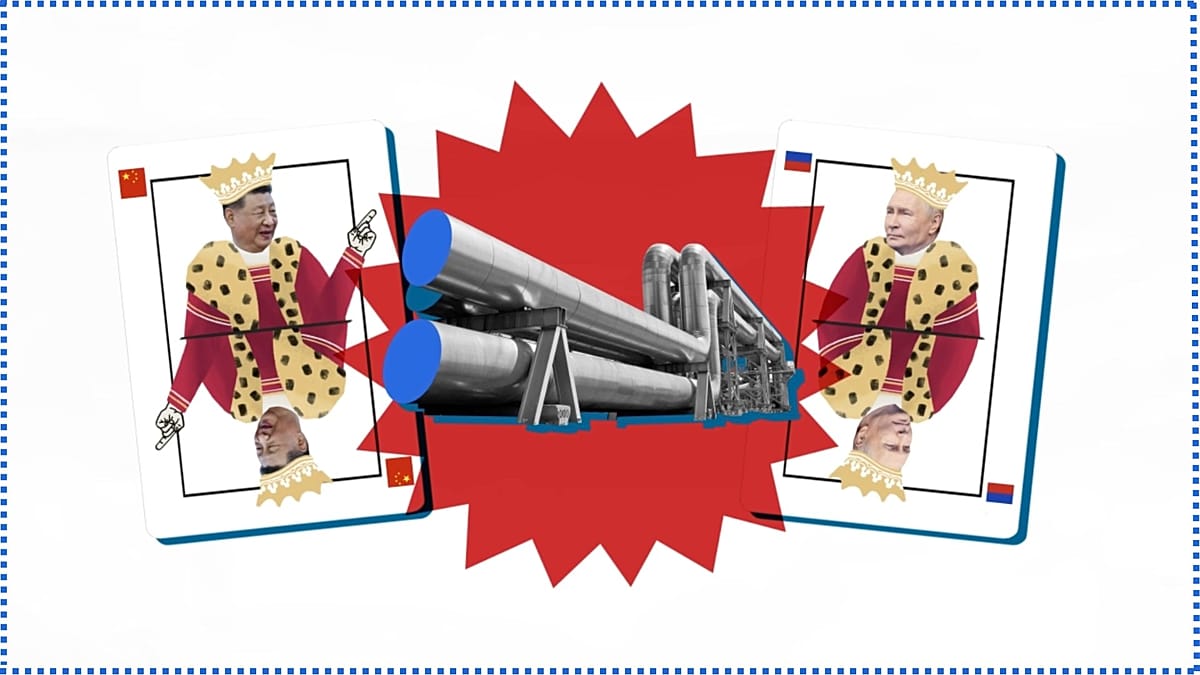
Less than a week after Donald Trump’s visit to Beijing, Vladimir Putin has touched down in the Chinese capital for a state meeting with Xi Jinping. The back-to-back visits are no coincidence. For European policymakers, the real story lies not in the official agenda but in the composition of the Russian delegation and the unspoken trade-offs being negotiated behind closed doors.
When Trump visited, he brought tech and finance executives. Putin’s entourage is far more telling: five deputy prime ministers, eight ministers, regional governors, and the head of Russia’s central bank. This is not a diplomatic courtesy call; it is a signal of structural dependency. Russia’s economy, battered by Western sanctions, now relies on China for industrial machinery, electronics, and cars. Bilateral trade has exceeded $200 billion for three consecutive years, and with major Russian banks cut off from SWIFT, settlements in Chinese yuan have surged from less than 2% in 2022 to an estimated 30–40% of Russia’s total trade.
What Beijing Wants in Return
China, for its part, is buying record volumes of discounted Russian oil—over 100 million tonnes annually. But Xi Jinping is pushing for more: the Power of Siberia 2 gas pipeline, a massive infrastructure project that would lock in cheap Russian energy for decades. The arithmetic is straightforward: Beijing wants raw materials at a discount, but it cannot afford to jeopardise its exports to the European Union, which remain a vital market. Any overt alignment with Moscow that triggers secondary sanctions would be costly.
Yet the visit is about more than energy. Among the delegation is Kirill Dmitriev, head of Russia’s Direct Investment Fund and the Kremlin’s key negotiator with Washington. His presence suggests Moscow hopes to use China’s diplomatic weight to find a way out of the war in Ukraine—a conflict that has already drawn intensified attacks on Ukrainian cities.
For Beijing, the Taiwan card is paramount. By demonstrating how close it can get to Moscow, China is pressuring the Trump administration to limit multi-billion-dollar arms sales to Taiwan. The message is clear: if Washington pushes too hard on Taiwan, Beijing can deepen its strategic embrace of Russia, complicating US global priorities.
Putin and Xi have met more than 40 times and openly call each other old friends. A hot mic last year caught them discussing living until 150. For Europe, the implication is sobering: this partnership is not a passing phase. The EU has struggled to formulate a unified stance toward the Moscow-Beijing axis, caught between escalating trade tensions with China and the need to manage energy dependencies and security threats from Russia.
If European leaders are waiting for Putin or Xi to retire, they may be waiting a very long time. The continent needs a coherent strategy—one that balances economic engagement with strategic deterrence, and that recognises the Moscow-Beijing relationship as a long-term structural challenge, not a temporary alignment of convenience.