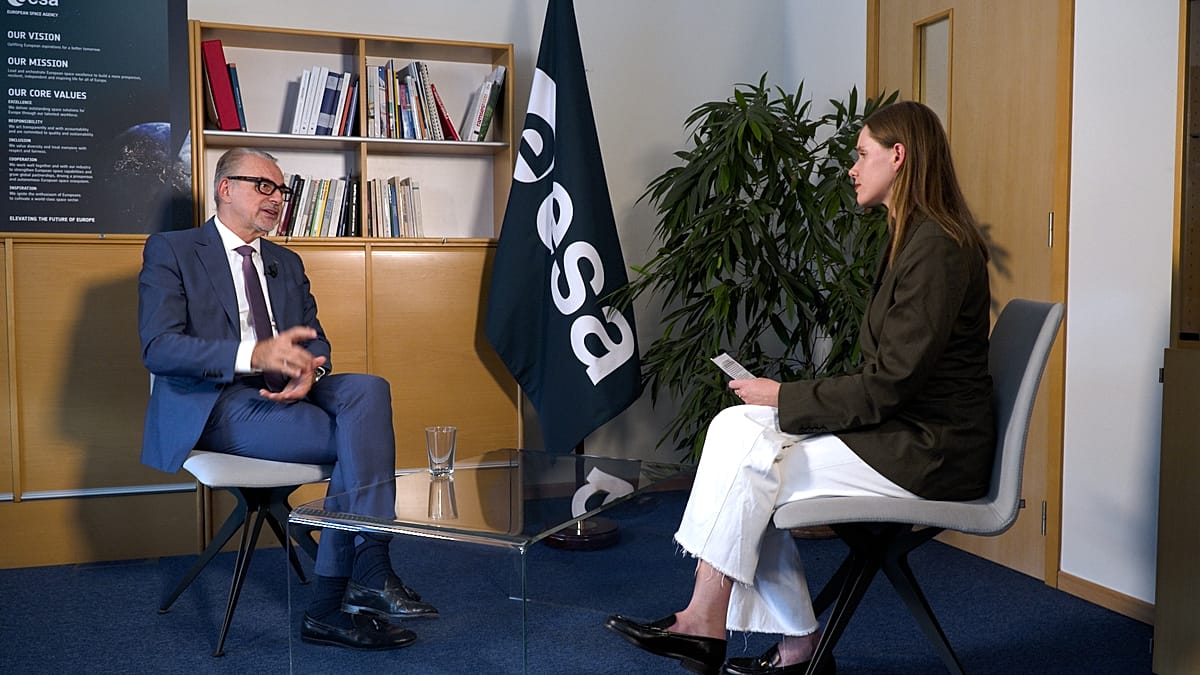
The destruction of a Blue Origin New Glenn rocket during an engine test at Cape Canaveral, Florida, has sent shockwaves through the global space industry. Josef Aschbacher, Director General of the European Space Agency (ESA), described the incident as a “huge setback” that harms everyone involved in space exploration.
Speaking on Euronews’ 12 Minutes With programme, Aschbacher said he was “saddened” and “concerned” by the images of the explosion, which occurred on 28 May 2026. Amazon founder Jeff Bezos, who owns Blue Origin, confirmed that no personnel were injured, but the damage to the launch pad and rocket infrastructure was extensive.
Impact on NASA’s Artemis Programme
The New Glenn rocket was expected to play a central role in NASA’s Artemis missions, which aim to return astronauts to the Moon. The Artemis II mission, a crewed lunar flyby, launched successfully in April 2026. The next step, Artemis III, was scheduled for 2027 and would involve testing two commercial lunar landers built by SpaceX and Blue Origin in low-Earth orbit.
Until the explosion, Blue Origin was considered the more advanced of the two contractors. Now, questions are mounting over whether the Artemis IV Moon landing — planned for 2028 — and the more ambitious goal of a permanent lunar base by 2032 remain achievable.
“You have seen the explosion. The launcher base, I think, is pretty much destroyed, something that will take quite some time to rebuild, but also to investigate the reason why this explosion happened,” Aschbacher explained. He noted that such incidents are particularly painful given the immense effort required to develop and test new rockets.
Europe’s Role in Lunar Infrastructure
Despite the setback, Aschbacher emphasised that ESA remains deeply integrated into NASA’s lunar plans. The agency is negotiating with NASA on contributions to a permanent Moon base, a concept he acknowledged may sound “a bit science fiction” but is becoming increasingly real.
“Infrastructure on the lunar surface — astronauts walking, driving rovers, taking measurements, extracting resources, even factories producing bricks for buildings — it will happen, but we are at the beginning of it,” he said.
ESA is already providing key technology for Artemis, including the European Service Module for the Orion capsule, the Argonaut lunar lander programme, and the Moonlight satellite constellation for telecommunications and navigation. These projects, funded since 2022, demonstrate Europe’s commitment to the broader lunar effort.
However, ESA’s future in the Artemis III mission was cast into doubt earlier this year when NASA paused development of the Lunar Gateway, a Moon-orbiting station that ESA was building. That decision cost the European space sector years of work and millions of euros.
When Will a European Walk on the Moon?
Aschbacher was cautious when asked about the timeline for European astronauts on the Moon. “That is a big question. I wish I could answer it,” he said. He confirmed that ESA is in intense discussions with NASA to secure crewed flight opportunities, but no agreement has been reached yet. “I hope before the end of the decade,” he added.
German ESA astronaut Alexander Gerst is widely considered a top candidate to become one of the first Europeans to set foot on the lunar surface, possibly during the Artemis IV mission.
The explosion at Cape Canaveral is a stark reminder of the risks inherent in space exploration. As Aschbacher put it, “This was only one of the very first flights, so it’s really in the ramp-up phase, and this is certainly something that concerns me.” For the global space community, the road to the Moon just got longer.
For more on international space cooperation, read our interview with former NASA astronaut Daniel Tani.



