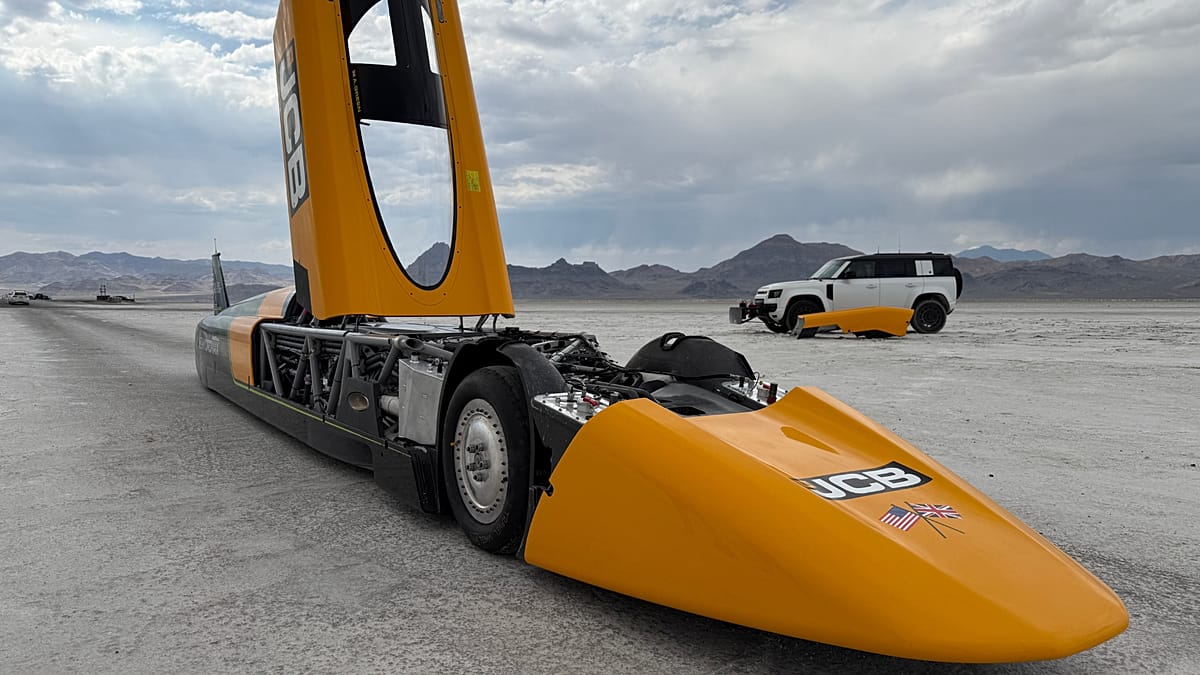
Retired Royal Air Force pilot Andy Green has added another chapter to his extraordinary career by setting a new world land speed record for a hydrogen-powered car. At the Bonneville Salt Flats in Utah, the 64-year-old drove the JCB Hydromax to an average speed of 653.908 km/h (406.320 mph) over two runs, a mark ratified by the FIA, motorsport's international governing body.
The previous hydrogen combustion record stood at 185.5 mph, set in 2004, meaning Green's achievement more than doubled that figure. The feat is the latest in a string of high-speed milestones for Green, who remains the only person to have broken the sound barrier in a car, a record he set in 1997 with the jet-powered ThrustSSC at 763 mph.
The JCB Hydromax is a 9.75-metre machine built by the British construction equipment manufacturer JCB. It is powered by two hydrogen internal combustion engines that together produce 1,600 horsepower. These engines are adapted from those used in JCB's construction machinery, and they operate by mixing pressurised hydrogen gas with air and igniting the mixture to generate power.
Speaking after the run, Green emphasised the environmental appeal of the technology: "You burn hydrogen, water comes out of the exhaust. It doesn't get any cleaner than that."
Hydrogen's industrial promise
JCB hopes the record will bolster the case for hydrogen as a viable fuel in heavy industry, where battery electric solutions are often impractical due to weight and charging constraints. The company has been developing hydrogen combustion engines for its excavators and loaders, arguing that they offer a practical path to decarbonisation for construction sites across Europe and beyond.
However, the environmental credentials of hydrogen depend heavily on how it is produced. The vast majority of hydrogen currently comes from fossil fuels, typically natural gas, in a process that releases carbon dioxide. So-called green hydrogen, produced via electrolysis powered by renewable energy, remains a tiny fraction of global production. JCB has contracted to buy green hydrogen for its demonstration projects, but scaling that supply remains a significant challenge.
The record comes at a time when Europe is grappling with how to decarbonise sectors that are hard to electrify. The European Union's hydrogen strategy, launched in 2020, aims to install 40 gigawatts of electrolyser capacity by 2030, but progress has been slow. Meanwhile, other regions, including the UK, are also investing in hydrogen infrastructure, though critics point to the high costs and energy losses compared to direct electrification.
Green's achievement is a reminder of the engineering potential of hydrogen combustion, but it also highlights the gap between a record-breaking prototype and the everyday realities of industrial decarbonisation. As JCB's chairman, Lord Bamford, noted, the project is about demonstrating what is possible: "We want to show that hydrogen can be a practical, clean fuel for the machines that build our world."
The Bonneville Salt Flats, where the record was set, have long been a testing ground for speed records, but they are also a site of environmental concern. The flats have been shrinking due to salt mining and drought, a reminder of the broader climate pressures facing such landscapes. In Europe, similar concerns are playing out, with record-low river levels disrupting shipping and exposing historical artefacts, as seen recently on the Danube.
For Green, the record is another milestone in a career defined by pushing boundaries. His 1997 sound barrier run in the Nevada desert remains a landmark in automotive history, and his 2006 diesel record at Bonneville was equally impressive. Now, with the Hydromax, he has shown that hydrogen can deliver extreme performance, even if the path to widespread adoption remains long.
As Europe debates its energy future, the JCB project offers a tangible example of how hydrogen could fit into the mix. Whether it will become a mainstream solution for heavy industry or remain a niche technology is still an open question. But for now, the record stands as a testament to British engineering and the enduring appeal of speed.