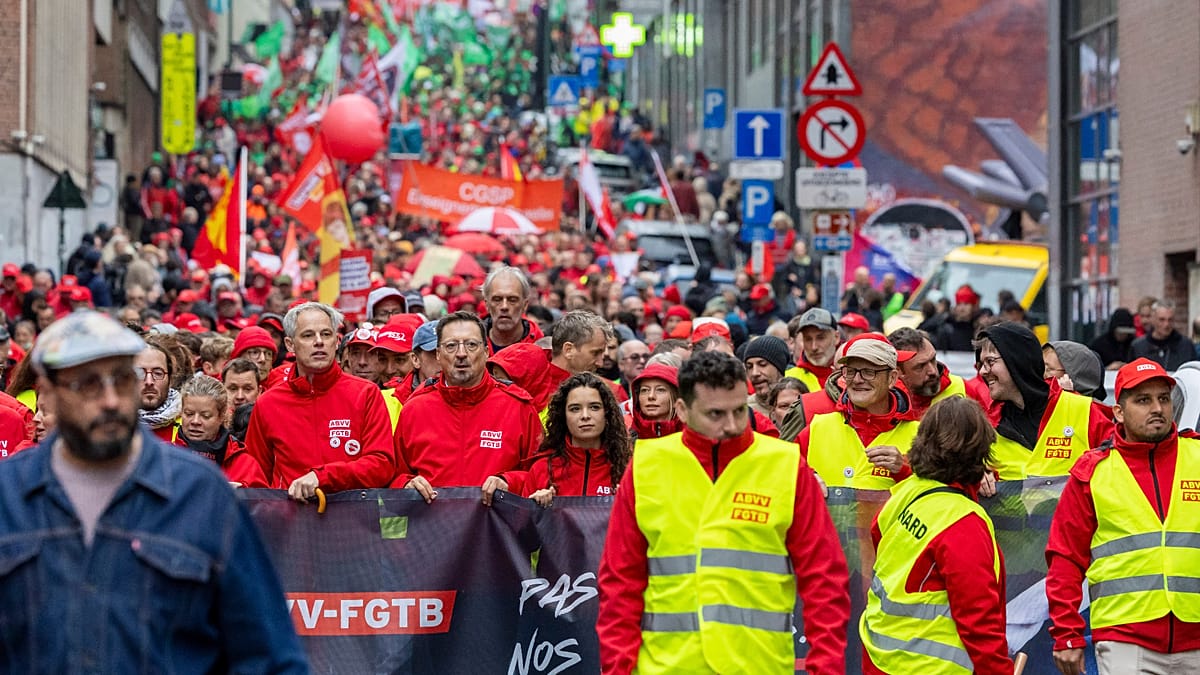
Brussels saw a day of high tension on Friday as a large anti-austerity protest turned violent on the fringes, with police deploying water cannons and tear gas against masked youths who threw rocks and firecrackers. The clashes came as tens of thousands of workers and supporters marched through the Belgian capital to oppose the government's budget-cutting plans.
Police estimated that some 30,000 people took part in the national strike, called by trade unions to pressure the coalition government of Prime Minister Bart De Wever. The demonstration followed a week of student protests in Liège, where authorities imposed a ban on public gatherings after clashes with police and vandalism. More than 200 people were arrested in Liège, and dozens of officers were injured.
In Brussels, the violence erupted near the central railway station, where a group of protesters, many dressed in black and wearing masks, set fire to a pile of city bikes and electric scooters. Riot police responded with water cannons and tear gas, pushing the crowd back. The scenes were chaotic but remained contained to the edges of the main march, which passed off peacefully.
Unions disown the rioters
Union leaders were quick to distance themselves from the troublemakers. "They have nothing to do with our rally," said Luc Toussaint, a union representative. "Things are getting worse at an ever-faster rate; people have had enough. Like the teachers, the pupils can also see that conditions are deteriorating."
The protest was the latest in a series of strikes against the government's efforts to save €10 billion over the next few years to reduce Belgium's high public deficit. The country, like its neighbours France and Italy, is struggling with heavy public debt. The government has proposed cuts in areas such as health and education, as well as a rise in VAT, which unions say will hit the poorest hardest.
Marie Gobert, a single mother and social worker from Namur, came to the march with her daughter. "I work, but I cannot make ends meet," she said. "School costs have just gone up, and so have public transport and train tickets. I don't think I've ever been this anxious about all the measures making my daily life difficult."
The protest also drew inspiration from student demonstrations in France, where high-school pupils have been protesting against education budget cuts. In Brussels, students from the French-speaking community have been holding their own rallies, echoing the protests in Paris and other French cities.
Prime Minister De Wever, a Flemish conservative, is locked in protracted negotiations with his coalition partners to finalise the budget by 13 October. The talks have been difficult, with unions pushing for higher taxes on the wealthiest Belgians instead of spending cuts. "You can feel the social tension; you can feel anger starting to simmer everywhere," Gobert said. "The education system is being dismantled, and when young people want to speak out, no one listens to them."
The violence in Brussels is likely to intensify the debate over protest policing, a topic that has already sparked controversy in France, where some MEPs have argued that police, not students, drive most protest violence. The Belgian authorities have not yet commented on the tactics used on Friday.
As the government races to meet its deadline, the social unrest shows no sign of abating. The unions have vowed to continue their actions if the budget does not shift towards taxing the rich. With the country's debt burden weighing heavily, the coming weeks will test both the government's resolve and the patience of a population that feels increasingly squeezed.