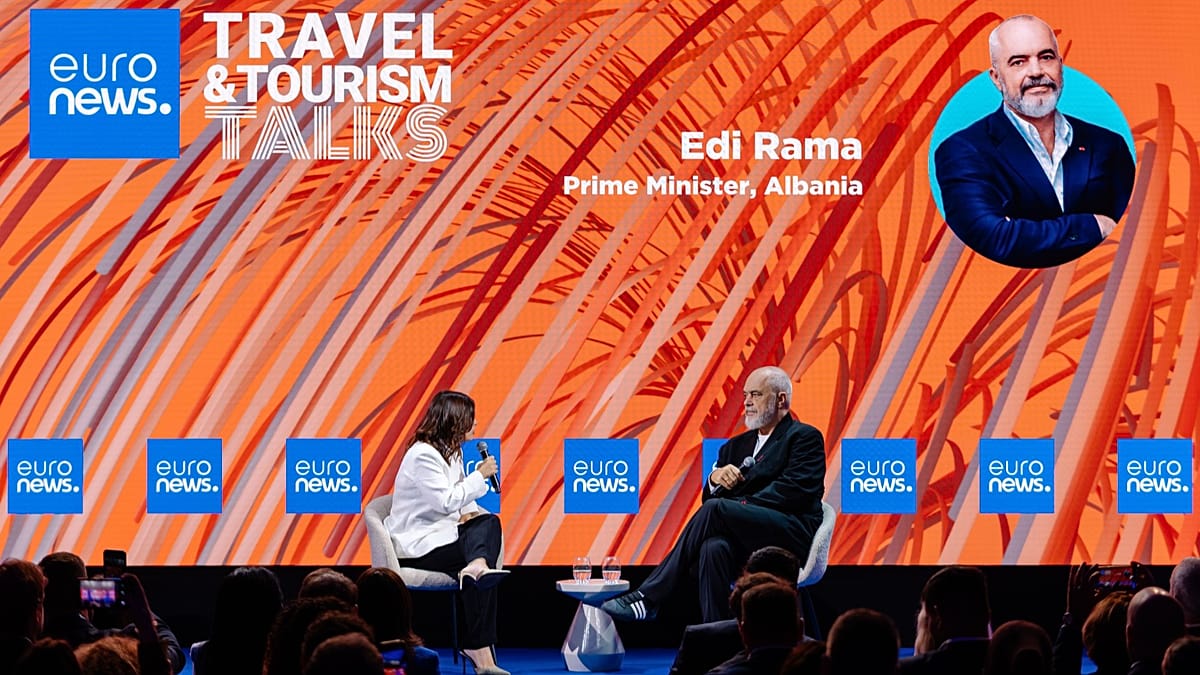
Tourism ministers, industry executives and European policymakers gathered in Brussels on 29 September for a one-day summit hosted by Euronews, where the conversation ranged from Albania's rapid rise as a destination to the mounting costs of a warming climate. Here are the five threads that mattered most.
Albania's prime minister: from isolation to 'shining jewel'
In a candid on-stage exchange with Euronews' Maria Tadeo, Albanian Prime Minister Edi Rama described how his country has transformed its image over the past decade. He recalled that Albania was once likened to the North Korea of Europe — a comparison he used to underline how far the country has travelled.
"We are not the Black Hole of Europe — we are the shining little jewel of Europe," Rama said, adding that while neighbours such as Croatia had a head start in building a tourism economy, "now it is our turn."
The focus, he said, has shifted toward attracting higher-spending visitors. Waldorf Astoria and Aman are both preparing properties in Albania, and Dubai's Atlantis brand has chosen the country for its first European outpost. Rama also addressed the controversy surrounding a resort project on Sazan Island and Zvërnec backed by Jared Kushner, promising that documentation would be released in the coming weeks amid continuing protests.
Climate change named the sector's biggest threat
Eduardo Santander, chief executive of the European Travel Commission, told Euronews' Mared Gwyn-Jones that the summer's extreme weather had exposed how exposed the industry is. "Climate change is the biggest threat to tourism right now, by far," he said, pointing to trains halted by buckling rails and cruise ships unable to navigate dried-up European rivers.
He called for a far more coordinated response, warning that the disruption is not only logistical. "Travelling is becoming much more expensive, and you all have travelled this summer, I guess, and you notice it in your pockets," Santander said. The commission has repeatedly flagged the link between a warming planet and rising costs for holidaymakers, a theme explored further in its assessment of climate risk to tourism.
Central Europe pitches itself as a single destination
Olivér Csendes, president of the Hungarian Tourism Agency, appeared alongside Sandrine Buffenoir of Atout France to argue that the region's future lies in cross-border cooperation. "I would love to see more international collaborations where we position the way we live and our regions, basically as one destination," he said. "We don't have to limit our thinking and the creation of experience spaces to national borders."
The approach fits a region where two or three capitals sit within 100 kilometres of one another, making multi-country itineraries — sometimes dubbed "trip-maxxing" — a natural draw for visitors.
Global Entry fast-track for Belgian citizens
US Ambassador to Belgium Bill White told host Jane Witherspoon that Washington is working to extend Global Entry to Belgian citizens, possibly before the end of the year or in early 2026. The programme allows pre-approved, low-risk travellers expedited processing on arrival in the United States.
"We're working with the Belgian government to get the paperwork in order. The Minister of Foreign Affairs, Maxime Prévot, is personally leading this effort," White said. Improved airport experiences on both sides of the Atlantic, he added, are central to boosting two-way travel.
Infrastructure gap holds back quieter destinations
On a panel about managing visitor flows, MEP Daniel Attard stressed that investment in rail links and airport capacity is a precondition for spreading tourism beyond overcrowded hotspots. Many of the lesser-known places that would benefit most from visitor spending currently lack the connections to bring people in — a gap that, if closed, could ease pressure on the continent's most congested cities.
The summit's underlying message was that Europe's tourism boom is real but fragile, exposed to climate shocks, infrastructure shortfalls and shifting geopolitical currents. How the industry responds will shape not just where Europeans travel, but how their economies and communities absorb the crowds.