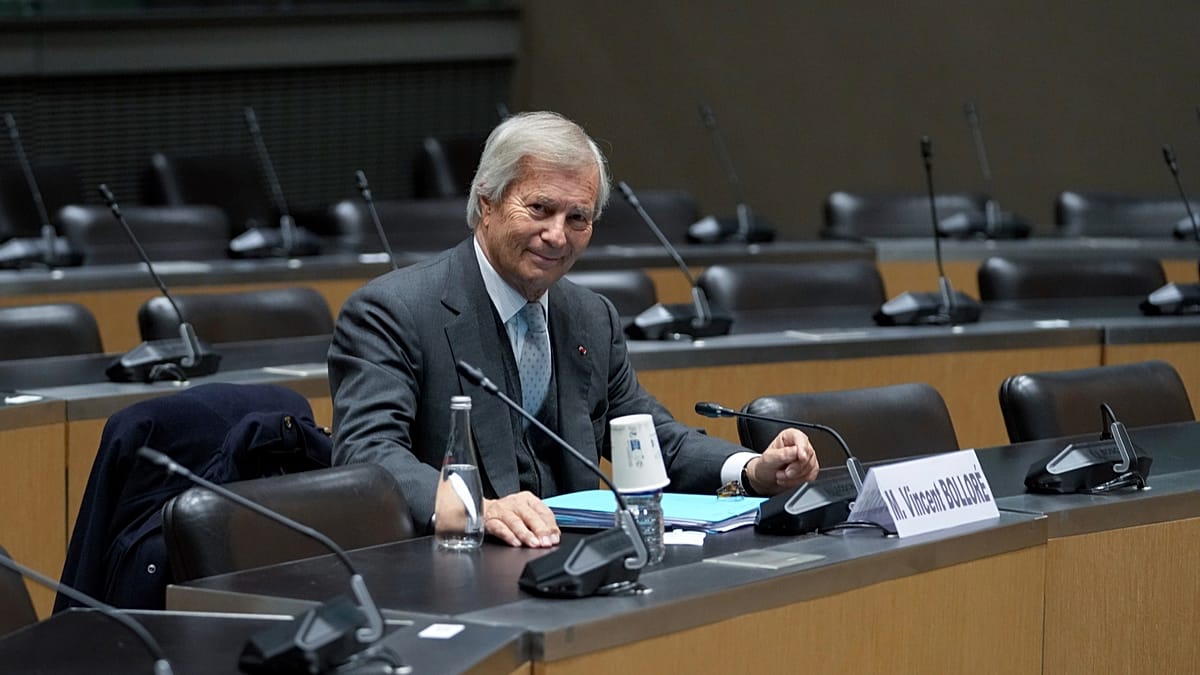
Just before the Cannes Festival in May, a petition signed by more than 600 French film professionals shook the country's cinema industry. The petition, initiated by the collective "Zapper Bolloré," protested the increasing influence of conservative businessman Vincent Bolloré on French media. Since then, the petition has gathered nearly 3,500 signatures, including those of Hollywood stars Javier Bardem and Ken Loach, as well as French actresses Adèle Haenel and Juliette Binoche.
The petition, published in the French newspaper Libération, accuses Bolloré of using his media empire to promote far-right ideas. It warns that "by leaving French cinema in the hands of a far-right figure, we risk not only a homogenisation of films, but also a fascist grip on the collective imagination." Bolloré, 74, is the largest stakeholder of Canal+, France's biggest film producer. In 2025, Canal+ acquired a 34% stake in the UGC cinema chain and signaled its intention to pursue a full takeover by 2028.
Threats from Canal+ Leadership
In response to the petition, Maxime Saada, CEO of Canal+, stated at a Cannes event for film producers on 17 May that he would no longer work with signatories. "I experienced that petition as an injustice toward the Canal+ teams, who are committed to defending the independence of Canal+ and the full diversity of its choices," Saada said. "I will no longer work with, and I no longer want Canal to work with the people who signed that petition." Euronews contacted Canal+ for comment on whether these threats would be carried out, but representatives declined to respond.
Many industry professionals and commentators view Saada's comments as a boycott threat that could violate freedom of speech. Socialist deputy Céline Hervieu accused Bolloré in the National Assembly of "quashing freedom of speech and of creativity." French actress Adèle Exarchopoulos remarked, "you cannot be afraid of losing your job simply for expressing a collective concern."
Legal Analysis: Free Speech vs. Discrimination
Yann Personnic, a Paris-based lawyer specializing in media and intellectual property law, told Euronews that the signatories exercised their right to free speech. However, he noted that Saada's comments are not a direct violation of French free speech laws, as the CEO is also entitled to speak freely. The legal question arises if Saada follows through with his threat. "This would come into conflict with certain legal principles, notably non-discrimination in the workplace," Personnic said. "One cannot discriminate against people or refuse to work with them based on their political opinions. If a distinction was made on this basis between two possible collaborators — disrupting a possible economic partnership — this could constitute a legal offence."
Personnic explained that this principle applies to both employees under employment law and independent producers with whom contracts could be signed. However, proving discrimination in court would be difficult. "If the Canal+ group says 'I do not want to work with you because you signed that open letter,' that is obviously reprehensible; but if it says 'I will not work with you, I will not take part in this film for such-and-such artistic or financial reasons' – reasons that are specific to it but legitimate – then that cannot be held against them," he said. "In practice, we could not put forward non-discriminatory arguments, but perhaps argue that the hidden intention behind them is discrimination. But you cannot always prove that; it is up to the person who made the decision. Ultimately, it is a question of evidence and proof."
Legal Obligations for Media Pluralism
Beyond the immediate dispute, Canal+ is bound by French laws designed to protect media pluralism. France's 1986 foundational legislation on freedom of communication requires TV channels to ensure the pluralistic expression of different schools of thought and promote diversity. Personnic noted that Canal+ has a legal obligation to invest in French-language works, work with independent productions, and adhere to set budgets. "While Canal+ is free to work with the individuals that it wants to work with, it has a legal obligation to invest in work produced in the French language, to work with independent productions, within set budgets — in short, obligations in general," he said.
In the background, key figures in French cinema have tried to defuse the situation. France's audiovisual regulatory body Arcom called on all sides to "engage in dialogue" and "lower the temperature." The controversy highlights broader concerns about media concentration in Europe, where a few powerful figures can shape cultural narratives. For more on France's legal landscape, see our coverage of the Air France and Airbus manslaughter conviction.
As the debate continues, the outcome could set a precedent for how European media companies balance free speech with business decisions. The petition's signatories argue that Bolloré's influence threatens the diversity of French cinema, while Canal+ insists on its right to choose collaborators. Legal experts say the key will be whether any blacklisting can be proven as discriminatory, rather than based on legitimate business reasons.