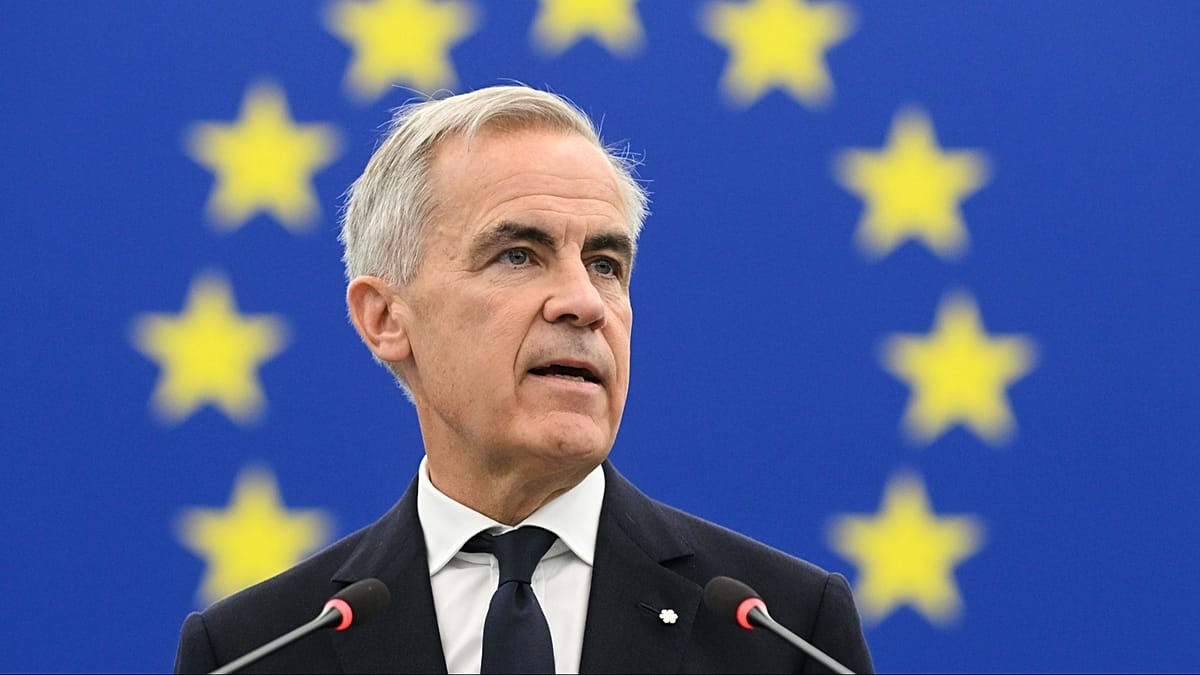
Canadian Prime Minister Mark Carney used a landmark address to the European Parliament in Strasbourg on Thursday to frame the proposed EU-Canada alliance as a forward-looking partnership, insisting it is not a response to pressure from Washington. Speaking alongside European Commission President Ursula von der Leyen, Carney welcomed the offer of an unprecedented "associate membership" but left the precise definition to Brussels.
"Europe and Canada are stronger together," Carney told MEPs, before expanding on the idea in a press conference. He repeatedly described the initiative as an "alliance" rather than "associate membership," saying the exact terminology was for the EU to decide. "The nomenclature, the precise nomenclature, is a question for Europe," he said. "What matters is the substance."
A new framework, not full membership
Carney was explicit that Canada is not seeking to join the EU as a full member. "Canada is not in a position nor seeking to become a full member of the European Union," he said. "Therefore, it's a different framework. It's a framework that is relevant for a country that shares deep bonds with Europe."
The proposed arrangement, which would be the first of its kind, is still at an early stage. Carney said it would need to be developed further ahead of the EU-Canada summit scheduled in Montreal in late October. He also stressed that any final agreement would be put to a vote in the Canadian parliament, and that it would respect Canadian sovereignty.
"We are looking for partnerships that are complementary, that reinforce our sovereignty," Carney said, pushing back against critics who fear the deal could undermine Canadian independence. "Canadians are united that nobody is going to tell us what language we speak. No one is going to dictate our culture or with whom we can strike international agreements."
Not a reaction to Trump
Asked directly about Donald Trump's threat to impose tariffs if the EU-Canada deal were seen as a "hostile act," Carney rejected the framing. "This is a positive initiative. It's ambitious, and it's positive. It's about building for people, creating opportunity," he said. "This is a fundamental point. This is for a better future for our citizens. It's not a reaction to something else. It's moving to the future."
Carney also said the alliance should become a "beacon for other democracies" and be "open enough" for other like-minded partners. He stressed that neither Canada nor the EU would seek to create a "great-power rival."
The Canadian leader highlighted the potential for young people to live, work, and study on both sides of the Atlantic, pointing to programmes such as Erasmus and Horizon. European Parliament President Roberta Metsola echoed that sentiment, saying the EU should not "be scared of something new" and that "opportunities can only get bigger with Canada."
The proposal has drawn attention across the continent, with some MEPs showing their support in symbolic fashion. Greens/EFA leader Terry Reintke wore a Sidney Crosby Canada hockey team T-shirt during Carney's address, drawing a smile from the prime minister.
The EU-Canada relationship has been in focus recently, with deeper cooperation between Paris and Ottawa amid transatlantic tensions. The proposed associate membership would go beyond the existing Comprehensive Economic and Trade Agreement (CETA), which remains unratified in several member states. CETA's future is still uncertain, but Carney's proposal suggests a broader political framework.
Carney also noted that the new partnership could strengthen Canada's relationship with the United States. "It will make Europe stronger. It will make Canada stronger. It will make Canada a better partner with the United States," he said.
The exact shape of the associate membership remains to be defined, but Carney's message was clear: this is about building bridges, not burning them.