The European Union and Canada recently unveiled plans for a deeper partnership that could eventually grant Ottawa a form of associate EU membership. Yet their existing landmark trade agreement remains unfinished business.
The Comprehensive Economic and Trade Agreement (CETA), signed in 2016 and applied provisionally since 2017, has removed nearly all tariffs and helped drive a sharp increase in transatlantic trade. But ten EU countries – Belgium, Bulgaria, Cyprus, France, Greece, Hungary, Ireland, Italy, Poland and Slovenia – have still not ratified it.
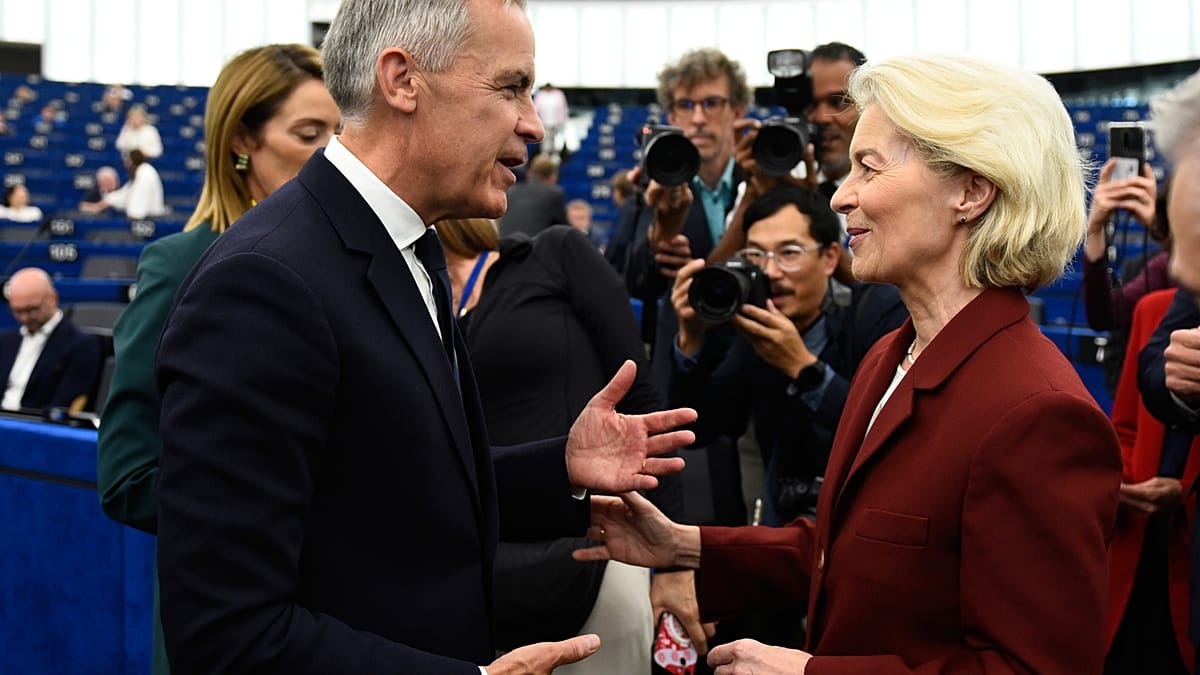
The contrast was underlined last week when European Commission President Ursula von der Leyen invited Canada to deepen its economic and security ties with the bloc.
“We will move from CETA to an Alliance for the Future to create a common prosperity and economic security space,” von der Leyen told MEPs and Canadian Prime Minister Mark Carney in Strasbourg.
Despite the lack of full ratification, the deal has been in force provisionally since 2017. But what exactly is CETA, and why is its ratification still blocked?
What does CETA cover?
CETA was concluded in 2016 after seven years of negotiations and often heated debate across EU member states. The agreement eliminated tariffs on 98% of goods traded between the EU and Canada, covering everything from wine and cars to chemicals. It also opened up more of the Canadian market to European companies in sectors such as financial services, telecommunications and transport.
The European Commission says the agreement boosted EU-Canada bilateral trade in goods and services by 80% in 2025 compared to 2016, reaching €130 billion, up from €72.1 billion nine years earlier. The EU now enjoys a trade surplus of €16 billion in goods and €9.7 billion in services.
For agricultural products, CETA allows 143 European products with geographical indication (GI) status to be sold in Canada, protecting them from imitation. The deal also includes quotas for EU cheese exports to Canada (32,000 tonnes per year), and for Canadian beef (50,000 tonnes) and pork (80,000 tonnes) into the EU. It also bans imports of Canadian products containing prohibited substances, such as growth hormones.
However, a Commission assessment found that only 3% of the beef quotas were filled between 2021 and 2023, largely due to the EU’s Sanitary and Phytosanitary (SPS) rules, which make it costly for Canadian beef producers to export.
Why is ratification blocked?
Concerns over food safety and environmental standards are among the reasons CETA has faced resistance in EU countries. European farmers have also raised worries about unfair competition from Canadian products, arguing that some of Canada's production rules are less stringent than those in the EU.
CETA opponents also criticised the deal's Investor-State Dispute Settlement (ISDS) provisions, which allowed companies to bring claims against a state before an arbitration tribunal if a government adopted a law that discriminated against a company and harmed its profits. The tribunals were ad hoc, composed of private arbitrators.
Controversies around a system that might favour business lobbies led the Commission to include safeguards and replace ISDS with an Investment Court System featuring permanent judges and an appeal mechanism. The EU and Canada have also introduced provisions to safeguard their right to regulate policies aimed at protecting public health, safety, the environment or social protection. But opponents say these safeguards won’t be enough. The new courts are planned to come into force only once the deal is ratified by all 27 member states.
When will full ratification happen?
There is no clear timetable, not least because the ratification process is effectively blocked in several member states. In France, the Senate rejected the deal in 2024, and the government then blocked its submission to the National Assembly, fearing a full rejection. In Poland, the process is also frozen, as is the case in Italy, where it has been stalled since the government rejected it in 2018, arguing that Italian GIs were not given enough protection. Italian MEP Carlo Fidanza, from the Brothers of Italy party, recently said there were few chances the deal would be submitted to parliament before the December 2027 elections.
The impasse has broader implications. As the EU and Canada explore a more ambitious associate membership framework, the unresolved status of CETA casts a shadow over the credibility of the bloc's trade policy. Meanwhile, the EU is also navigating other trade challenges, such as the Trump-Xi summit and its potential impact on global trade dynamics.
For now, CETA remains a testament to the complexities of EU decision-making, where a deal that has already delivered tangible economic benefits can still be held hostage by domestic politics and lingering distrust.