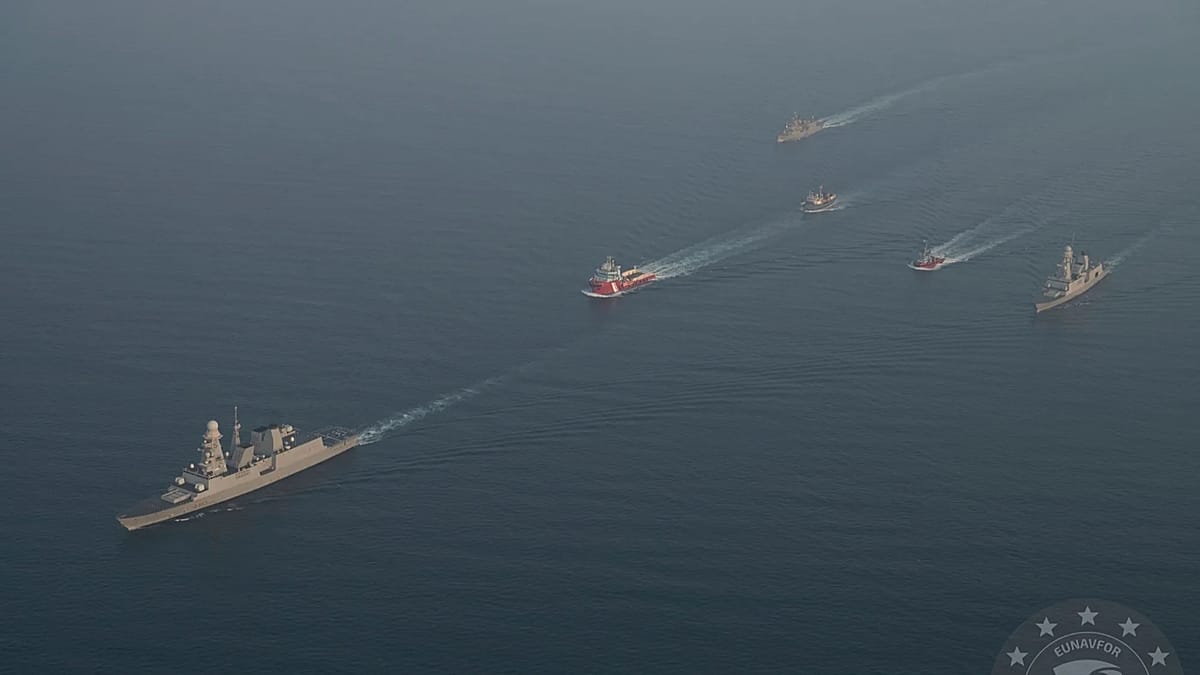
The European Union is weighing a significant reinforcement of its naval mission in the Red Sea, Operation Aspides, as Houthi attacks on commercial shipping intensify. In a letter dated 19 September and addressed to EU capitals, the bloc's foreign policy chief, Kaja Kallas, urged member states to contribute more ships and aircraft to protect the Bab el-Mandeb strait, a vital artery for trade between the Indian Ocean and the Mediterranean.
The move comes after Italy's Defence Minister, Guido Crosetto, raised the alarm following an incident last Friday in which an Italian frigate had to intervene to escort a merchant vessel flying the Italian flag off the coast of Yemen. Rome has been pressing for months for a stronger EU presence in the region, warning that the current force is insufficient to guarantee safe passage.
In her letter, Kallas stressed the need for "more suitably equipped naval and air assets," including enhanced capacity for "close protection" of merchant ships. She argued that the EU must increase its footprint to ensure the operation can "fully carry out its mandate." The letter also highlights the strategic gains made by the Houthis, who have seized the port of Mocha, Perim Island, and the Hanish Islands, giving them leverage over one of the world's busiest shipping lanes. This, Kallas wrote, represents "a serious threat" to maritime security and is "already harming European interests."
What more can be done?
Currently, the core of Aspides consists of three ships provided by Italy and Greece, with temporary contributions from Germany, France, Spain, the Netherlands, and Belgium. Kallas has asked national governments to "suggest possible actions" to improve the mission's effectiveness. One option is for more countries to take responsibility for specific stretches of sea, as Italy did when it protected its own merchant vessel. French and Dutch units are already operating in the area to shield their national fleets.
Italy could also bolster its presence with additional ships based in Djibouti, but that would require financial contributions from allies, a politically sensitive ask. Analysts caution that naval assets alone may not be enough. The Houthis control large parts of the Yemeni coast, and air cover could be necessary to counter their capabilities. The issue will be discussed by EU defence ministers in Brussels on 28 September, followed by the Foreign Affairs Council on 12 October in Luxembourg.
Aspides was launched in February 2024 with a defensive mandate, but it is authorised to use force to protect merchant vessels. Italian ships, including the Caio Duilio and Fasan, have already engaged in such actions. Strategic command is held by Greece, while operational control alternates between Italy and Greece; it is currently under Admiral Vasileyos Griparis.
The Italian government is among the most exposed. Last week, Crosetto complained that only two European warships were present in the area and announced that Italy would not wait for Europe if further escorts were needed for its commercial vessels. Foreign Minister Antonio Tajani echoed these concerns, saying, "We have been asking the EU for months to reinforce the Aspides mission: Italy and Greece are doing a great deal [...] but if there is no military contribution [from the other EU states] there must be a financial contribution."
Rome considers around ten critical maritime journeys through the strait each week. The stakes are high: Italy lost a Eurofighter in a Houthi bombing raid on a Saudi Arabian base last week, and Italian assets are stationed at several Saudi bases, as well as in Bahrain, the UAE, and Kuwait, which are already at risk given the broader tensions with Iran. The situation is further complicated by the escalating US-Iran confrontation, which could spill over into the region.
As European leaders weigh their options, the question remains whether a purely naval response can secure the strait. Some experts argue that without air cover, the Houthis will continue to pose a threat. The EU's ability to project power in the region is being tested, and the outcome will have direct consequences for energy prices and supply chains across the continent. The bloc's energy costs are already soaring, and any disruption to the Bab el-Mandeb could exacerbate the situation, as highlighted by Macron's call for a G7 energy summit to address broader energy security concerns.
In the meantime, the Houthis have shown no sign of backing down. Their pledge not to target US ships after President Trump cancelled strikes, reported by our earlier coverage, appears fragile, and attacks on other vessels continue. The EU's response will be closely watched, not only in Brussels but also in the shipping and energy markets that depend on the free flow of goods through the Red Sea.