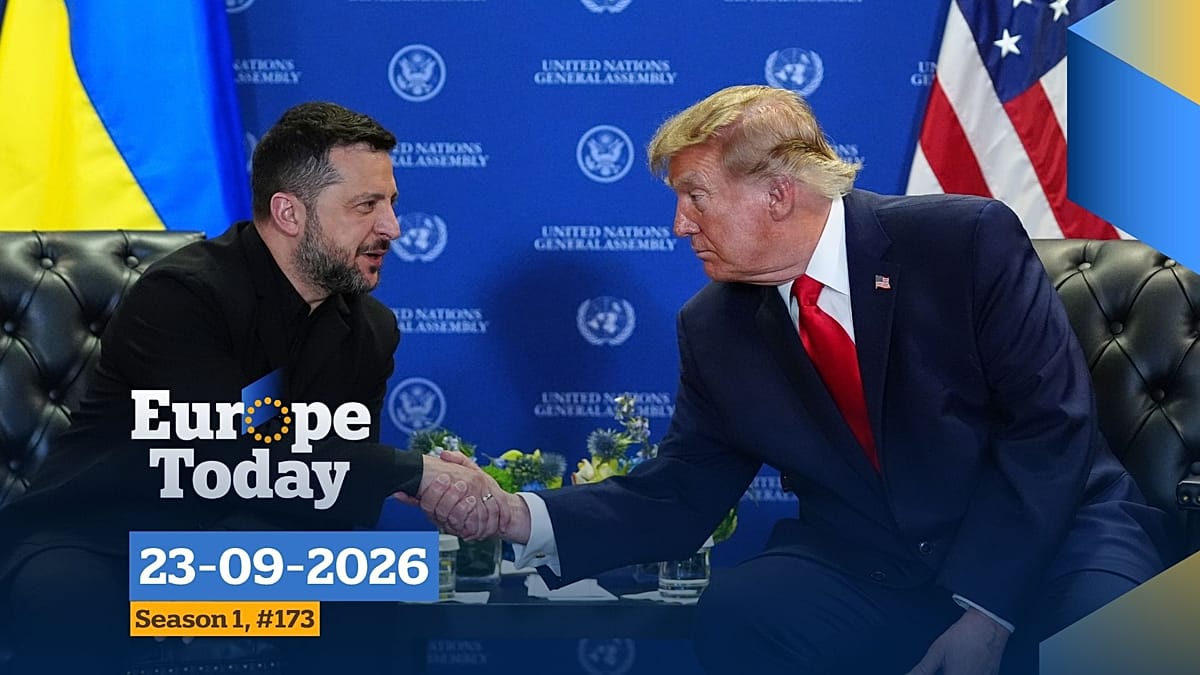
Speaking at the United Nations General Assembly in New York, US President Donald Trump said he expects the war in Ukraine to end sooner than many people think. His remarks followed a meeting with Ukrainian President Volodymyr Zelenskyy on the sidelines of the summit, where Washington signalled a renewed push to broker a ceasefire before winter sets in.
Trump's optimism contrasts with the grim reality on the ground, where Russian and Ukrainian forces continue to exchange deadly strikes. The US president did not offer a concrete timeline, but his language suggested a belief that both sides are nearing exhaustion. European diplomats, however, remain cautious, noting that any deal would require Moscow to make concessions it has so far refused.
EU sanctions rift deepens
In Brussels, a separate drama unfolded as EU member states, after intense negotiations, agreed to remove two Russian businessmen from the bloc's sanctions blacklist. The decision, which took effect yesterday, marks a rare break in the EU's unified stance on Russia and has drawn sharp criticism from Baltic capitals.
Latvian Prime Minister Andris Kulbergs, in an exclusive interview with European Pulse, warned against what he called "cherry-picking" sanctions. "If we start picking and choosing who stays on the list based on political expediency, we undermine the entire credibility of our sanctions regime," he said. His comments echo concerns that the EU's resolve is fraying as the war drags on.
The delisting of the two oligarchs—whose names have not been officially confirmed but are widely reported to be Alisher Usmanov and Mikhail Fridman—follows a legal challenge and lobbying efforts by their lawyers. The EU's legal service had advised that the evidence against them was insufficient, but several member states, including Poland and the Baltics, opposed their removal.
The compromise, which saw the EU renew its broader Russia sanctions for 36 months, was hailed by some as a pragmatic solution. But critics argue it sets a dangerous precedent. "This is a slippery slope," said a senior EU diplomat speaking on condition of anonymity. "If we start delisting oligarchs, what message does that send to Putin?"
The decision has also reignited a broader debate about the effectiveness of sanctions. While the EU has imposed sweeping measures on Russia's energy sector, financial system, and military-industrial complex, enforcement remains uneven. A recent report by the EU's anti-fraud office found that many assets linked to sanctioned individuals are still not frozen across member states.
Arctic security pact signed
In a separate development, the United States, Denmark, and Greenland signed a deal to strengthen Arctic security, ending more than a year of tensions after Trump threatened to "take" the world's largest island by force. The agreement, signed in Nuuk, commits the three parties to increased cooperation on defence, surveillance, and infrastructure in the region.
The pact is seen as a victory for Danish diplomacy, which had been under pressure from Washington to allow greater US military access to Greenland. It also reflects the growing strategic importance of the Arctic as melting ice opens new shipping routes and access to natural resources.
For Greenland, the deal brings economic benefits and a degree of autonomy in security matters. Prime Minister Múte Bourup Egede called it "a historic step" that respects Greenland's interests while ensuring its protection.
Morocco votes amid regional shifts
Meanwhile, Morocco held legislative elections today, a vote that comes at a critical moment for the North African kingdom. The election is seen as a test of the country's stability and its role as a key partner for Europe on migration, security, and trade.
Aboubakr Jamai, a Moroccan writer and dean of the Donna Dillon Manning School of Global Affairs at The American College of the Mediterranean in Aix-en-Provence, told European Pulse that the outcome will shape Morocco's relations with the EU. "Morocco is a pivotal player in the region, and its political trajectory matters for Europe," he said.
As the day unfolds, European leaders will be watching closely. The EU has invested heavily in its partnership with Morocco, and any political upheaval could have ripple effects across the Mediterranean.