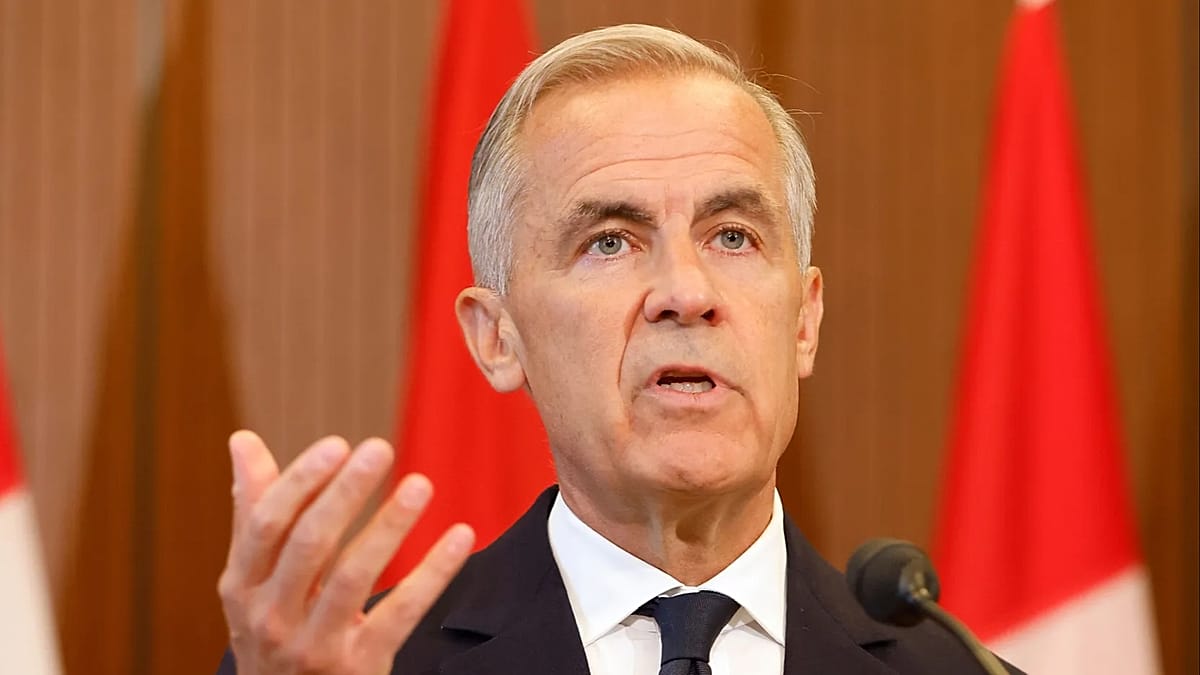
As the trade conflict with the United States intensifies, Canadian Prime Minister Mark Carney has reiterated his commitment to forging a closer economic and security partnership with the European Union. His remarks came after trade negotiations between Ottawa and Washington collapsed last week, with Canada accusing the US of interfering in its sovereignty by demanding concessions on French-language rights.
In response, US President Donald Trump announced on Truth Social that tariffs on cars and trucks would rise to 50% from 1 January 2027. "WE DON'T NEED CANADA, THEY NEED US!" he wrote. "They do 95% of their business with the US, with us, the exact opposite!"
Canada retaliated by imposing tariffs ranging from 15% to 50% on over 700 American imports, worth about $20 billion (€17.2 billion), effective 8 September. This escalation follows a pattern of friction since Trump's return to power in 2025, prompting Ottawa to look towards Brussels as a more reliable partner.
"This fall we will begin intense discussions with the European Union, the world's second-largest economy, to build a much stronger and deeper economic and security partnership," Carney said on Monday. According to Politico, he will attend the State of the EU speech in Strasbourg on 16 September, after an invitation from European Commission President Ursula von der Leyen.
Shared goals, but limits on both sides
Brussels and Ottawa share a common objective: diversifying their trade relations away from Washington. However, the existing Comprehensive Economic and Trade Agreement (CETA) already provides a framework, and both sides face constraints on how far they can go.
Canada is poised to offer the EU better access to its critical raw materials, including lithium, graphite, and nickel, which are vital for the EU's green transition and reducing dependence on China. Energy cooperation is another potential area, with Canada currently supplying most of its energy to the US. "We should be talking about a more viable Canada-EU corridor for energy, and not just in respect of oil and gas, but also of nuclear," said Mark Camilleri, President of the Canada-EU Trade and Investment Association.
On defence, Canada already participates in the EU's SAFE instrument, a €150 billion fund for joint defence procurement. The selection of German-Norwegian firm TKMS to build a new fleet of submarines signals deeper defence ties, and Arctic security could be a further area of collaboration.
Canadian businesses are increasingly interested in the European market, but diversification will take time. "The Canadian economy is very much oriented and integrated to the US and North American economy," Camilleri added. "We are not looking to untangle the relationship, despite the very distressing political issues taking place."
The EU also has its limits. CETA, signed in 2016, has not been ratified by all member states and has only been provisionally applied since 2017, illustrating the difficulty of accessing the EU market.
Membership not on the table
Article 49 of the Treaty on European Union limits membership to "any European State", which excludes Canada. Guntram Wolff, a senior fellow at Bruegel, notes that while there is a new openness in Brussels, strategic alignment "could go far" but likely falls short of full membership.
One option is to deepen integration to the level of the European Economic Area, as Norway, Iceland, and Liechtenstein have done. "One can go to the point where Norway is, which is a single market membership," Wolff told Euronews. "Whether that is where Canada wants to go and whether that's where all the European countries want to go, we will see in the coming weeks."
For now, the focus is on practical cooperation. The upcoming Canada-EU summit will likely address critical minerals, energy, and defence, building on the momentum of Carney's visit to Strasbourg. As the trade war with the US shows no signs of abating, both sides are keen to strengthen their partnership, but the path to deeper integration remains constrained by geography and political realities.