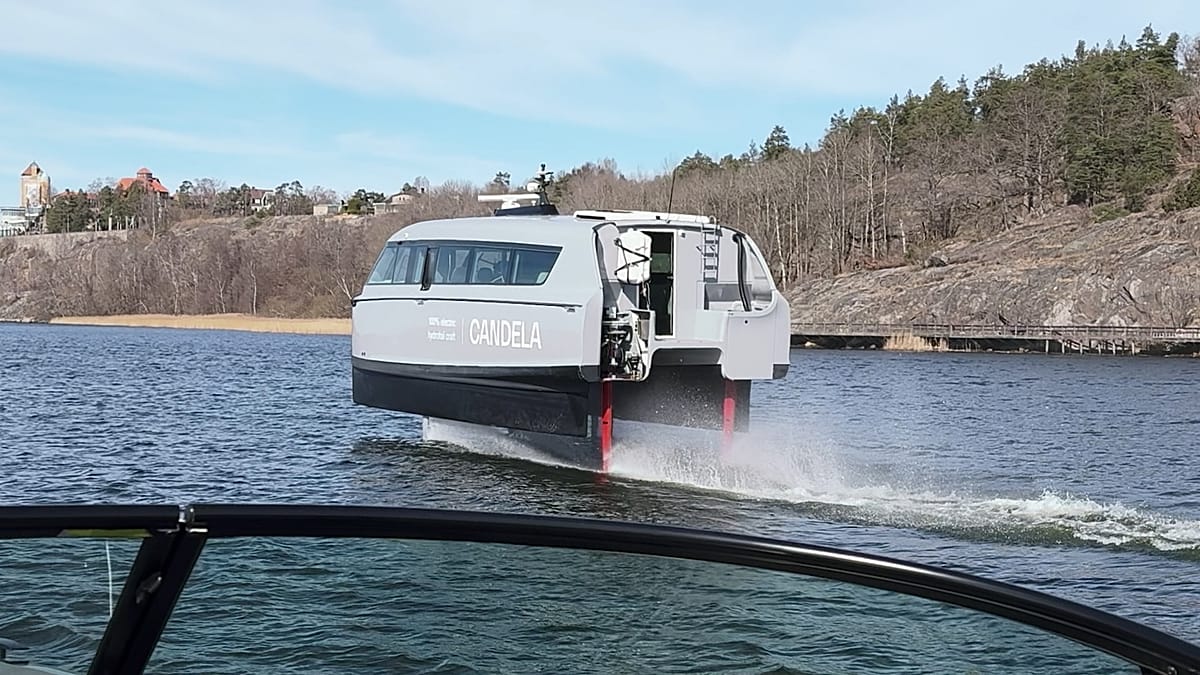
In Stockholm's Frihamnen harbour, a sleek, low-slung vessel departs from the quay. It resembles an aircraft fuselage more than a traditional commuter ferry. This is the Candela P12, an electric hydrofoil ferry that its creators hope will bring commuters back to Europe's underused waterways.
Gustav Hasselskog, founder and CEO of the Swedish company Candela, explains the experience: “We will go full power up to 17 knots, then she lifts above the water and we fly at around 25 knots.” As Captain Lars Billström calls out the numbers, the 30-seat boat rises smoothly, lifted by computer-controlled hydrofoils. The churn of conventional ferry travel disappears, leaving almost no wake as Stockholm's shoreline slips silently past.
Engineering a Revolution
The P12 is the world's first electric hydrofoiling vessel of its size. Hasselskog, who founded Candela in 2014 after initially developing high-speed electric leisure boats, is now betting on the global commuter market. “We reduce energy consumption by about 80%, which takes out a lot of the fuel costs; it's much cheaper than operating traditional diesel ferries,” he says.
The engineering challenge was formidable. “Compared to a car, a smaller boat consumes 15 times more fuel per kilometre. But if you want to use batteries, they contain much less energy than diesel or gasoline, so you have a challenge,” Hasselskog notes. The solution came from re-exploring hydrofoil technology—wings placed under the water that lift the entire hull above the surface. “It's basically the same technology as for an airplane. The core difference is that the centre of gravity in a boat is above the lifting point, so you get something that doesn't want to stay up there. It's a fascinating engineering challenge to make something unstable become stable.”
To achieve stability, the P12 uses computers, sensors, and software that measure the boat's position when it lifts off. “They adjust the angle of the foil system 100 times per second to stabilise the boat. That creates a much smoother ride,” says Mikael Mahlberg, Candela's head of communications, aboard one of the company's smaller electric foiling leisure boats gliding silently one metre above the water. “We take the discomfort out of boating, while reducing operating costs, and sparing the environment of emissions, oil spillage, wake and noise. And when we pass shorelines, we don't cause erosion.”
Global Demand, European Hurdles
At Candela's production facility north of Stockholm, output of the P12 is ramping up to meet demand. Orders have come from India, Thailand, Saudi Arabia, the Maldives, and the United States, alongside a recent Norwegian contract for twenty ferries—the world's largest electric hydrofoil fleet order so far. Yet Europe remains Candela's slowest market. “It takes a long time to get this type of transition to a new technology in Europe. You need long political and public tendering processes that can be terribly slow,” Hasselskog says. Still, he remains confident: “The waterways are the oldest way of transport in Europe and elsewhere in the world, yet they are underused. We can get back to that in a new way.”
Candela plans to grow from 250 employees to 1,000 and open a new factory in Poland. That growth, Hasselskog says, must rely not only on attracting the right talent but also on a strong company culture. “We call it revolutionary kindness. The revolutionary part is believing that with the right knowledge, you can do anything, as long as you stay within the laws of nature. The kindness side is wanting to do something good for society, while maintaining a friendly internal culture. I've worked in organisations with more of a fear culture. That can drain creativity and efficiency. The creative, free-thinking spirits leave, then you move very slowly, and it's no longer fun.”
As European cities grapple with congestion and emissions, Candela's flying ferries offer a glimpse of a quieter, cleaner future on the water—if the continent's bureaucratic currents can be navigated as smoothly as its hydrofoils glide above the waves.