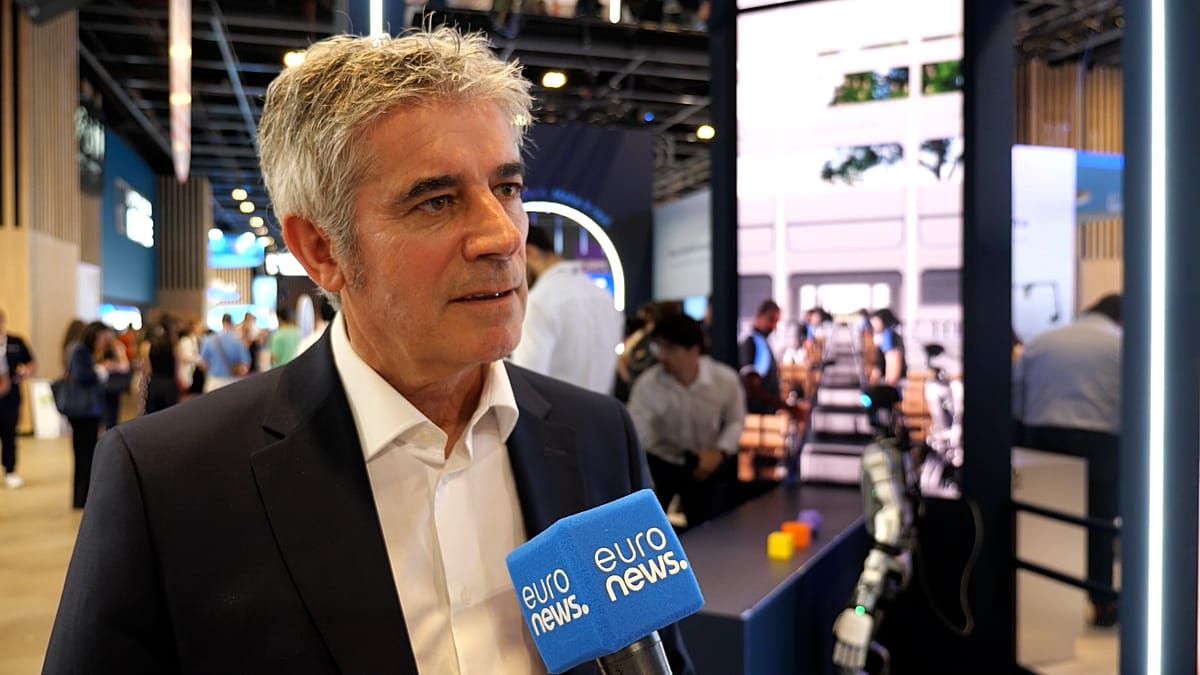
At VivaTech in Paris, the buzz around artificial intelligence is palpable. Startups and established firms alike are showcasing AI agents, automation tools, and the promise of a transformed workplace. But Pascal Brier, group chief innovation officer at the French IT consultancy Capgemini, struck a more cautious note: the real challenge is not building AI, but making it work at scale.
“Not everybody will win with AI,” Brier told Euronews Next. Capgemini has designated 2026 as its “year of truth” for the technology, a deadline to prove that enterprise-level AI can deliver tangible results. The executive acknowledged that AI is “redefining the wider technology landscape,” but warned that many businesses have underestimated the time required to understand, implement, and extract value from it.
Trust as the missing ingredient
Brier emphasised that the biggest obstacle to AI adoption is not technical but human. He described the need for “human-AI chemistry” — a level of trust that allows workers to rely on AI systems without fear or hesitation. “There is no way a technology can be successful if you don’t build that trust,” he said.
Fear, he noted, is a natural part of the process when new tools enter the workplace. But once employees see what AI can help them achieve, excitement often replaces anxiety. Capgemini’s own experience suggests that the transition, while challenging, is manageable — though the company recently announced plans to cut up to 2,400 jobs in France. Brier insisted those cuts are not directly linked to AI, and that he does not believe AI will simply replace jobs. “AI definitely is redefining the way you do business,” he said. “But doing things differently doesn’t mean you’re going to get rid of people.”
The trust issue extends beyond individual users to the broader regulatory environment. For physical AI — robots and machines that operate in the real world — Brier argued that rules should focus first on human protection and emergency controls, such as the ability to stop a robot instantly if something goes wrong. “You have to have humans, machines and robots coexisting in the same environment. That’s why you need some regulations,” he said.
However, he cautioned against over-regulation that could stifle innovation. Physical AI, he noted, is still in its infancy. Unlike generative AI, which spread rapidly, physical AI will take longer to deploy because it involves machines operating in real workplaces. “Nobody currently is running fleets of hundreds of robots,” he pointed out. “Regulation should also be progressive and try to adjust to the way this technology is evolving.”
Agentic AI and the sovereignty question
For now, Brier believes the greatest near-term value lies in agentic AI — systems that can carry out tasks autonomously and reshape internal business operations. “This is really where AI is changing the way we do operations in a company, and that’s where we’re going to derive the biggest return on investment,” he said.
Another critical issue is avoiding dependence on a single AI model or provider. Earlier this month, the US government ordered Anthropic to suspend foreign-national access to its Fable 5 and Mythos 5 models, forcing the company to disable them for all customers. Such events underscore the risks of relying on a single source. But Brier rejected the idea of total sovereignty, which he equated with isolation. “We don’t believe in total sovereignty, which would mean isolation,” he said.
Instead, he argued for a pragmatic approach: treat sovereignty as a matter of business continuity and risk management. “There are something like 1,000 models available on the market,” he noted. “They are small and big models. They are open source or private. They can be European, they can be US, they can be Chinese, so you can choose.” The goal, he said, is to avoid dependence on one technology and to “always have a plan B.”
This perspective aligns with broader European efforts to reduce reliance on non-European tech giants. For instance, France recently replaced US firm Palantir with a French company for DGSI data analysis, a move that reflects growing concerns about data sovereignty. Yet Brier’s message is one of diversification rather than autarky: Europe should engage with global AI developments while maintaining the ability to switch providers if needed.
As Capgemini approaches its self-imposed 2026 deadline, the company’s message is clear: AI’s potential is real, but realising it requires patience, trust, and a willingness to adapt. The technology may be redefining the landscape, but the human element remains the hardest part to get right.