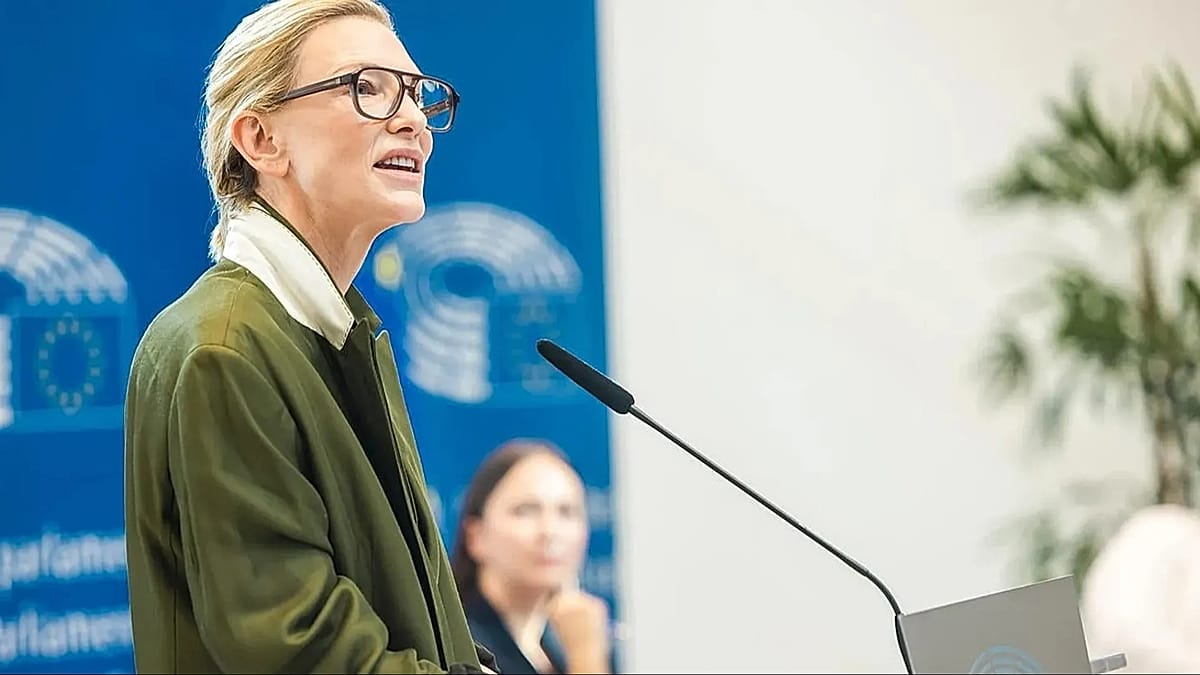
On Tuesday, Australian actor Cate Blanchett stood before the European Parliament in Brussels to unveil a practical answer to one of the most pressing questions in the creative industries: how can artists retain control over their digital selves in the age of artificial intelligence?
Blanchett, together with co-founders Nikki Hexum, Doug Leeds, and Eckart Walther, launched RSL Media, a non-profit initiative whose new online platform allows any artist to record whether they permit their face, voice, movements, or creative ideas to be used or transformed by AI. The tool is free and open to all creators, from Hollywood stars to independent musicians in Ljubljana or graphic designers in Malmö.
Three tiers of consent
The system is deliberately simple. Artists register, verify their identity, and then choose one of three colour-coded consent levels: green for permitted use, yellow for conditional use (for instance, only after payment or under specific terms), and red for a complete ban. The resulting database is machine-readable, meaning AI companies can consult it at scale to respect individual choices.
Blanchett framed the initiative as a necessary safeguard, not a brake on innovation. “To find a path between unbridled enthusiasm and the dangers of AI, we need safeguards based on consent. Not to prevent technological progress, heaven forbid, but safeguards that can evolve at scale and at the same pace as the technology itself. Safeguards that protect our human rights,” she said.
The launch comes just months after the European Union adopted the AI Act, the world’s first comprehensive regulatory framework for artificial intelligence. The RSL Media platform is designed to complement that legislation by providing a transparent, voluntary infrastructure that bridges the gap between regulation and real-world practice.
Blanchett was joined by director Steven Soderbergh, known for Ocean’s Eleven and Erin Brockovich, and Bulgarian MEP Eva Maydell. Together they met with legal advisers, filmmakers, musicians, lawmakers, and tech industry leaders. Some representatives from the technology sector expressed concern that such projects could put Europe at a competitive disadvantage against rivals in the United States or China.
Soderbergh dismissed that fear. “This is not a law, it is not a restriction; it is a persuasive mechanism to do the right thing in a simple and elegant way,” he said. On the broader dangers of AI, he added: “There are a lot of things that AI cannot do and never will, and that is why I am not afraid, but people need some kind of direction.”
Javier Bardem, who has been vocal in his criticism of AI’s capacity to manipulate reality, has also backed the project. The initiative rests on the principle that human identity constitutes a form of intellectual property and therefore requires an infrastructure where consent can be recorded tangibly and transparently.
For European artists and creators, the platform offers a way to assert agency without waiting for slower legislative processes. It also signals a growing transatlantic alliance between Hollywood and European cultural figures to shape how AI interacts with creative work. The debate, as Blanchett put it, is no longer about whether AI should exist, but how it should be used.