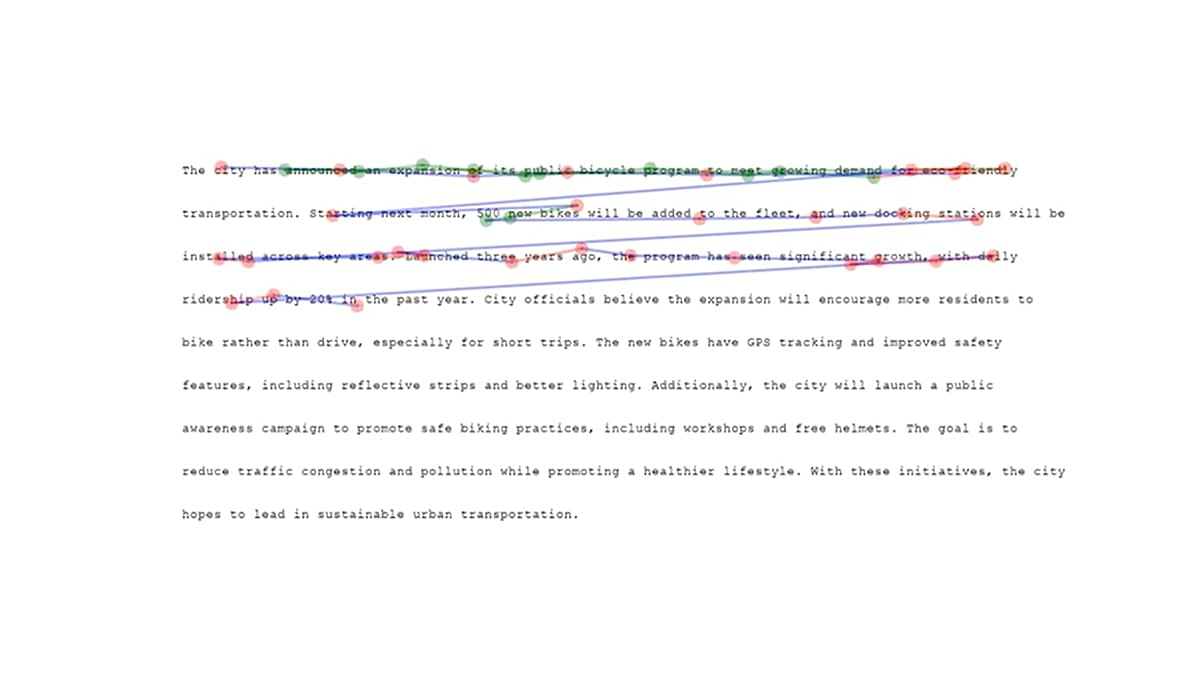
An artificial intelligence model that taught itself to read efficiently has ended up mimicking human reading patterns, offering new insights into the cognitive processes behind one of our most fundamental skills. The research, led by scientists at Aalto University in Finland, the Hong Kong University of Science and Technology, City University of Hong Kong, and the National University of Singapore, could eventually lead to personalized text for different readers and situations.
“For the first time we’ve used AI methods to understand – not just mimic – how people read,” said Antti Oulasvirta, a professor at Aalto University, in a press release.
The team built the model on the premise that readers have limited time, memory, and visual processing capacity. They then trained the AI on millions of texts, rewarding it for maximizing comprehension within those constraints. Notably, the AI was not given any human gaze or comprehension data to copy, yet it spontaneously developed behaviors that closely resemble those of human readers.
For instance, the model spent less time on common or predictable words and was more likely to skip them, while difficult or ambiguous words and sentences prompted it to go back and reread more often. This mirrors the way humans allocate attention when reading.
“Reading feels effortless, but your brain is constantly deciding where to look, what to skip, and when to backtrack, spending attention like a budget to maximise understanding,” said Shengdong Zhao, a professor at City University of Hong Kong.
Resource rationality in reading
The researchers describe this behavior as “resource rationality” – the idea that limited cognitive resources are directed where they are most useful for comprehension. The AI model adapted to time pressure in a way that paralleled the behavior of 39 adults in an experiment. When time was short, it prioritized covering more of the text; with more time, it spent extra attention on difficult passages and reread more.
However, the results do not prove that the human brain performs exactly the same calculations as the AI. Instead, the model offers a plausible explanation for how different reading behaviors could emerge from the goal of understanding as much as possible with limited cognitive resources.
The findings, published in the journal Nature Human Behaviour, could have practical applications. A better understanding of how memory shapes reading could help create technologies that adapt text to individual readers and situations, such as customizable apps or augmented reality (AR) smart glasses that adjust the pace or layout of on-screen text based on the user’s needs and activities.
“We could take the same source text, say, a convoluted piece of legal writing and with little effort produce versions that are more comprehensible for different readers,” said Oulasvirta.
The team plans to explore whether the technology could assist people with dyslexia or lower language proficiency. They also envision adapting text in situations where attention is critical, such as presenting information to drivers without causing unnecessary distraction.
“We want to help users in real-time situations, for example, by designing text that helps drivers without distracting them,” Oulasvirta said.
As the research progresses, it could reshape how we interact with written content, making reading more efficient and accessible for everyone. For more on how technology is influencing our daily lives, see our coverage of modern pop's hidden melody.