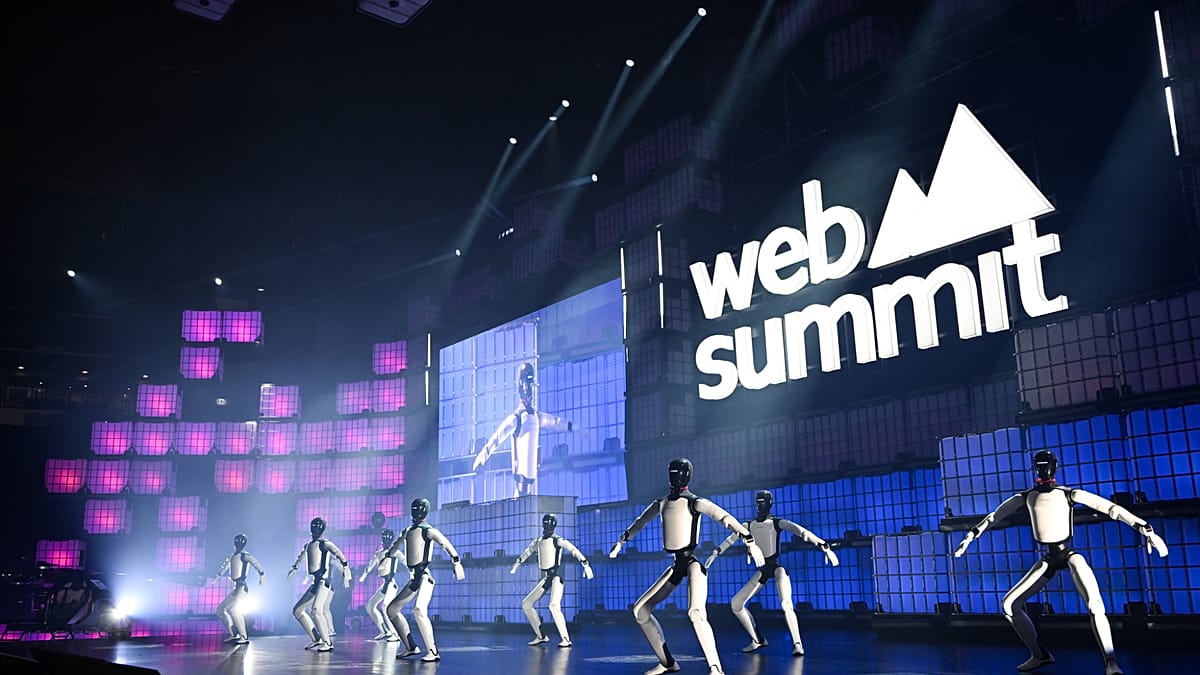
Web Summit 2026 opened in Lisbon on Monday with a clear message: the centre of gravity in artificial intelligence is shifting east. Dancing robots built by the Chinese company Aigibot took to the stage at the Altice Arena, and the conference's founder and CEO, Paddy Cosgrave, told an audience of up to 12,000 that the industry's next champions will not come from Silicon Valley.
"The superstars of the future are not coming from California; they're coming from China," Cosgrave said. He argued that Chinese firms are building more of the shared technological future than anyone else, pointing in particular to open-source development. The remark lands in the middle of an intensifying US-China contest over AI, with Washington restricting exports of the most advanced chips to Chinese buyers.
Lisbon as a stage for a shifting tech order
The Portuguese capital has hosted Web Summit since 2016, and this year's edition is expected to draw close to 70,000 attendees, 900 speakers and more than 2,000 startups. For a European audience, the event is a reminder that the continent is not a passive spectator in the AI race: it is a venue where the terms of that race are being argued over in public.
AI agents — systems designed to take autonomous action without waiting for a human prompt — featured prominently on the main stage. Manus AI, a company originally founded in China, demonstrated a 30-second video generated from a prompt of just 13 words using its new 2.0 video technology. Tao Zhang, Manus's co-founder and chief product officer, said the technology is already reshaping how he recruits engineers. "We found the people we are looking for; it's not just a good attitude," he said. "We don't need more people; we need people who can work with AI."
The summit's opening day was shadowed by news from the United States, where chipmaker Nvidia is investigating its chief executive, Jensen Huang, following reports that he was the target of a foreign intelligence effort in his contacts with an alleged Chinese spy. The story has added uncertainty to an already jittery AI sector, and it has raised questions about the entanglement of corporate leadership, geopolitics and espionage.
Asked about the Nvidia news on stage, Cloudflare co-founder and CEO Matthew Prince called it "very salacious" but cautioned that it is too early to judge Huang's legacy. "Jensen did a lot to cement the AI ecosystem," Prince said, adding that history would decide whether Huang emerges as "a hero or villain."
Europe's stake in the AI contest
The allegations against Huang, and the broader US-China rivalry, matter well beyond California and Shenzhen. European governments are trying to build domestic chip capacity, regulate AI through the EU's AI Act, and attract investment without becoming dependent on either American or Chinese platforms. The presence of so many Chinese firms in Lisbon — and the prominence given to their products — underlines how quickly that balance is being tested.
Cosgrave's remarks also reflect a broader argument within the industry: that open-source models, many of them developed in China, are advancing faster than proprietary systems and are harder to contain through export controls. That view is contested in Washington, where policymakers argue that restricting access to advanced semiconductors is essential to maintaining a strategic edge.
For European startups and researchers attending the summit, the practical question is less about which superpower wins than about where Europe fits. The continent has strong research institutions, a large single market and a regulatory framework that is already shaping global norms. What it has lacked, critics say, is the scale of private capital and the tolerance for risk that produced Nvidia, OpenAI and their Chinese counterparts.
Web Summit continues through the week in Lisbon, with sessions on climate technology, digital regulation and the future of work. The robots may have opened the show, but the harder debates — over chips, spies and sovereignty — are only beginning.