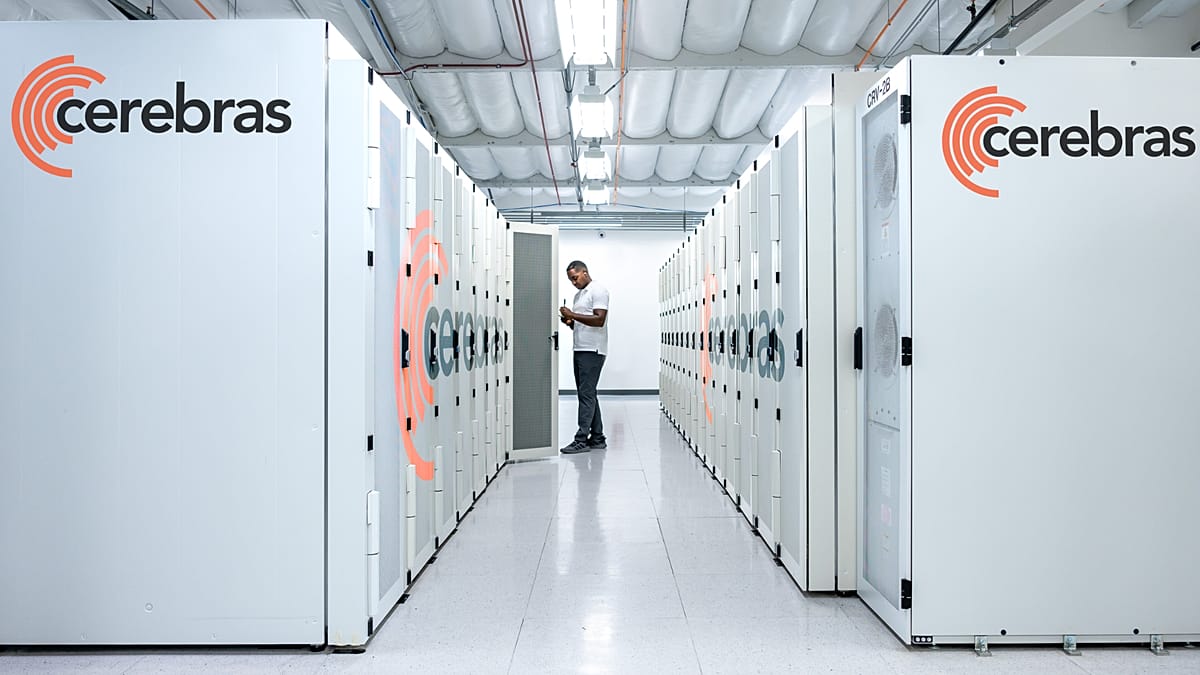
American AI chip startup Cerebras has announced a multibillion-dollar plan to build a network of data centres across Europe, aiming to challenge Nvidia's near-total dominance of the continent's AI infrastructure market. The company said on Thursday that it will bring its first European facility online by the end of 2026, followed by a rapid rollout across France and the Nordic countries, targeting a combined power capacity of 200 megawatts by the end of 2027.
Power capacity has become the primary metric for AI data centres, as electricity constraints increasingly limit the expansion of compute-intensive workloads. For context, typical enterprise data centres consume between 1 and 20 MW, while hyperscale cloud facilities can draw 100 MW or more. Cerebras's planned 200 MW network would place it among the larger dedicated AI infrastructure projects in Europe.
Demand for Local AI Compute Surges
In a statement, Cerebras said demand for local, low-latency AI infrastructure has surged across European businesses, research institutions, and governments seeking alternatives to compute capacity concentrated in the United States and Asia. The company's chief executive, Andrew Feldman, described the expansion as "massive" and worth several billion dollars, speaking on the sidelines of the RAISE Summit in Paris.
"These deployments will enable us to move decisively on what our customers have been asking for: fast, high-performance AI compute located in Europe," Feldman said. He added that demand for computing power to run generative AI across the continent is "extraordinary... growing very, very quickly," and that the sector's growth is "faster than we can keep up."
Part of the planned capacity is expected to support OpenAI workloads under an existing partnership between the two companies, though Cerebras did not specify the exact allocation.
Challenging Nvidia's Grip
The expansion comes as AI infrastructure investment accelerates across Europe, where Nvidia says its technology powers more than 90% of the continent's announced AI factory projects. Cerebras, founded in 2015, has focused on chips dedicated to AI inference—the process by which trained models respond to user prompts—rather than the more intensive training phase. Appetite for inference-specific chips has exploded with the rise of AI agents, a new type of interface that can carry out tasks autonomously on behalf of users.
But transatlantic tensions have made many European governments and firms wary of overreliance on US providers. Feldman emphasised that by placing data centres across Europe, Cerebras can "meet all the unique European requirements" on issues such as data sovereignty. The company's network is expected to provide high-speed inference infrastructure, helping deliver faster response times for increasingly complex AI workloads.
The announcement also comes amid broader European efforts to build sovereign AI capabilities. Several EU member states have launched initiatives to develop local compute capacity, and the European Commission has proposed a €10 billion fund for AI infrastructure. Cerebras's plan could complement these efforts, though it remains to be seen how the company will navigate regulatory and energy challenges across different jurisdictions.
Feldman declined to provide a precise total investment figure but confirmed the expansion is worth several billion dollars. The company's first European data centre is expected to be operational by the end of 2026, with additional facilities coming online in France and the Nordics through 2027.