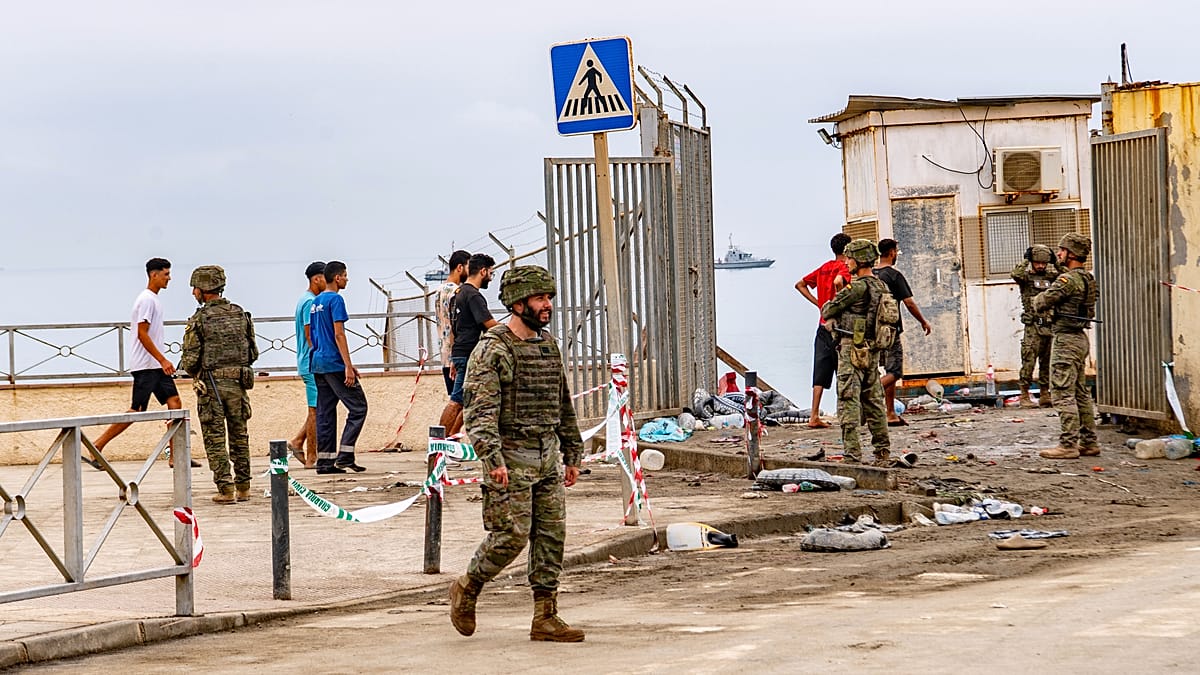
The Spanish enclave of Ceuta has been brought to a near standstill after a massive influx of migrants from Morocco. By Friday, most shops remained shuttered, fresh bread was increasingly hard to come by, and the local government had suspended the weekend's patron saint celebrations as authorities scrambled to regain control.
On the ground, the usual bustle of the central Calle Real has given way to groups of migrants gathered in the streets, while the shutters of many businesses stay down. In this city of around 84,000 people, only a handful of pharmacies and a well-known restaurant chain were open.
The Ceuta Business Confederation has advised businesses not to reopen "until security can be guaranteed," reflecting the deep uncertainty that hangs over the city. Additional security forces have been deployed, but the atmosphere remains tense.
Medical services under severe strain
Health sector sources say medical services are under severe pressure despite reinforcements. The most common cases being treated include hypothermia, anxiety attacks, and fractures. Municipal street sweeper Miguel Ángel Campana told AFP, "We are running out of bread. There was no fresh bread today because the bakeries are closed." He added that some residents fear migrants might try to enter homes "asking for water and other things" and urged neighbours to "keep an eye on their balconies." Across the city, migrants have been seen stopping passing vehicles to ask for food, money, or to borrow mobile phones to contact their families.
Local authorities estimate that around 60,000 people have crossed irregularly from Morocco into Ceuta since early Thursday, many swimming around the border breakwater. The Spanish government says more than 37,500 have already returned to Morocco. Police have been directing large groups of migrants, many of them young people, towards the border crossing to facilitate their return.
The crisis has triggered an intense political and diplomatic response. The army has been deployed in Ceuta, and several European countries have criticised the way the situation has been handled. The scale of the influx has also raised questions about the broader implications for the European Union's external borders, with some analysts calling it the EU's largest single irregular border crossing in recent memory.
Residents on edge
"It remains a heartbreaking situation from a humanitarian point of view, seeing so many people with nowhere to go, without food or water, because the few services available for them are completely overwhelmed," a Ceuta resident told Euronews. At the same time, concern among residents is growing. Mohammed, a taxi driver from Ceuta, believes many migrants have decided to return to Morocco after seeing the conditions awaiting them in the city. "They thought they knew what they were going to find here and they have been confronted with reality," he told AFP. Some had told him they were returning "because they had no food."
"There is nothing here. Those of us who are from here are struggling to get by. We are having a hard time," he added. Mohammed said he and other neighbours stayed awake until the early hours of the morning for fear of possible robberies. "I have nieces who are afraid," he said.
That sense of unease is shared by 56-year-old Yolanda Moreno, who said she had felt "afraid from the start" of the migration crisis. "It was like during the pandemic: the feeling that it was better to stay at home than to go out onto the streets," she told AFP. Another resident expressed concern that tensions could escalate, saying people increasingly feared violence. "This morning I was shocked to see people from here, from the neighbourhood, with lots of knives, trying to take justice into their own hands," she said. "I just saw one boy with a katana running after a Moroccan boy, without really knowing what was going on."
The crisis has also fuelled political friction. Spanish Prime Minister Pedro Sánchez has called the surge a violation of Spain's territorial integrity, while right-wing parties across Europe have seized on the events to criticise the EU's migration approach. Meanwhile, Spain and Morocco have agreed to accelerate the return of the latest arrivals, as reported in the latest diplomatic efforts.
The scale of the crisis has forced the Ceuta government to cancel the patron saint festivities that were due to begin on Saturday. At the fairground, rides remain covered with tarpaulins and motionless — a striking symbol of a city whose normal rhythm has been brought to a halt as it struggles to cope with one of the largest migrant arrivals in its history.