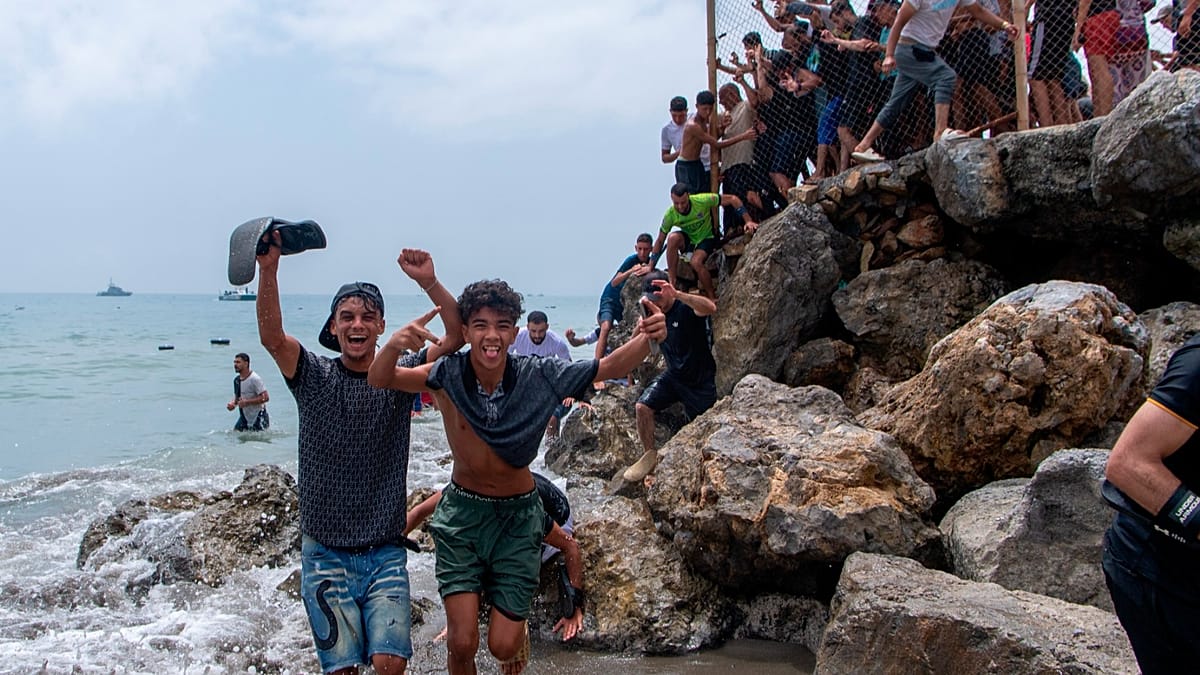
Spain's Interior Ministry said on Friday that an estimated 40,000 migrants had crossed into the North African enclave of Ceuta over the previous 24 hours, in what officials described as an unprecedented surge. The arrivals, who came by sea and overland from Morocco, have overwhelmed local authorities and triggered a political crisis that is reverberating across Europe.
Police sources told reporters that the flow of people continued throughout the night and into Friday morning. “There was a steady stream of people all night long,” one officer said, adding that migrants were still arriving as dawn broke. The influx is the largest since 2021, when thousands swam around the breakwater that separates Ceuta from Moroccan territory. This time, the numbers are far higher, with the majority being young men and adolescents. At least 18 deaths have been reported during the crossing, according to figures released by the same source.
Local forces overwhelmed
Spanish authorities have admitted they are struggling to cope. According to the newspaper El Mundo, only 55 Civil Guard agents were on the front line when the situation escalated. David Gómez, secretary of communication for the Justice Professional Association for the Civil Guard, told the paper that the number of active troops on the ground was “three or four times less than what would be needed to face something like this.”
Videos from the enclave showed migrants walking through the streets, some thanking Spanish police and shouting “Bye bye Morocco, hello Spain.” Officers appeared to make little effort to intervene, though some tried to direct arrivals to the local migrant reception centre. By Friday, hundreds of migrants had begun to return to Morocco through the same breakwater, escorted by the military, as Spanish authorities said they would seek to expel those who entered illegally as quickly as possible.
The situation has been complicated by a court ruling that placed new restrictions on the special “border rejection” rules that allow immediate expulsions. It remains unclear whether that ruling contributed to the sudden surge, but the Spanish government has vowed to use all legal means to return migrants to Morocco.
Diplomatic fallout
The crisis has already had diplomatic consequences. Italy on Thursday called for Spain to be suspended from the Schengen open-borders zone, prompting Madrid to summon the Italian ambassador and accuse Rome of exploiting the situation for political gain. Two senior officials in the Trump White House also used footage from Ceuta to push their anti-immigration agenda, drawing criticism from European leaders.
France, meanwhile, has moved to reinforce its border controls with Spain. Interior Minister Laurent Nuñez said on Friday that he had given instructions to step up checks at the Spanish border and was mobilising the Rapid Border Intervention Force to conduct thorough inspections. “In light of the situation in the enclave of Ceuta, I gave instructions yesterday evening to immediately step up controls at the Spanish border,” he said.
European implications
The events in Ceuta highlight the broader challenges facing the European Union as it grapples with migration policy. The enclave, along with Melilla, serves as the EU’s only land border with Africa, making it a flashpoint for irregular migration. The Spanish government has long sought to cooperate with Morocco to manage the flow, but the recent surge suggests that cooperation has broken down.
Prime Minister Pedro Sánchez was due to visit Ceuta on Friday to assess the situation. His government has called for a European response, arguing that the crisis is not just a Spanish problem but a European one. However, the immediate priority is to restore order in the enclave and prevent further loss of life.
As the situation develops, European leaders will be watching closely. The response to this crisis could set a precedent for how the EU handles future migration surges, particularly as the bloc debates its new pact on migration and asylum. For now, the focus remains on Ceuta, where local authorities are struggling to cope with an influx that has stretched their resources to the limit.